Lap Time Calculator
A lap time calculator computes your average lap time from total race time and number of laps, estimates total race duration, or determines how many laps fit in a given time. Enter your race data in the panel to get an instant calculation.
What Is a Lap Time Calculator?
A lap time calculator is a tool that computes one of three race or training metrics when the other two are known: average lap time, total race time, or number of laps. It is used by runners, cyclists, swimmers, go-kart racers, and motorsport teams who record split times during training or competition and need to analyze pace, plan race strategy, or verify timing data.
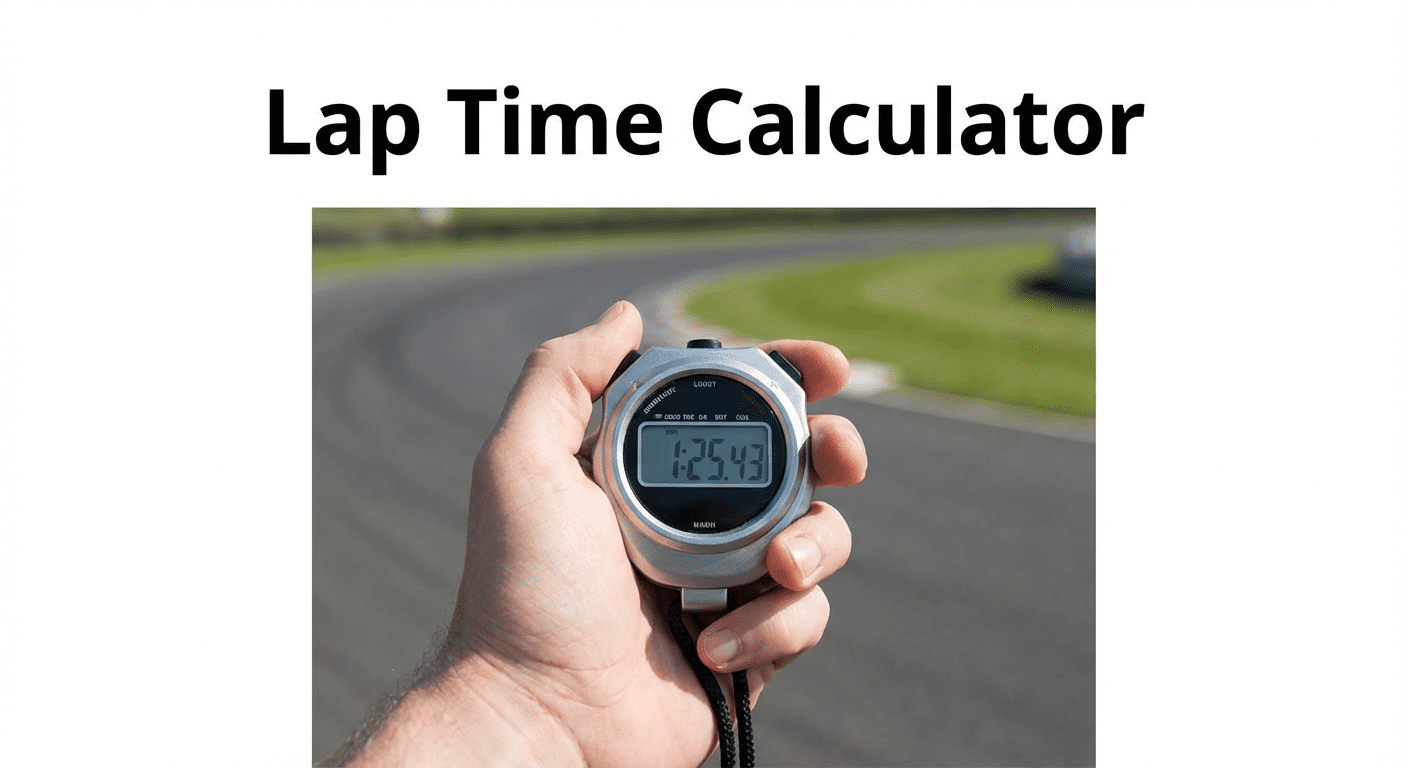
The calculator works with times expressed in the standard format of minutes, seconds, and milliseconds (mm:ss.ms). This format is used across all major timing systems in athletics, motorsport, and aquatics. For example, a 400-metre lap completed in 1 minute and 45 seconds at 500 milliseconds would be expressed as 01:45.500.
How to Calculate Average Lap Time
Average lap time is calculated by dividing the total elapsed time by the number of laps completed. The formula is:
For example, a runner who completes 20 laps in a total time of 35 minutes (35:00.000) has an average lap time of 35:00.000 ÷ 20 = 1:45.000 per lap. This average does not reflect variation between fast and slow laps, which is why professional timing systems record each split individually. However, for planning training loads, comparing sessions, or calculating pace-per-lap targets for an upcoming race, the average lap time is the most practical and widely used metric.
How to Calculate Total Race Time
Total race time is the product of a consistent lap time multiplied by the number of laps. The formula is:
This calculation assumes a constant pace across all laps, which is an idealized model used for race planning and target setting rather than a reflection of real-world variation. For example, a competitive cyclist targeting a lap time of 02:15.000 over 12 laps would plan for a total race time of 27:00.000. This calculation is used by coaches to set goal paces and by race directors to estimate field finish windows.
For time tracking across multiple sessions, the time clock converter can help translate between time formats used in different recording systems.
Lap Time in Motorsport
Formula 1 Lap Times
Formula 1 lap times are among the most precisely measured in any sport, recorded to the millisecond by transponder-based timing systems certified to FIA timing and scoring standards. At a circuit like Silverstone, current F1 cars produce lap times in the range of 1:27 to 1:30 during a Grand Prix, while qualifying laps on soft tyres can dip below 1:25. Lap time variation across a race stint is studied by teams to model tyre degradation, fuel load changes, and safety car impacts.
A 70-lap Grand Prix with an average lap time of 1:30.000 produces a total race duration of 1 hour 45 minutes. Teams calculate fuel loads, tyre stop windows, and driver gap strategies based on these average lap time projections. Slight improvements in average lap time — even 0.1 seconds per lap — translate to 7 seconds over a 70-lap race, which is often the difference between winning and finishing third.
Go-Kart Lap Times
Go-kart lap times at arrive-and-drive rental circuits typically range from 00:35.000 to 00:55.000 depending on track length and kart power. Competitive arrive-and-drive sessions lasting 10 minutes with a lap time of 00:45.000 produce approximately 13 complete laps. Racers use the number-of-laps calculation to verify their lap counter is accurate and to compare their session lap count to competitors. At club level, a sub-40-second lap on a standard 750-metre outdoor circuit is considered highly competitive.
Lap Time for Running
Track Lap Times
A standard outdoor athletics track is 400 metres per lap. A 5,000-metre race on the track consists of 12.5 laps. Elite distance runners complete 400m laps in approximately 1:00 to 1:05 during a 5000m race, producing total times around 13:00. For recreational runners, a 400m lap time of 2:00 (8-minute-per-mile pace) is considered a comfortable aerobic training pace, while 1:30 per lap represents a solid competitive pace for most age group athletes. According to World Athletics timing information, the world record for the 1500m is approximately 3:26, corresponding to an average lap time of about 55 seconds per 400m.
How to Improve Lap Time
Improving lap time requires consistent interval training, pacing discipline, and technique work specific to the sport. For runners, interval sessions targeting specific lap time goals — for example, 8 x 400m at 1:40 with 90 seconds rest — are the most effective method to build the fitness required to sustain a target lap pace across a full race distance.
Using the average lap time mode on this calculator, athletes can track session-to-session improvement by comparing average lap times across training sessions of the same distance. A reduction of even 2–3 seconds per lap over 8 weeks of structured training represents meaningful progress. For race planning, the lead time calculator can help schedule training blocks leading up to a target event date. Athletes interested in data-driven training may also find the AI productivity planner useful for structuring training schedules.
For motorsport, lap time improvement comes from optimizing braking points, apex selection, and throttle application. According to track timing methods explained by industry experts, the difference between a novice and an experienced driver on the same circuit can be as large as 15–20 seconds per lap, primarily lost at corner entry due to late braking and insufficient confidence in the apex.
Lap Time Calculator Examples
Example — 20 Laps in 35 Minutes
A runner completes 20 laps of a 400-metre track in a total time of 35 minutes (35:00.000). To find the average lap time: 35:00.000 ÷ 20 = 01:45.000 per lap. This corresponds to a pace of 4 minutes and 22.5 seconds per kilometre, which is a competitive recreational running pace suitable for a 10km road race finish time of approximately 43:45. The runner can use this result to assess whether their training pace is aligned with their race target.
To verify the reverse calculation using total race time mode: 01:45.000 lap time × 20 laps = 35:00.000. This confirms the calculation is consistent. Similarly, using number-of-laps mode: 35:00.000 total ÷ 01:45.000 lap time = 20 complete laps with 00:00.000 remaining. All three modes of the lap time calculator produce consistent, cross-verifiable results.
Frequently Asked Questions

How do I calculate my average lap time?
Divide your total race or session time by the number of laps completed. For example, if you ran 10 laps in 18:30.000, your average lap time is 18:30.000 ÷ 10 = 01:51.000 per lap. Use the Average Lap Time mode in the calculator on this page to compute this instantly.
What is a good lap time for a 400m track?
A good 400m track lap time depends on your age, gender, and purpose. For recreational runners, 2:00 to 2:30 per lap is a comfortable training pace. Competitive club runners target 1:30 to 1:45. Elite athletes competing in 5000m events average around 1:00 to 1:05 per lap. For context, the world record average 400m lap pace for the 5000m is approximately 52 seconds.
How do you track lap times?
Lap times are tracked using a stopwatch (like the one on this page), a GPS sports watch with auto-lap functionality, transponder timing systems for motorsport, or dedicated lap timing apps. Most running watches allow you to press a lap button at each circuit completion to record individual split times, which can then be averaged using this calculator.
How many laps is a mile?
On a standard 400-metre outdoor athletics track, one mile (1,609 metres) is 4.0225 laps, which is conventionally rounded to 4 laps for training purposes. For a precise calculation, use the number-of-laps mode: enter 1,609 metres total and 400 metres per lap, which gives 4 complete laps with 9 metres remaining. Indoor tracks are typically 200 metres, requiring 8 laps per mile.
How do you convert lap time to speed?
To convert lap time to speed, divide the lap distance by the lap time. Speed in km/h = (lap distance in km) ÷ (lap time in hours). For example, a 400m lap in 01:45.000 (1.75 minutes = 0.02917 hours) gives a speed of 0.4 km ÷ 0.02917 h = 13.7 km/h. For pace instead of speed: pace (min/km) = lap time in minutes ÷ lap distance in km = 1.75 ÷ 0.4 = 4:22 per km.
Also check out: