Grain Bin Calculator
A grain bin calculator estimates storage capacity in bushels from your bin's diameter and grain height. Enter your grain bin dimensions to instantly calculate the volume in cubic feet, capacity in bushels, and estimated weight for corn, wheat, soybeans, or other grain types.
What Is a Grain Bin Calculator?
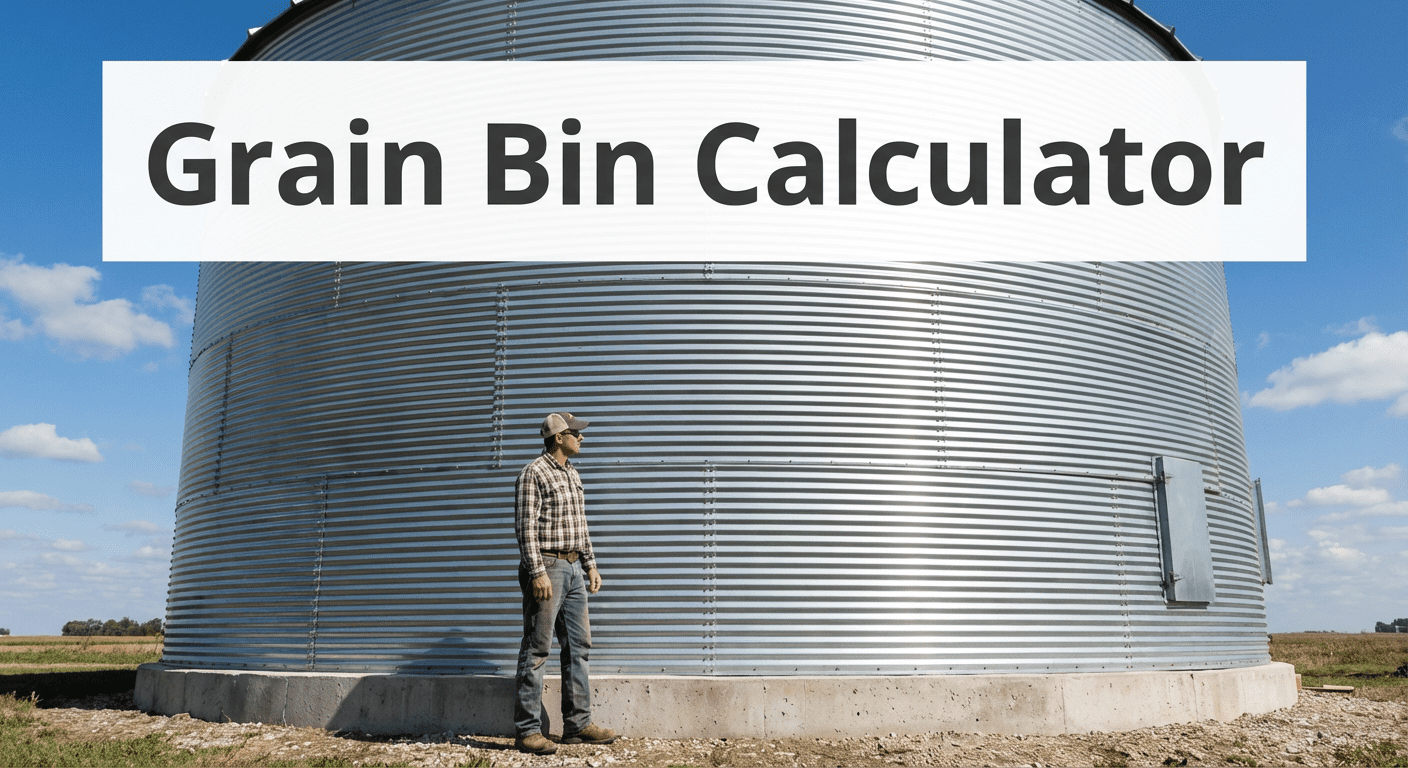
A grain bin calculator is a tool that estimates how much grain a cylindrical storage bin can hold based on its physical dimensions. Grain bins are cylindrical steel structures used on farms across North America, the Great Plains, and throughout the Midwest to store harvested crops such as corn, soybeans, wheat, oats, and barley after they leave the field.
Knowing bin capacity is essential for harvest planning, grain marketing, buying and selling grain contracts, estimating grain weight for trucking, and managing on-farm storage so harvested crops do not exceed structural limits. The calculation involves converting the physical volume of the bin into bushels using the standard cubic feet per bushel conversion, then multiplying by the appropriate weight per bushel for the grain type stored.
This calculator uses the same formula applied by agronomists, extension offices, and grain elevator operators throughout the United States. The result gives you three outputs: cubic feet of volume (the physical space occupied), bushels (the agricultural unit used for trading and storage), and weight in pounds and tons (used for trucking, load planning, and structural limits).
How to Calculate Grain Bin Capacity
Volume Formula for Cylindrical Bins
A grain bin is a cylinder. The volume of a cylinder is calculated using the standard formula:
- V — Volume in cubic feet
- π — Pi, approximately 3.14159
- r — Radius of the bin in feet (diameter ÷ 2)
- h — Grain depth (height) in feet
For a bin with a 30-foot diameter and 20 feet of grain: r = 15 ft, so V = 3.14159 × 15² × 20 = 3.14159 × 225 × 20 = 14,137 cubic feet.
This formula calculates the volume of grain as a perfect cylinder, which assumes the grain surface is flat. In practice, grain peaks in the center (a cone shape) during fill and settles toward the edges during removal, so actual capacity may vary by 5 to 10 percent from the calculated value. Most grain managers apply a 5 to 10 percent safety margin below the calculated capacity to account for this and for grain settling due to moisture loss.
Converting Cubic Feet to Bushels
One bushel equals 1.2445 cubic feet. This is the USDA standard conversion factor for grain storage in the United States. To convert cubic feet of bin volume to bushels:
Continuing the example: 14,137 cu ft ÷ 1.2445 = 11,360 bushels. Once you have the number of bushels, multiply by the pounds per bushel for the specific grain type to find the total weight. For corn at 56 lbs/bushel: 11,360 × 56 = 636,160 lbs ÷ 2,000 = 318 tons.
Bushel Weights by Grain Type
Each grain type has a standard legal test weight per bushel established by the USDA. These weights apply at standard moisture content. Grain stored at higher moisture content is heavier per bushel; grain that has dried below standard moisture is lighter. The values below are standard dry weights used for trading, storage, and transportation calculations.
| Grain Type | Lbs per Bushel | Standard Moisture | Metric Tons per 1,000 bu |
|---|---|---|---|
| Corn | 56 | 15.5% | 25.4 |
| Wheat | 60 | 13.5% | 27.2 |
| Soybeans | 60 | 13.0% | 27.2 |
| Oats | 32 | 14.0% | 14.5 |
| Barley | 48 | 14.5% | 21.8 |
Grain Bin Size Chart
The table below shows approximate bushel capacities for common bin diameters at various grain heights. Values assume a flat grain surface and standard bushel conversion of 1.2445 cubic feet per bushel.
| Diameter | 10 ft grain | 16 ft grain | 20 ft grain | 24 ft grain |
|---|---|---|---|---|
| 18 ft | 2,043 bu | 3,268 bu | 4,086 bu | 4,903 bu |
| 24 ft | 3,632 bu | 5,810 bu | 7,263 bu | 8,716 bu |
| 30 ft | 5,680 bu | 9,088 bu | 11,360 bu | 13,632 bu |
| 36 ft | 8,179 bu | 13,086 bu | 16,357 bu | 19,629 bu |
| 48 ft | 14,542 bu | 23,267 bu | 29,083 bu | 34,900 bu |
Partial Bin Calculations
The grain bin capacity formula works for any grain height, not just a full bin. If your bin is 30 feet in diameter but currently only has 8 feet of corn in it, you simply enter 8 feet as the grain height. The calculator will return the volume and bushels for that partial fill level. This is useful for:
- Inventory tracking — Calculating how many bushels remain in the bin at any point during the marketing season.
- Space planning — Determining how much additional storage capacity is available before harvest.
- Grain loans — Lenders often require bushel counts to determine collateral value on grain loans.
- Insurance documentation — Documenting bushels on hand for crop insurance or commodity insurance purposes.
To calculate the remaining capacity, find the capacity at the current fill level and subtract from the capacity at the maximum safe fill height for the bin. Maximum fill height is typically specified by the bin manufacturer and depends on the bin's ring height and roof structure. Overfilling beyond the manufacturer's rating can cause structural failure and is a serious safety hazard.
Grain Storage Best Practices
Proper grain storage involves more than calculating capacity. The condition of grain inside the bin — primarily its moisture content and temperature — determines how long it can be stored safely before spoilage or quality loss occurs.
- Moisture management — Corn should be stored at 14% moisture or below for long-term storage (6 months or more) and 15.5% or below for short-term storage. Wheat stores well at 13% or below. Soybeans should be at 13% or below. Storing at high moisture invites mold growth and insect activity that can destroy entire bins.
- Temperature control — Grain should be cooled to 35–40°F for winter storage. Aeration fans push outdoor air through the grain mass to equalize temperature and moisture. The goal is to cool grain as quickly as possible after harvest and keep it cool through spring.
- Grain inspection — Check stored grain monthly for temperature spikes, which indicate spoilage. Temperature cables strung through the bin provide continuous monitoring. Any hot spot should be investigated immediately by running aeration fans.
- Structural limits — Never exceed the bin manufacturer's rated capacity or maximum fill height. Overfilling places dangerous lateral pressure on bin walls. Ensure the bin floor is rated for the weight of a full load of grain.
- Safety — Grain bins are confined spaces. Flowing grain can trap and suffocate a person in seconds. Never enter a bin alone, always use a safety harness and lifeline, and follow OSHA confined-space entry procedures. The OSHA grain handling safety guidelines outline required safety procedures for working around grain storage facilities.
For calculating the volume of other storage structures such as square or rectangular commodity sheds, see the box volume calculator. For calculating floor area of a bin site or storage pad, the area calculator handles circular and rectangular footprints.
Frequently Asked Questions
How many bushels are in a grain bin?
The number of bushels depends on the bin's diameter and the depth of grain inside. Use the formula: Bushels = π × (diameter ÷ 2)² × grain height ÷ 1.2445. A 30-foot diameter bin with 20 feet of corn holds approximately 11,360 bushels. A 36-foot diameter bin with 24 feet of grain holds approximately 19,629 bushels. Enter your specific dimensions in the calculator above for an exact result.
How do you calculate grain bin capacity?
Grain bin capacity is calculated in two steps. First, calculate the cylindrical volume: V = π × r² × h, where r is the radius (diameter ÷ 2) and h is the grain height. Second, divide the volume by 1.2445 to convert cubic feet to bushels. Multiply bushels by the grain's pounds per bushel to find total weight. This calculator performs all three steps automatically.
How much does a bushel of corn weigh?
A bushel of corn weighs 56 pounds at the standard moisture content of 15.5%. A bushel of wheat weighs 60 pounds at 13.5% moisture. A bushel of soybeans weighs 60 pounds at 13% moisture. A bushel of oats weighs 32 pounds at 14% moisture. A bushel of barley weighs 48 pounds at 14.5% moisture. These are USDA standard test weights.
How many cubic feet per bushel?
One bushel equals 1.2445 cubic feet. This is the standard conversion factor used throughout the US grain industry. To convert a bin's cubic foot volume to bushels, divide by 1.2445. To convert bushels back to cubic feet, multiply by 1.2445. This factor applies to all grain types; the grain type only affects the weight calculation.
What size grain bin do I need?
To determine the bin size you need, estimate your storage requirement in bushels, then work backward through the formula. As a reference: a 24-ft bin at 16 ft holds about 5,800 bu; a 30-ft bin at 20 ft holds about 11,360 bu; a 36-ft bin at 24 ft holds about 19,629 bu; a 48-ft bin at 20 ft holds about 29,083 bu. Add 10-15% to your estimated storage need to account for grain settling and shrinkage.