Polygon Area Calculator
A polygon area calculator computes the area of regular polygons from the number of sides and side length, and estimates the area of irregular polygons from vertex coordinates. Enter your polygon details in the panel to calculate the area instantly, or use AI for irregular polygons with the Shoelace formula.
What Is a Polygon Area Calculator?
A polygon area calculator is a tool that computes the enclosed area of a polygon given its dimensions. For regular polygons, where all sides and angles are equal, the area can be calculated from just two values: the number of sides and the side length. For irregular polygons, where sides and angles differ, the area requires the coordinates of each vertex and uses the Shoelace formula (also known as the Coordinate Method or Surveyor's formula).
Polygon area calculations appear in architecture, land surveying, engineering, tiling, graphic design, and academic geometry. Whether you are finding the area of a regular hexagon for a tile layout or calculating the footprint of an irregularly shaped land parcel, this calculator covers both cases. Use the instant tab for regular polygons and the AI tab for coordinates-based irregular polygons. You can also use our area calculator for rectangles and triangles, or the circle calculator for circular areas.
Area of a Regular Polygon Formula
The Formula Explained
The standard formula for the area of a regular polygon with n sides each of length s is:
- A — Area of the polygon
- n — Number of sides (must be 3 or more)
- s — Length of one side
- π — Pi, approximately 3.14159265
- tan(π/n) — Tangent of the central half-angle, which relates the side length to the apothem
This formula works because a regular polygon can be divided into n congruent isosceles triangles all meeting at the center. Each triangle has a base equal to the side length s and a height equal to the apothem a = s / (2 × tan(π/n)). Multiplying n triangles of area (s × a / 2) gives the total polygon area.
Apothem Method
If you know the apothem (the perpendicular distance from the center to the midpoint of any side) rather than the side length, you can use the alternative formula:
This is equivalent to the primary formula. The apothem can be derived from the side length using a = s / (2 × tan(π/n)), which is built into the main formula above.
Common Regular Polygon Areas
Triangle (3 sides)
For an equilateral triangle with side length s: A = (√3 / 4) × s². This simplifies to approximately 0.4330 × s². A triangle with side length 10 m has an area of 43.30 m². The triangle is the polygon with the fewest possible sides and is found in structural engineering due to its rigidity. For non-equilateral triangles, use base × height / 2 or Heron's formula.
Square (4 sides)
For a square with side s: A = s². This is the simplest polygon area formula. A square with side 10 m has an area of 100 m². Squares are used for flooring tiles, room layouts, and land parcels. The formula A = (n × s²) / (4 × tan(π/4)) simplifies to A = s² since tan(π/4) = 1 and n = 4.
Pentagon (5 sides)
For a regular pentagon with side s: A ≈ 1.7205 × s². A pentagon with side 10 m has an area of approximately 172.05 m². Interior angles of a regular pentagon are 108°. Pentagons appear in soccer ball panels, architectural features, and the US Department of Defense building (The Pentagon).
Hexagon (6 sides)
For a regular hexagon with side s: A = (3√3 / 2) × s² ≈ 2.5981 × s². A hexagon with side 10 m has an area of approximately 259.81 m². Hexagons are the most efficient shape for tessellating a plane (covering a surface with no gaps), which is why honeycombs, bathroom tiles, and board game grids often use hexagonal patterns.
Octagon (8 sides)
For a regular octagon with side s: A ≈ 4.8284 × s². An octagon with side 10 m has an area of approximately 482.84 m². Interior angles of a regular octagon are 135°. Octagons are commonly found in stop signs, clock faces, and architectural floor plans. For octagonal rooms or buildings, this formula gives the usable floor area given the wall-to-wall width.
How to Calculate Irregular Polygon Area
Shoelace Formula (Coordinate Method)
For an irregular polygon (one with unequal sides or angles), the Shoelace formula calculates the area from the (x, y) coordinates of each vertex. Given vertices listed in order (either clockwise or counterclockwise), the formula is:
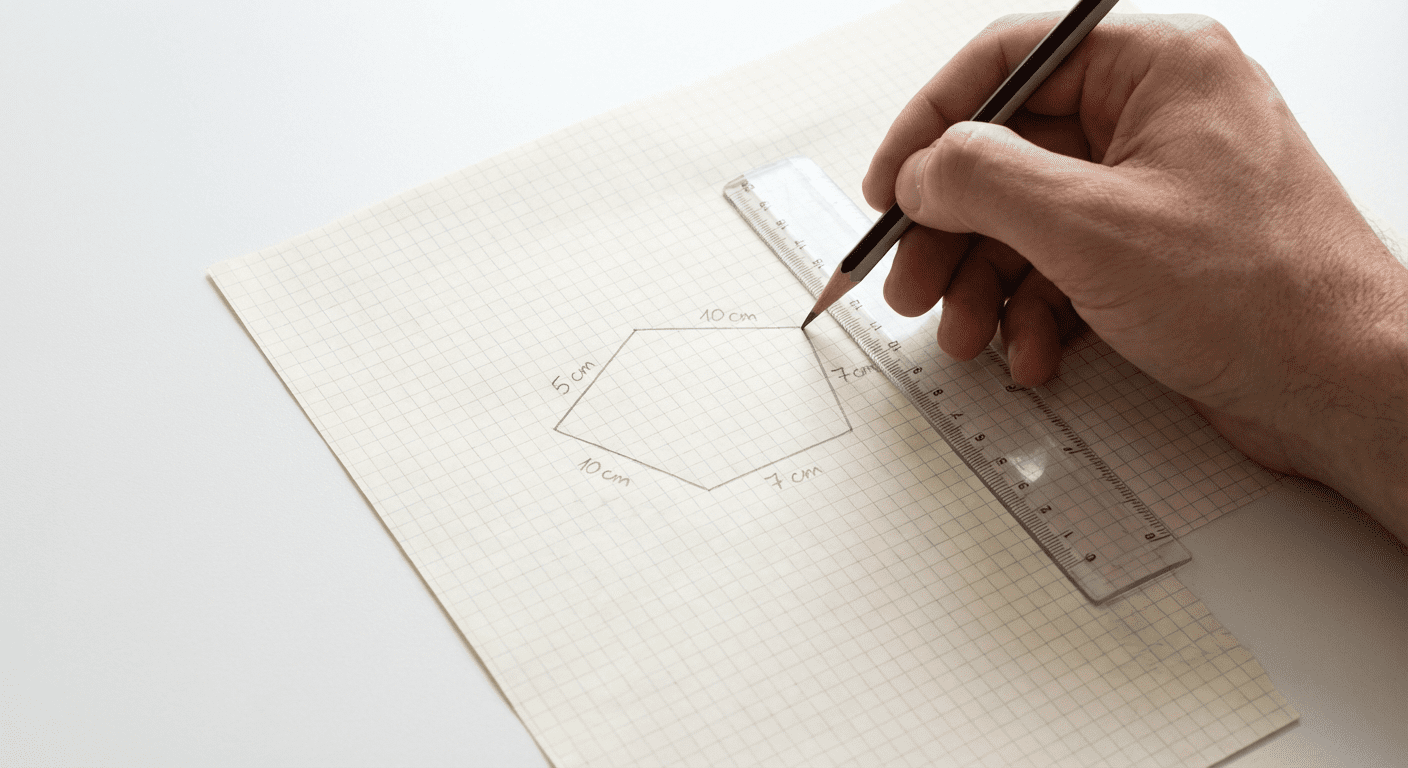
Where the vertices are listed as (x₁, y₁), (x₂, y₂), ..., (xₙ, yₙ) and the last vertex connects back to the first. The absolute value ensures a positive area regardless of whether the vertices are listed clockwise or counterclockwise. The Shoelace formula works for any simple polygon (one that does not self-intersect), including L-shapes, irregular land plots, and any custom-shaped region.
To use this method, measure or record the coordinates of each corner of your polygon in order, then paste them into the AI tab of this calculator. The AI will apply the Shoelace formula and return the area with full working steps. Our AI math solver can also handle complex geometry problems if you need broader support.
Polygon Area Calculator Examples
Example - Regular Hexagon with Side 10
Given: n = 6 sides, s = 10 m.
A = (6 × 10²) / (4 × tan(π/6))
A = (6 × 100) / (4 × 0.57735)
A = 600 / 2.3094
A ≈ 259.81 m²
The perimeter is n × s = 6 × 10 = 60 m. Each interior angle is (6 - 2) × 180 / 6 = 120°. The apothem (center-to-midpoint distance) is s / (2 × tan(π/6)) = 10 / (2 × 0.5774) ≈ 8.66 m.
| Polygon | Sides | Area (s=10) | Interior Angle |
|---|---|---|---|
| Triangle | 3 | 43.30 | 60° |
| Square | 4 | 100.00 | 90° |
| Pentagon | 5 | 172.05 | 108° |
| Hexagon | 6 | 259.81 | 120° |
| Octagon | 8 | 482.84 | 135° |
| Decagon | 10 | 769.42 | 144° |
FAQ
How to find the area of a polygon?
For a regular polygon, use A = (n × s²) / (4 × tan(π/n)), where n is the number of sides and s is the side length. For an irregular polygon, use the Shoelace formula with the vertex coordinates: A = (1/2) × |Σ(xᵢ × yᵢ₊₁ − xᵢ₊₁ × yᵢ)|. Enter your values in the calculator panel above for instant results.
What is a regular polygon?
A regular polygon is a polygon where all sides are equal in length and all interior angles are equal. Examples include equilateral triangles, squares, regular pentagons, hexagons, and octagons. The sum of interior angles of any polygon with n sides is (n − 2) × 180°, and each interior angle of a regular polygon is (n − 2) × 180° / n.
How to calculate area of an irregular polygon?
Use the Shoelace formula (coordinate method). List the vertex coordinates (x, y) in order — either all clockwise or all counterclockwise. Then calculate A = (1/2) × |sum of (xᵢ × yᵢ₊₁ − xᵢ₊₁ × yᵢ) for all i|. Enter your coordinates in the AI tab of the calculator above and the AI will show you every step.
What is the shoelace formula?
The Shoelace formula (also called the Surveyor's formula or Gauss's area formula) calculates the area of a simple polygon from its vertex coordinates. The name comes from the way you alternate between multiplying diagonally — like lacing a shoe. It works for any non-self-intersecting polygon regardless of the number of sides, making it the standard method for irregular polygon area calculations in surveying, GIS, and computational geometry.
How many sides does a polygon need?
A polygon must have at least 3 sides. A 3-sided polygon is a triangle, a 4-sided polygon is a quadrilateral, and so on. There is no upper limit to the number of sides. As the number of sides increases and the side length decreases, a regular polygon approaches the shape of a circle. A regular polygon with many sides (like 100 or 1000) is called a megagon or circle approximation.