Cholesterol Calculator
A cholesterol calculator converts cholesterol readings between mg/dL and mmol/L and calculates your total cholesterol to HDL ratio. Enter your cholesterol values below to convert units or assess your cholesterol ratio against recommended health guidelines.
What Is a Cholesterol Calculator?
A cholesterol calculator performs two related functions. First, it converts cholesterol values between the two measurement systems used worldwide: mg/dL (milligrams per deciliter), used in the United States, and mmol/L (millimoles per liter), used in Canada, the United Kingdom, Australia, and most of Europe and Asia. Second, it calculates the total cholesterol to HDL ratio, a widely used clinical indicator of cardiovascular risk.
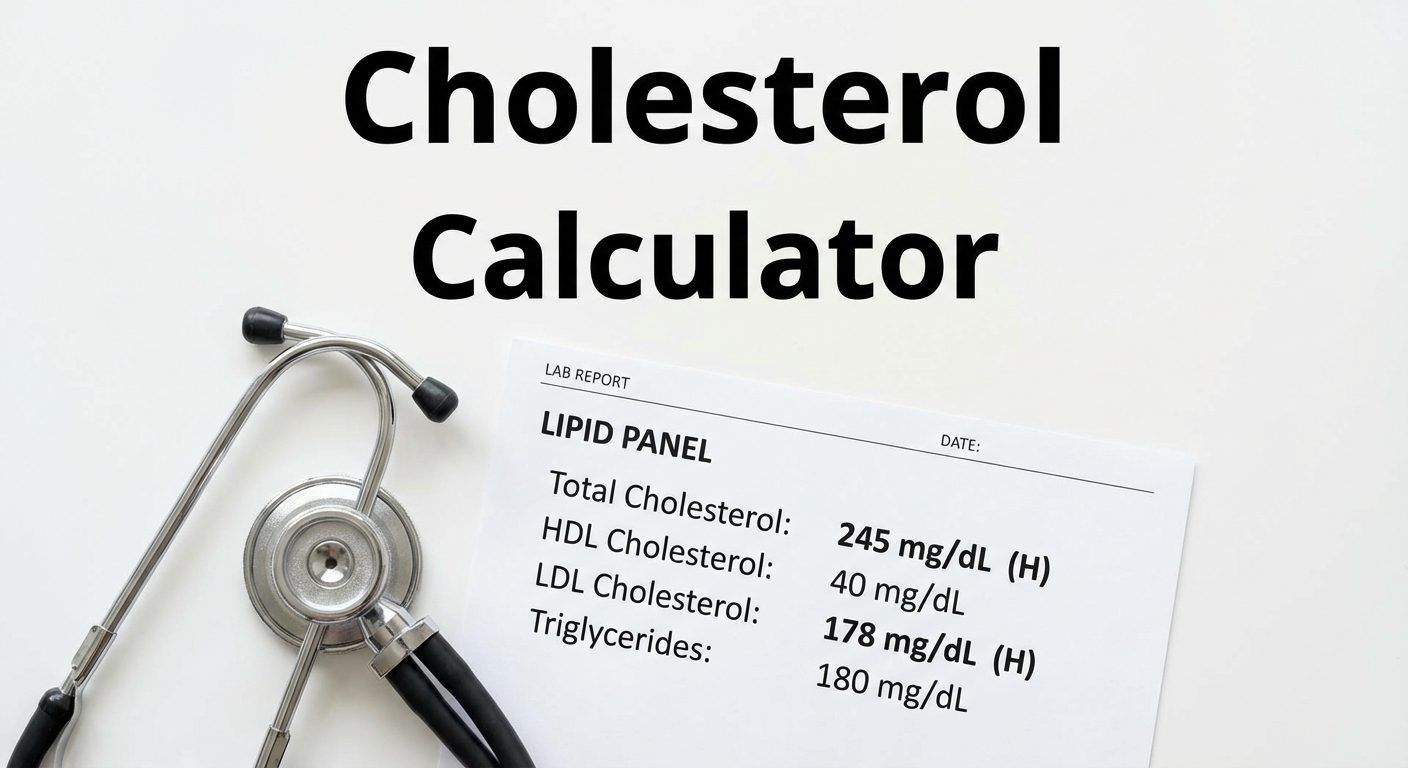
Cholesterol readings appear on standard lipid panel blood tests. A complete lipid panel typically includes total cholesterol, HDL (high-density lipoprotein), LDL (low-density lipoprotein), and triglycerides. If you have results from different countries or laboratories, this calculator allows you to compare values in a consistent unit. The American Heart Association cholesterol guide provides comprehensive clinical guidance on understanding lipid panel results.
Cholesterol Units Explained
mg/dL vs mmol/L
Both mg/dL and mmol/L measure the same thing — the concentration of a substance in blood — but using different scales. mg/dL expresses the mass of the substance in milligrams per deciliter of blood. mmol/L expresses the amount as millimoles (a measure of the number of molecules) per liter of blood. For cholesterol (molecular weight approximately 386.65 g/mol), the conversion factor is 38.67. For triglycerides (molecular weight approximately 885.43 g/mol), the conversion factor is 88.57.
In practice, US cholesterol results appear as larger numbers (e.g., 200 mg/dL) while international results appear as smaller numbers (e.g., 5.17 mmol/L). A patient moving from the US to the UK may find that their "200 cholesterol" becomes "5.2 cholesterol" — same result, different units.
Why Different Countries Use Different Units
The United States adopted mg/dL as its standard medical measurement system and has maintained it throughout its clinical history. Most of the rest of the world transitioned to the SI (International System of Units) in medicine, which uses mmol/L for blood measurements because it reflects the number of molecules present rather than their mass — this is scientifically more meaningful for biological processes since reactions occur at the molecular level. Neither unit is wrong; both are used in peer-reviewed research and clinical practice. The WHO blood lipids reference provides international context for cholesterol measurement standards.
Cholesterol Conversion Formulas
Total Cholesterol, HDL, LDL Conversion
Total cholesterol, HDL, and LDL all share the same molecular weight and therefore use the same conversion factor:
Triglycerides Conversion
Triglycerides use a different conversion factor because their molecular weight (approximately 885 g/mol) is about 2.3 times higher than cholesterol:
Using the cholesterol factor for triglycerides (or vice versa) will produce an incorrect result, so it is important to select the correct measurement type when converting.
Cholesterol Conversion Chart
Common cholesterol and triglyceride values in both measurement systems:
| mg/dL (US) | mmol/L (International) | Clinical Context (Cholesterol) |
|---|---|---|
| 130 | 3.36 | Desirable total cholesterol |
| 160 | 4.14 | Borderline high LDL |
| 180 | 4.65 | High LDL |
| 200 | 5.17 | Desirable/borderline total cholesterol threshold |
| 220 | 5.69 | Borderline high total cholesterol |
| 240 | 6.21 | High total cholesterol threshold |
| 270 | 6.98 | High total cholesterol |
| 300 | 7.76 | Very high total cholesterol |
Triglycerides: 150 mg/dL = 1.69 mmol/L | 200 mg/dL = 2.26 mmol/L | 500 mg/dL = 5.65 mmol/L
Cholesterol Ratio Calculator
What Is the Total/HDL Ratio
The total cholesterol to HDL ratio (also called the cholesterol ratio or cardiac risk ratio) is calculated by dividing total cholesterol by HDL cholesterol:

The ratio can be calculated using either mg/dL or mmol/L values — since both are divided by the same factor, the ratio is the same regardless of unit. The ratio gives a more complete picture of cardiovascular risk than total cholesterol alone because it accounts for the protective effect of HDL. A person with high total cholesterol but very high HDL may have a lower ratio and lower risk than someone with moderate cholesterol but very low HDL. Use the blood alcohol calculator for blood alcohol assessment.
Healthy Ratio Ranges
| Total/HDL Ratio | Risk Category | Guidance |
|---|---|---|
| Below 3.5 | Optimal | Low cardiovascular risk |
| 3.5 – 5.0 | Borderline | Moderate risk — lifestyle review recommended |
| 5.0 – 6.0 | High | Elevated risk — consult healthcare provider |
| Above 6.0 | Very High | Significantly elevated risk — medical evaluation needed |
Normal Cholesterol Levels
Total Cholesterol
The American Heart Association classifies total cholesterol as follows: below 200 mg/dL (5.17 mmol/L) is desirable, 200 to 239 mg/dL (5.17 to 6.18 mmol/L) is borderline high, and 240 mg/dL (6.21 mmol/L) or above is high. These thresholds apply to fasting measurements for adults and are used as screening criteria. Total cholesterol alone is not the most reliable predictor of cardiovascular risk — the full lipid panel including HDL, LDL, and triglycerides provides a more complete picture.

HDL (Good Cholesterol)
HDL cholesterol transports excess cholesterol from tissues back to the liver for processing and removal. Higher HDL levels are protective. The American Heart Association considers HDL below 40 mg/dL (1.03 mmol/L) a risk factor for cardiovascular disease. HDL between 40 and 59 mg/dL (1.03 to 1.52 mmol/L) is considered acceptable, and HDL of 60 mg/dL (1.55 mmol/L) or above is considered protective and associated with reduced cardiovascular risk. Women naturally have higher average HDL than men.
LDL (Bad Cholesterol)
LDL cholesterol is the primary driver of arterial plaque formation. The optimal LDL level is below 100 mg/dL (2.59 mmol/L). For people with established heart disease or very high risk, targets of below 70 mg/dL (1.81 mmol/L) or even below 55 mg/dL (1.42 mmol/L) are recommended by some guidelines. LDL between 100 and 129 mg/dL (2.59 to 3.34 mmol/L) is near optimal, 130 to 159 mg/dL (3.37 to 4.12 mmol/L) is borderline high, 160 to 189 mg/dL (4.14 to 4.90 mmol/L) is high, and 190 mg/dL (4.92 mmol/L) or above is very high. See the blood sugar converter for glucose unit conversion alongside lipid panel interpretation.
Triglycerides
Triglycerides are fats in the blood stored for energy. Normal triglycerides are below 150 mg/dL (1.69 mmol/L). Borderline high is 150 to 199 mg/dL (1.69 to 2.25 mmol/L). High triglycerides are 200 to 499 mg/dL (2.26 to 5.64 mmol/L), and very high triglycerides are 500 mg/dL (5.65 mmol/L) or above. Very high triglycerides can cause pancreatitis in addition to increasing cardiovascular risk. Triglycerides are particularly sensitive to diet — a high-carbohydrate meal before a non-fasting blood draw can significantly elevate the result, which is why lipid panels are typically ordered after an 8 to 12 hour fast.
FAQ
What is a good cholesterol ratio?
A total cholesterol to HDL ratio below 3.5 is optimal and associated with low cardiovascular risk. Below 5.0 is acceptable. Above 5.0 is elevated and warrants discussion with a healthcare provider. The ratio is calculated by dividing total cholesterol by HDL — for example, 200 mg/dL total ÷ 55 mg/dL HDL = 3.64.
How do you convert cholesterol units?
To convert total cholesterol, HDL, or LDL from mg/dL to mmol/L, divide by 38.67. To convert triglycerides from mg/dL to mmol/L, divide by 88.57. To convert either back to mg/dL, multiply by the same factor. The calculator above handles both directions and all four measurement types instantly.
What is normal total cholesterol?
Normal (desirable) total cholesterol is below 200 mg/dL (5.17 mmol/L). Borderline high is 200 to 239 mg/dL (5.17 to 6.18 mmol/L). High is 240 mg/dL (6.21 mmol/L) or above. These thresholds apply to fasting lipid panel results for adults per AHA guidelines.
What does HDL and LDL mean?
HDL (high-density lipoprotein) is often called good cholesterol because it carries cholesterol back to the liver for removal. Higher HDL reduces cardiovascular risk. LDL (low-density lipoprotein) is called bad cholesterol because it deposits cholesterol in artery walls, contributing to plaque formation and increasing heart attack and stroke risk. Lower LDL is generally better.
What is a dangerous cholesterol level?
Total cholesterol above 240 mg/dL (6.21 mmol/L), LDL above 190 mg/dL (4.92 mmol/L), HDL below 40 mg/dL (1.03 mmol/L), or triglycerides above 500 mg/dL (5.65 mmol/L) are all considered clinically significant and warrant medical evaluation. Cholesterol risk must always be interpreted alongside other cardiovascular risk factors including blood pressure, smoking history, diabetes, and family history.
Also check out: