Bristol Stool Chart
The Bristol Stool Chart is a health reference tool covering bristol stool chart, poop chart, bristol stool scale, stool color chart. Use the chart below to look up values instantly. Printable and downloadable versions are available on this page.
Stool Health Checker
Select your stool shape type (1–7) and colour from the visual picker below to get an interpretation of your digestive health status.
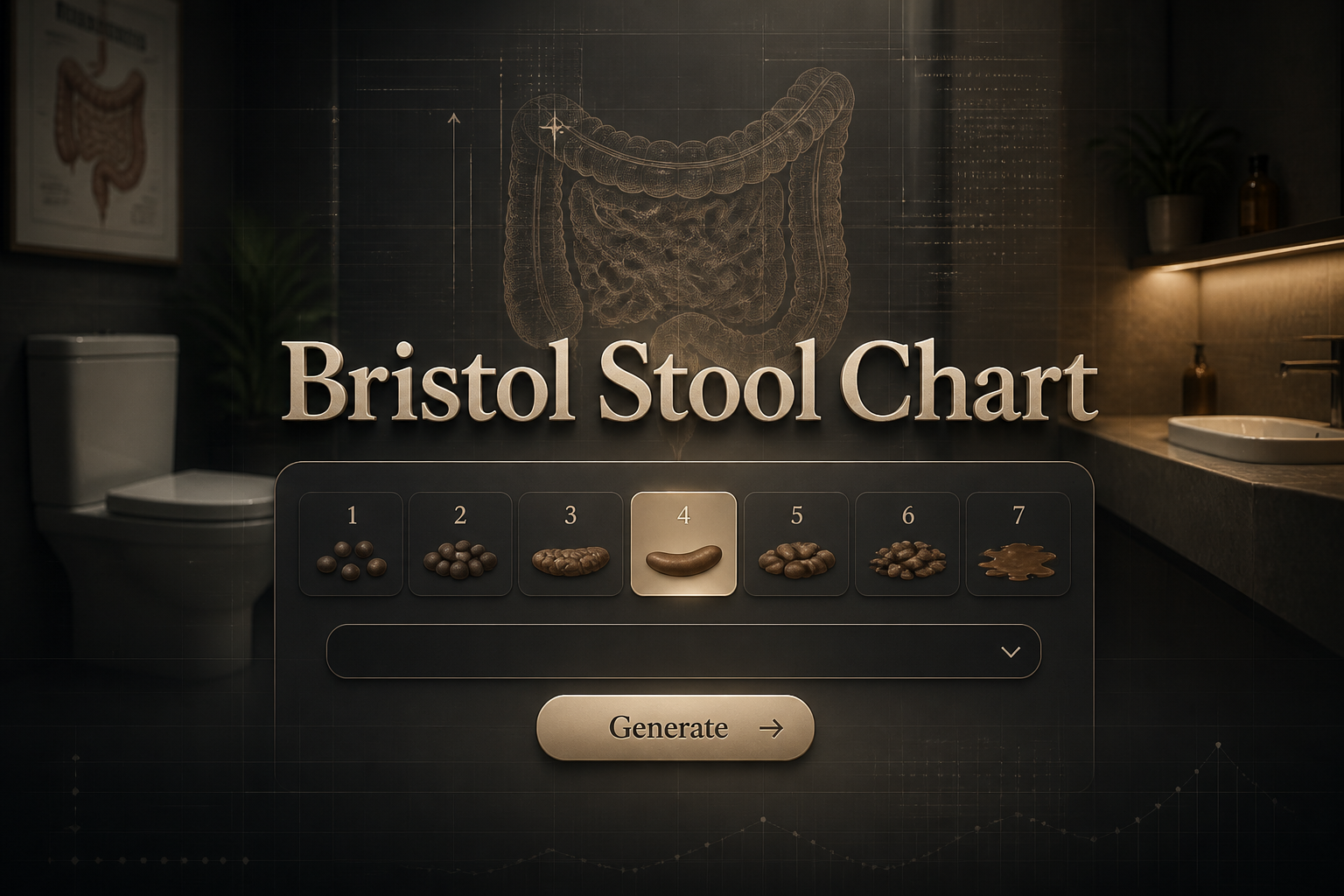
Bristol Stool Chart — All 7 Types
| Type Number | Shape Name | Visual Description | Estimated Transit Time | What It Indicates |
|---|---|---|---|---|
| Type 1 | Separate hard lumps | Hard dry pellets like small nuts, pebbles, or rabbit droppings. Difficult and painful to pass. | More than 100 hours in the colon | Severe constipation. Increase water intake and dietary fibre significantly. |
| Type 2 | Sausage-shaped but lumpy | A thick log with a lumpy bumpy surface. The lumps are compressed together. | 72 to 100 hours | Mild to moderate constipation. Increase fibre and fluid intake. |
| Type 3 | Sausage-shaped with surface cracks | A smooth log shape with cracks or fissures on the surface. Passes more easily than Type 2. | 36 to 72 hours | Normal to slightly dry. Acceptable but slightly lacking moisture. |
| Type 4 ★ Ideal | Smooth soft sausage or snake | A smooth uniform log or snake shape with no cracks. Passes easily in one piece. | 24 to 36 hours | Ideal — this is the gold standard of healthy bowel movements. |
| Type 5 | Soft blobs with clear-cut edges | Separate soft pieces with well-defined smooth edges. Easy to pass. | 12 to 24 hours | Borderline loose. May indicate insufficient fibre or mild bowel urgency. |
| Type 6 | Fluffy pieces with ragged edges | Mushy consistency with uneven torn edges. No single formed piece. | Under 12 hours | Mild diarrhoea. May indicate inflammation, infection, stress, or food sensitivity. |
| Type 7 | Watery — no solid pieces | Entirely liquid with no solid component. Passes without warning. | Under 10 hours | Severe diarrhoea. Risk of dehydration — replace fluids and electrolytes immediately. |
Normal bowel movement frequency ranges from 3 times per day to 3 times per week. Both extremes of this range are normal provided the stool is Type 3 or 4 and passes without straining or urgency.
Source: Lewis SJ and Heaton KW — Scandinavian Journal of Gastroenterology, 1997. Developed at Bristol Royal Infirmary.
Stool Colour Chart
The table below summarises common stool colours and their significance. For a more detailed breakdown of every colour including urgency levels and infant stool colour guidance, see the full Stool Color Chart.
| Stool Colour | Most Likely Cause | Possible Medical Cause | Action Needed |
|---|---|---|---|
| Brown (all shades) | Normal bile pigment breakdown | None — this is the normal healthy colour | No action needed |
| Black or tarry | Iron supplements, bismuth products such as Pepto-Bismol, red wine | Upper GI bleed from stomach or oesophagus ulcer | Urgent if not explained by food or medication — see a doctor same day |
| Bright red | Beets, red food dye, tomato juice | Haemorrhoids, anal fissure, lower GI bleed | See doctor if not explained by diet or if recurrent |
| Maroon or dark red | Large amount of beets or red food dye | Lower GI bleed (colon or small intestine) | See doctor promptly if not dietary |
| Green | Leafy green vegetables, green food dye, fast transit | Infection such as giardia, Clostridium | Usually dietary. Monitor if persistent without cause |
| Yellow, greasy, or pale | High-fat meal, fat-soluble vitamins | Fat malabsorption, coeliac disease, bile duct obstruction | See doctor if persistent — especially if stools are greasy and difficult to flush |
| Clay, white, or grey | Barium enema procedure (temporarily) | Bile duct obstruction, hepatitis, liver failure | Seek medical attention immediately — this is a red-flag symptom |
| Orange | High beta-carotene intake (carrots, sweet potato) | Partial bile duct obstruction | Usually dietary. Monitor if persistent and not explained by food |
Source: NHS and American Gastroenterological Association
What Healthy Stool Looks Like
- Shape — Type 4 on the Bristol scale. A smooth uniform sausage or snake shape that passes as a single piece without breaking apart.
- Colour — medium to dark brown. The normal result of bile pigments breaking down as food moves through the digestive system.
- Ease of passage — passes comfortably without straining or pain in under 10 minutes.
- Frequency — anywhere from 3 times per day to 3 times per week is within the normal range for healthy adults.
Bristol Stool Chart for Babies and Infants
Infant stool varies dramatically depending on age and feeding type — what is normal for a breastfed newborn would be alarming in an adult.
| Stage or Age | Normal Stool Appearance | Normal Duration or Frequency | When to Contact a Paediatrician |
|---|---|---|---|
| Newborn days 1–2 (any feeding) | Meconium — very dark green-black and sticky. Has a tar-like consistency. | Should pass within the first 24–48 hours of life | If no meconium has been passed within 48 hours of birth — possible obstruction |
| Transitional days 3–4 | Greenish-brown and looser as meconium clears | Brief transitional period | Normal change |
| Breastfed baby | Yellow or mustard. Seedy or grainy texture. Loose and watery consistency is normal. | Very frequent — up to 10 or more times per day is normal for newborns. Can reduce to once every few days in older infants. | Blood or mucus in stool. White or pale grey colour. Failure to gain weight. |
| Formula-fed baby | Tan, yellow-brown or beige. Firmer and more formed than breastfed stool. | 1–4 times per day | Firm pellets (Type 1) may indicate constipation. Blood in stool. |
| Starting solid foods (4–6 months onward) | Changes colour and texture with each new food introduced. Can become very firm or very loose as the digestive system adjusts. | Variable by food | Persistent blood or mucus. Stool that remains very hard despite adequate fluid intake. |
Source: American Academy of Pediatrics
Stool Health Checker
Select your stool shape type (1–7) and colour from the visual picker below to get an interpretation of your digestive health status, likely causes, and dietary suggestions.
Frequently Asked Questions
What is the ideal poop type on the Bristol Stool Chart?
Type 4 — a smooth uniform sausage or snake shape that passes easily in one piece without straining. It indicates a healthy transit time and adequate fibre and fluid intake.
Is Type 5 normal on the Bristol Stool Chart?
Type 5 (soft blobs with clear-cut edges) is borderline — it passes easily but indicates that transit time is slightly faster than ideal. If occasional it is not a concern but if persistent it may suggest insufficient dietary fibre.
What does black stool mean?
Black tarry stool — called melaena — can indicate bleeding in the upper gastrointestinal tract such as a stomach ulcer or oesophageal bleed. It can also result from iron supplements or bismuth products. Unexplained black stool requires urgent medical evaluation.
What does white or clay-coloured stool mean?
White or clay-coloured stool indicates a lack of bile which is produced by the liver and stored in the gallbladder. It is a red-flag symptom that can indicate bile duct obstruction, hepatitis, or liver failure — seek immediate medical attention.
How often should I have a bowel movement?
Anywhere from 3 times per day to 3 times per week is considered normal for healthy adults. The quality and consistency matter more than the frequency — Type 3 or 4 on the Bristol scale is the goal regardless of how often you go.
What causes Type 1 stool?
Type 1 (separate hard pellets) indicates severe constipation — stool has spent too long in the colon and has lost too much moisture. Common causes include insufficient dietary fibre, inadequate water intake, physical inactivity, and certain medications.
Can stress affect bowel movements?
Yes — the gut and brain are directly connected via the gut-brain axis. Acute stress commonly triggers loose stools or diarrhoea while chronic stress can slow transit time and cause constipation.
What is the Bristol Stool Chart used for medically?
The Bristol Stool Scale is used by gastroenterologists and nurses to objectively describe stool consistency in patient records and clinical studies. It provides a standardised visual language that reduces ambiguity when describing bowel habits — particularly in diagnosing IBS, IBD, and bowel disorders.