Steak Temperature Chart
A steak temperature chart shows the exact internal temperature to pull your steak off the heat for every doneness level — from Rare at 120°F to Well Done at 160°F. Pull temperatures are listed separately from final serving temperatures to account for carryover cooking. All ranges are cross-referenced with USDA guidelines for whole-muscle beef.
Check Your Steak Temperature
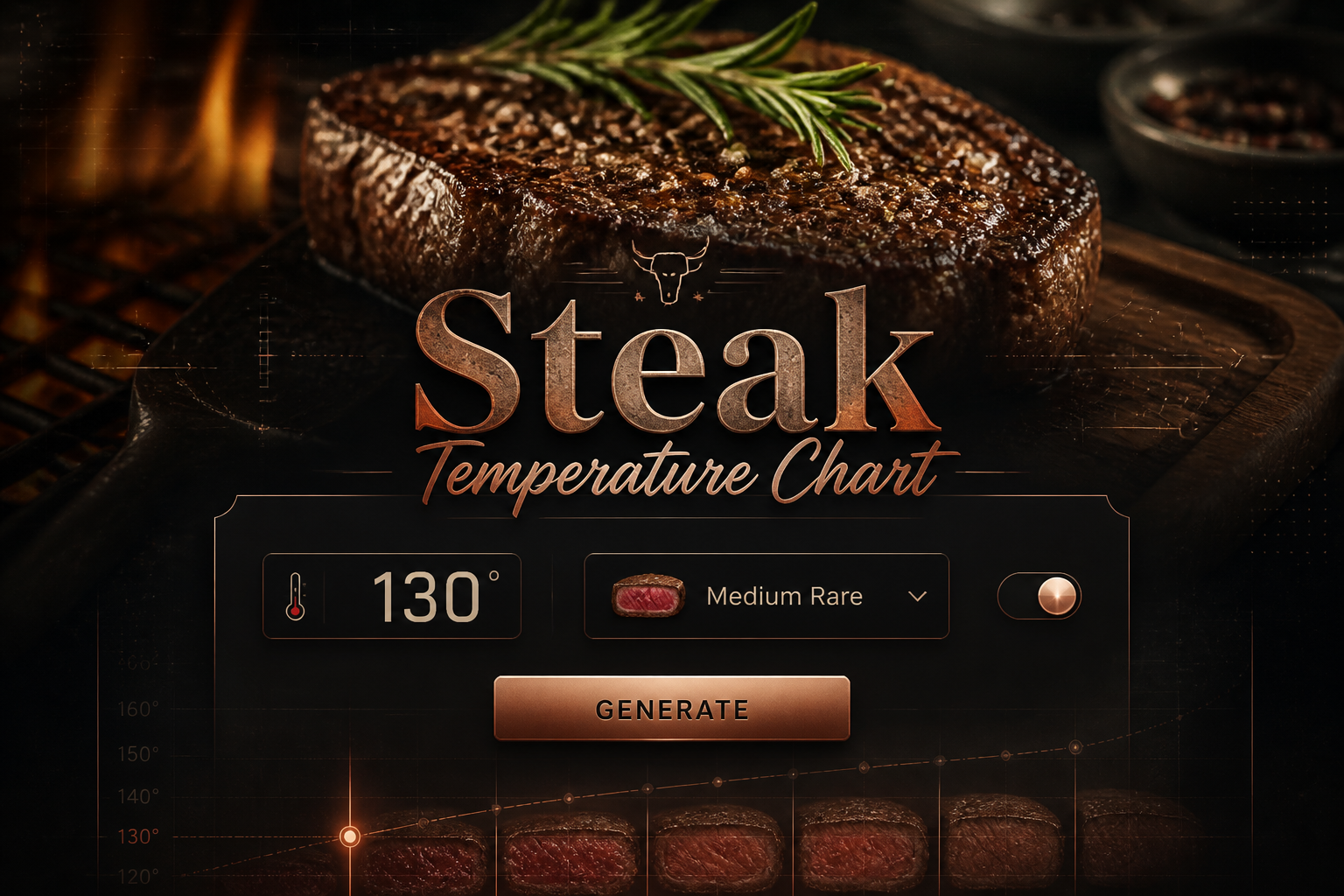
Steak Doneness Temperature Chart
| Doneness Level | Pull Off Heat (°F) | Final Serving (°F) | Pull Off Heat (°C) | Final Serving (°C) | Centre Appearance | Texture |
|---|---|---|---|---|---|---|
| Blue / Raw | 115°F | 115–120°F | 46°C | 46–49°C | Cool deep red throughout | Very soft and yielding |
| Rare | 120°F | 120–125°F | 49°C | 49–52°C | Red centre, warm throughout | Soft with slight resistance |
| Medium-Rare ★ Most Popular | 125°F | 130–135°F | 52°C | 54–57°C | Pink-red centre | Firm outer edge with soft centre |
| Medium | 130°F | 140–145°F | 54°C | 60–63°C | Pink centre | Springy and moderately firm |
| Medium-Well | 145°F | 150–155°F | 63°C | 66–68°C | Slight pink trace | Mostly firm with little moisture |
| Well Done | 155°F | 160°F and above | 68°C | 71°C and above | No pink — fully grey | Firm and dry throughout |
USDA minimum safe temperature for whole-muscle steak is 145°F with a 3-minute rest. Ground beef must reach 160°F regardless of appearance.
Source: USDA Food Safety and Inspection Service
Steak Temperature Chart by Cut
Different cuts respond differently to heat because of their fat content, muscle fibre density, and thickness.
| Steak Cut | Recommended Doneness | Reason |
|---|---|---|
| Ribeye | Medium-Rare | The intramuscular fat renders best at this temperature, maximising flavour and juiciness. |
| Filet Mignon | Medium-Rare | This is a very lean cut and dries out quickly if cooked beyond medium. |
| New York Strip | Medium-Rare to Medium | Good fat marbling makes it slightly more forgiving across doneness levels. |
| T-Bone and Porterhouse | Medium-Rare | Contains both strip and tenderloin sections which cook at different rates. |
| Flank and Skirt | Medium-Rare | Tough muscle fibres tighten rapidly when overcooked, making the meat chewy. |
| Chuck and Round | Well Done or braised | These are tough working muscles that need either very high doneness or long slow cooking to break down collagen. |
Source: USDA — Cooking Meat? Check the New Recommended Temperatures
Carryover Cooking Chart
Internal temperature continues rising after a steak is removed from heat because residual energy keeps conducting inward from the seared outer crust.
| Steak Thickness | Expected Temperature Rise | Recommended Rest Time |
|---|---|---|
| 1 inch thick | 5°F rise | 3 to 5 minutes |
| 1.5 inches thick | 7°F rise | 5 to 7 minutes |
| 2 inches thick | 10°F rise | 8 to 10 minutes |
Cooking Method Reference Chart
Cook times below are for a one-inch steak targeting medium-rare. Adjust proportionally for thicker cuts.
| Cooking Method | Heat Setting | Approximate Time Per Side | Notes |
|---|---|---|---|
| Cast iron sear | Very high heat | 2 to 3 minutes per side | Add butter, garlic and thyme in the final 60 seconds and baste continuously. |
| Gas grill | High direct heat | 3 to 4 minutes per side | Keep lid open. Look for grill marks before turning. |
| Charcoal grill | High direct heat | 3 to 4 minutes per side | Move to indirect heat if flare-ups occur. |
| Reverse sear method | 250°F oven first, then a quick sear | 25 minutes oven time, then 1 to 2 minutes per side to sear | Best for steaks 1.5 inches or thicker. Use a probe thermometer. |
| Sous vide | 130°F water bath, then a quick sear | 1 to 4 hours in the bath, then 1 minute per side to sear | Most precise method. Pasteurises the steak safely at this time and temperature combination. |
Safe Internal Temperatures for All Meats
Different proteins require different minimum internal temperatures to be safe to eat. For a full reference covering beef, pork, chicken, turkey, lamb, fish, and ground meat with resting times, see the meat temperature chart.
| Meat Type | Safe Internal Temp (°F) | Safe Internal Temp (°C) | Rest Time Required |
|---|---|---|---|
| Beef, lamb, and veal steaks and roasts | 145°F | 63°C | 3 minutes |
| Ground beef and ground pork | 160°F | 71°C | None required |
| Pork chops and pork roasts | 145°F | 63°C | 3 minutes |
| Chicken and turkey — all parts | 165°F | 74°C | None required |
| Fish and shellfish | 145°F | 63°C | None required |
| Fresh ham | 145°F | 63°C | 3 minutes |
| Eggs | 160°F | 71°C | Cook until yolk is firm |
Source: USDA Food Safety and Inspection Service — Safe Temperature Chart
Sous Vide Steak Temperature and Time Chart
Sous vide cooks steak in a temperature-controlled water bath for an extended time, producing perfectly even doneness from edge to edge before a final sear.
| Doneness Level | Water Bath Temp (°F) | Water Bath Temp (°C) | Minimum Time | Maximum Time Before Texture Degrades |
|---|---|---|---|---|
| Rare | 120–128°F | 49–53°C | 1 hour | 2.5 hours |
| Medium-Rare | 129–134°F | 54–57°C | 1 hour | 4 hours |
| Medium | 135–144°F | 57–62°C | 1 hour | 4 hours |
| Medium-Well | 145–155°F | 63–68°C | 1 hour | 3 hours |
| Well Done | 156°F and above | 69°C and above | 1 hour | 3 hours |
| Thick steaks 2 inches or more (any doneness) | As per doneness row above | As per doneness row above | 3 hours minimum | 6 hours |
After the water bath, pat the steak completely dry then sear in a very hot cast iron pan or on a very hot grill for 45 to 90 seconds per side. The exterior must be fully dry to achieve a proper crust without steaming.
Source: ChefSteps — Sous Vide Steak and USDA sous vide pasteurisation guidelines
Lamb, Pork, and Poultry Temperature Chart
Different proteins require different temperatures because of their muscle fibre structure, fat content, and pathogen risk profile. For expanded cut-by-cut guidance on pork, chicken, turkey, fish, and ground meat see the meat temperature chart.
| Protein | Doneness Level | Internal Temp (°F) | Internal Temp (°C) | USDA Minimum Met? |
|---|---|---|---|---|
| Lamb chops and rack of lamb | Rare | 125°F | 52°C | No — below USDA minimum |
| Lamb chops and rack of lamb | Medium-Rare | 130–135°F | 54–57°C | No — many chefs accept this as safe for whole muscle |
| Lamb chops and rack of lamb | Medium | 140–145°F | 60–63°C | Yes — meets USDA 145°F minimum |
| Lamb chops and rack of lamb | Well Done | 160°F and above | 71°C and above | Yes |
| Pork chops and pork tenderloin | Medium (USDA new minimum since 2011) | 145°F with 3-minute rest | 63°C | Yes |
| Pork chops and pork tenderloin | Well Done | 160°F | 71°C | Yes |
| Whole chicken (all parts) | Safe minimum | 165°F | 74°C | Yes — no rest required |
| Turkey (all parts) | Safe minimum | 165°F | 74°C | Yes |
| Fish and salmon | Flaky and opaque | 145°F | 63°C | Yes |
| Salmon (many chefs prefer this) | Medium-rare style | 125–130°F | 52–54°C | Below USDA minimum — personal risk decision |
| Shrimp and prawns | Fully opaque and pink | 145°F | 63°C | Yes |
| Ground chicken or turkey | Safe minimum | 165°F | 74°C | Yes |
| Ground pork | Safe minimum | 160°F | 71°C | Yes |
| Veal chops and roasts | Safe minimum | 145°F with 3-minute rest | 63°C | Yes |
Source: USDA Food Safety and Inspection Service
Reverse Sear Timer
Enter your steak thickness and target doneness to get a recommended oven time at 250°F, the target pull temperature, and a live countdown timer.
Frequently Asked Questions
What temperature is medium-rare steak?
Pull medium-rare steak at 125°F and serve after resting at 130 to 135°F. The pink-red centre and soft-firm texture are characteristic of this doneness level, which is the most popular choice for most cuts including Ribeye, Fillet, and T-Bone.
Is medium-rare steak safe to eat?
Yes, for whole-muscle steaks. Pathogens live on the surface of whole-muscle beef, and that surface reaches temperatures far above safe levels during searing. The USDA minimum is technically 145°F with a 3-minute rest, but medium-rare is widely accepted as safe by culinary authorities for intact cuts because surface bacteria are eliminated during the sear.
How do I tell if steak is done without a thermometer?
Press the centre of the steak and compare the firmness to the base of your thumb — a relaxed thumb feels like Rare, pressing the tip of your thumb to your index finger mimics Medium-Rare, and pressing to your pinkie finger feels like Well Done. This touch test is a useful guide, though a probe thermometer remains the most reliable method for consistent results.
Why should I let steak rest after cooking?
During cooking, heat forces moisture toward the cooler centre of the steak, where it collects under pressure. Resting allows the muscle fibres to relax and reabsorb those juices so they are distributed evenly — cutting too soon causes them to run out onto the plate rather than staying in the meat.
What is the best temperature to cook a ribeye steak?
Medium-Rare at a final serving temperature of 130 to 135°F is optimal for ribeye because it renders the intramuscular fat without drying out the meat. The fat is what gives ribeye its characteristic richness and juiciness, and it renders most effectively in this temperature window.
Can you eat steak cooked to 130 degrees Fahrenheit?
Yes, for whole-muscle steak. At 130°F the surface has been fully seared at temperatures exceeding 300°F which kills surface pathogens — the safety concern applies to ground beef, which must reach 160°F throughout because grinding redistributes surface bacteria into the interior of the meat.
What internal temperature is well done steak?
Well Done is reached at 160°F and above. At this temperature the steak loses most of its moisture and the interior turns fully grey — for cuts like Chuck and Round, this level of doneness or a low-and-slow braise is actually the correct approach to break down tough collagen.
How long should you rest a steak before cutting?
A 1-inch steak needs 3 to 5 minutes of resting time, while a 2-inch steak needs 8 to 10 minutes — refer to the carryover cooking chart above for exact rest times by thickness. During this time the steak's internal temperature will continue rising by 5 to 10°F, so always pull it off heat before it reaches your target serving temperature.