Chili Pepper Chart
The Chili Pepper Chart is a reference tool covering chili pepper chart, pepper scoville chart, hot pepper chart, scoville scale chart. Use the chart below to look up values instantly. Printable and downloadable versions are available on this page.
Scoville Heat Comparator
Enter any two peppers to see their Scoville units side-by-side with a visual heat bar.
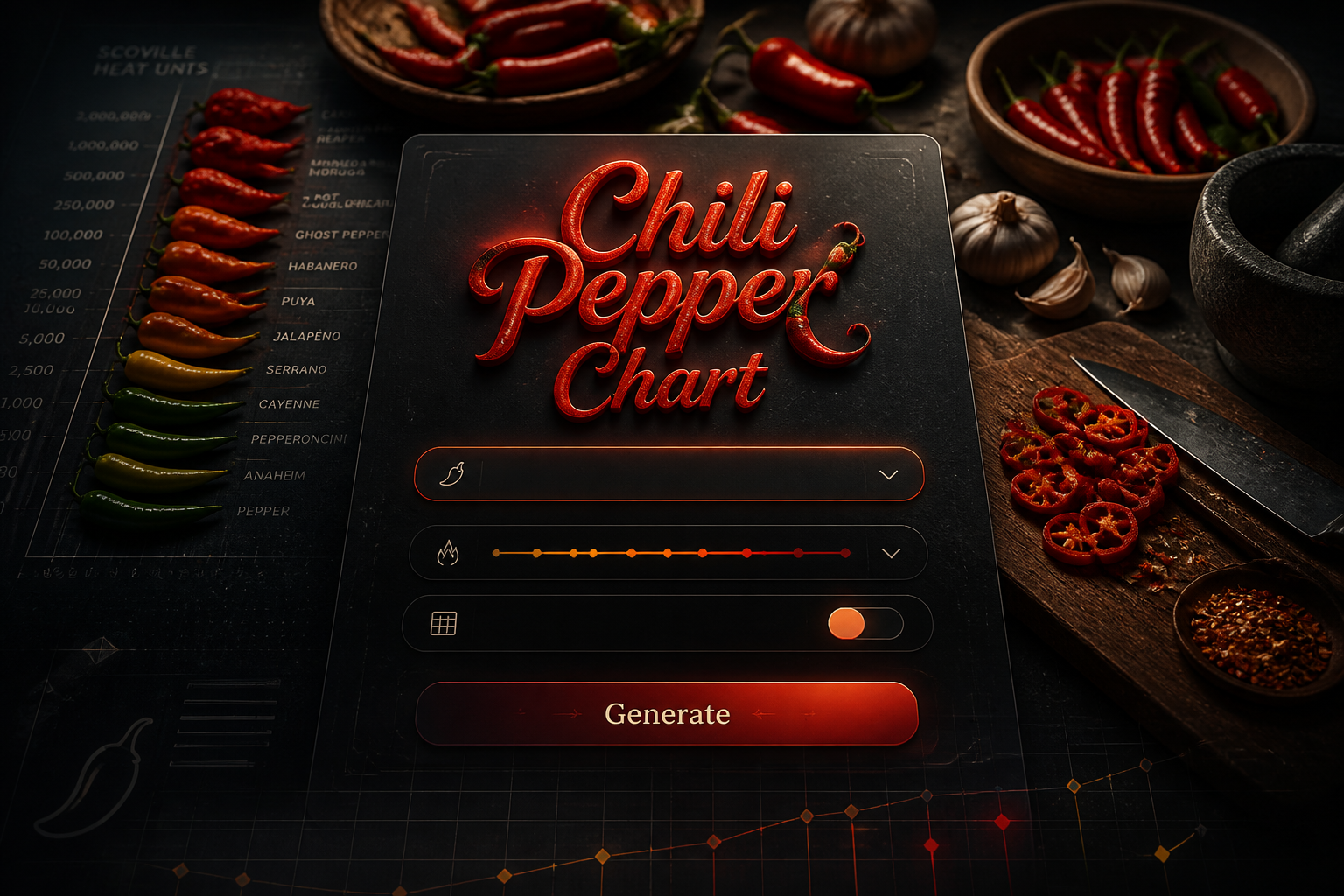
Scoville Scale Chart — Chili Pepper Heat Levels
| Pepper Name | Scoville Heat Units (SHU) | Heat Category | Flavour and Use Notes |
|---|---|---|---|
| Pepper X | 2,693,000+ SHU (unofficial) | Extreme — beyond measurement | Cultivated by Ed Curlin — not yet officially verified by Guinness as of 2026. |
| Carolina Reaper | 1,641,183 SHU average (2,200,000 peak) | Extreme — beyond most human tolerance | Certified hottest pepper in the world by Guinness 2013. Fruity tropical flavour under the extreme heat. |
| Trinidad Moruga Scorpion | 1,200,000 to 2,009,231 SHU | Extreme | Deeply fruity flavour with delayed onset of intense heat. |
| 7 Pot Douglah | 923,000 to 1,853,936 SHU | Extreme | Chocolate brown colour. One of the hottest naturally occurring peppers. |
| 7 Pot Primo | 800,000 to 1,469,000 SHU | Extreme | Developed by Troy Primeaux. Has a scorpion-like tail. |
| Ghost Pepper (Bhut Jolokia) | 855,000 to 1,041,427 SHU | Super Hot | First chili to exceed 1 million SHU. Used in Indian cooking and military-grade pepper spray. |
| Red Savina Habanero | 350,000 to 577,000 SHU | Super Hot | Held the Guinness World Record from 1994 to 2006. |
| Habanero | 100,000 to 350,000 SHU | Very Hot | Fruity citrus flavour. Common in Caribbean and Mexican cooking. |
| Scotch Bonnet | 100,000 to 350,000 SHU | Very Hot | Similar heat to habanero. Sweet fruity flavour common in Jamaican cuisine. |
| Datil Pepper | 100,000 to 300,000 SHU | Very Hot | Fruity flavour. Grown primarily in St. Augustine, Florida. |
| Thai Chili (Bird's Eye) | 50,000 to 100,000 SHU | Hot | Small and very potent. Widely used in Southeast Asian cooking. |
| Cayenne Pepper | 30,000 to 50,000 SHU | Hot | Thin walled and often dried and ground. Classic hot sauce ingredient. |
| Tabasco Pepper | 30,000 to 50,000 SHU | Hot | The base of Tabasco sauce. Tangy acidic flavour. |
| Serrano Pepper | 10,000 to 23,000 SHU | Medium Hot | Crisp and bright flavour. Very common in Mexican cooking — used fresh. |
| Jalapeño | 2,500 to 8,000 SHU | Medium | The most widely consumed hot pepper in the US. Green = unripe and bright. Red = ripe and slightly sweeter. |
| Chipotle | 2,500 to 8,000 SHU | Medium | A smoked and dried jalapeño. Rich smoky flavour — used in sauces and stews. |
| Fresno Pepper | 2,500 to 10,000 SHU | Medium | Similar to jalapeño but slightly hotter and fruitier at red stage. |
| Poblano (fresh) / Ancho (dried) | 1,000 to 2,000 SHU | Mild | Large thick-walled pepper. Earthy rich flavour — basis of mole sauce. |
| Banana Pepper | 0 to 500 SHU | Very Mild | Sweet tangy flavour with almost no heat. |
| Bell Pepper | 0 SHU | No heat | Contains no capsaicin. Sweet varieties used raw, roasted, and cooked. |
Source: Scoville organoleptic test and HPLC chemical analysis — American Spice Trade Association reference data
What Is the Scoville Scale?
- The Scoville scale was created in 1912 by American pharmacist Wilbur Scoville. His original method — the Scoville Organoleptic Test — diluted pepper extract in sugar water until trained tasters could no longer detect heat. The dilution factor became the Scoville Heat Unit (SHU) value.
- Modern measurement uses High-Performance Liquid Chromatography (HPLC) to directly measure capsaicinoid concentration in parts per million. This value is then multiplied by a conversion factor to give the SHU equivalent.
- The heat in chili peppers comes from capsaicin and related compounds called capsaicinoids. Capsaicin binds to TRPV1 pain receptors in the mouth and throat — it does not cause actual tissue damage but the pain signal is identical to genuine burning.
- Capsaicin is fat-soluble not water-soluble. Drinking water does not neutralise the burn — it spreads the capsaicin further. Milk (casein protein), bread, rice, or sugar are more effective at reducing capsaicin burn.
Scoville Heat Unit Reference — Common Products
| Product | Approximate SHU |
|---|---|
| Bell pepper | 0 SHU |
| Pepperoncini | 100 to 500 SHU |
| Frank's RedHot Original | 450 SHU |
| Cholula Hot Sauce | 1,000 to 2,000 SHU |
| Sriracha | 2,200 SHU |
| Tabasco Original Red Sauce | 2,500 to 5,000 SHU |
| Crystal Hot Sauce | 3,000 to 4,000 SHU |
| Jalapeño (fresh) | 2,500 to 8,000 SHU |
| El Yucateco Habanero Sauce | 9,000 SHU |
| Police-grade pepper spray | 2,000,000 to 5,300,000 SHU |
Source: Manufacturer data and independent HPLC testing
Scoville Heat Comparator
Enter any two peppers below to see their Scoville heat units side-by-side with a visual heat bar. Click any pepper in the full database to pre-fill an input field.
Frequently Asked Questions
What is the hottest pepper in the world?
The Carolina Reaper holds the Guinness World Record as of 2023 with an average of 1,641,183 SHU. Ed Curlin claims his Pepper X exceeds this at over 2.6 million SHU but it had not yet received official Guinness verification at the time of this publication.
What does SHU stand for?
SHU stands for Scoville Heat Units — the measurement scale for the pungency (spiciness) of chili peppers developed by Wilbur Scoville in 1912.
How hot is a jalapeño on the Scoville scale?
A jalapeño measures 2,500 to 8,000 SHU — mild to medium on the scale. Most fresh jalapeños sold in supermarkets fall toward the lower end of this range.
What stops chili pepper burn?
Capsaicin is fat-soluble — dairy products like milk, yoghurt, or sour cream contain casein proteins that bind to capsaicin and wash it away from receptors. Bread, rice, or sugar also help — water spreads the capsaicin rather than removing it.
Is the Carolina Reaper dangerous to eat?
Eating a Carolina Reaper is intensely painful but not directly toxic — capsaicin does not cause actual tissue damage. However people with pre-existing heart conditions, high blood pressure, or severe acid reflux should avoid extreme chili consumption as the stress response can trigger cardiac symptoms.
How hot is ghost pepper compared to jalapeño?
A ghost pepper averages approximately 855,000 to 1,041,000 SHU. A jalapeño averages 2,500 to 8,000 SHU — making the ghost pepper roughly 100 to 400 times hotter than a jalapeño.
What pepper is used in pepper spray?
Oleoresin capsicum (OC) derived primarily from cayenne and habanero peppers is the active ingredient in pepper spray. Police-grade pepper spray is approximately 2,000,000 to 5,300,000 SHU — vastly hotter than even the hottest eating peppers.
What is the mildest chili pepper?
Bell peppers have 0 SHU — they contain no capsaicin at all. Banana peppers and pepperoncini are among the mildest chili varieties with 0 to 500 SHU.