Eye Color Chart
The Eye Color Chart is a reference tool covering eye color chart, human eye color chart, rare eye colors chart, eye color genetics chart. Use the chart below to look up values instantly. Printable and downloadable versions are available on this page.
Eye Color Inheritance Predictor
Enter both parents' eye colors to see a probability breakdown of possible offspring eye colors.
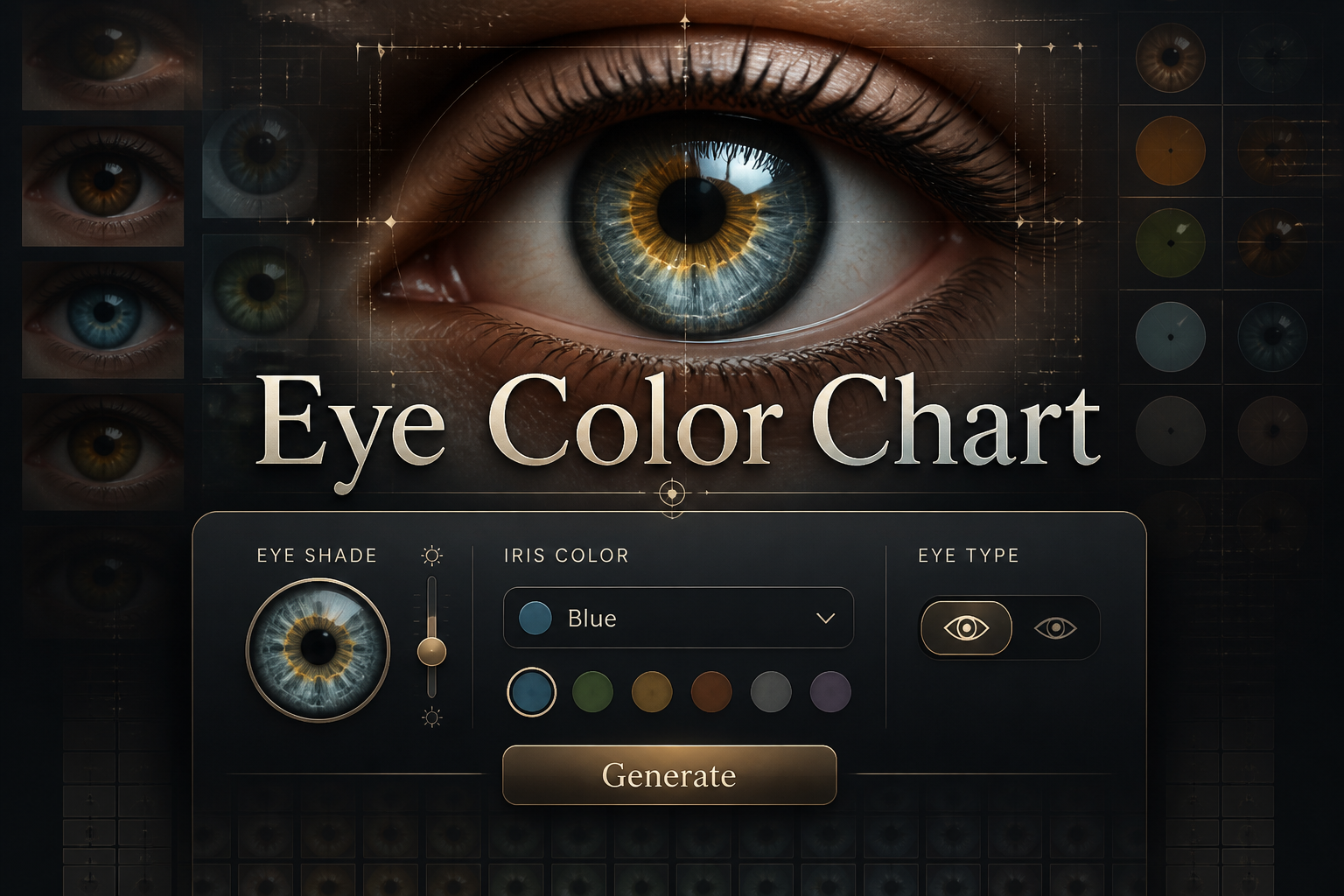
Eye Color Chart — Types and Frequency
| Eye Colour | Estimated Global Prevalence | Melanin Level in Iris | Primary Regions |
|---|---|---|---|
| Brown | 55 to 79% of global population | High melanin | Most common worldwide — dominant in Africa, Asia, South America, and Southern Europe |
| Blue | 8 to 10% | Very low melanin — colour from light scattering (Tyndall effect) | Most common in Northern and Eastern Europe, Scandinavia, Baltic states |
| Hazel | 5% | Medium melanin with green and brown specks | Common in Europe, Middle East, and Brazil |
| Amber | 5% | Yellow-golden melanin deposit (lipochrome) | Uncommon — found in Europe, Asia, and South America |
| Green | 2% | Low to medium melanin with yellow pigment | Rarest common colour — most prevalent in Northern and Central Europe |
| Grey | 3% | Very low melanin with high collagen in the stroma | Common in Northern and Eastern Europe |
| Red or Violet | Extremely rare — associated with albinism | No melanin in iris — colour from blood vessels showing through | People with albinism (ocular or oculocutaneous) |
| Heterochromia | Less than 1% | Different melanin levels in each iris | Can be hereditary or acquired — sometimes associated with specific conditions |
Source: American Academy of Ophthalmology and NCBI — World Atlas of eye colour distribution
Eye Colour Genetics Chart
Eye colour is a polygenic trait — meaning it is controlled by multiple genes rather than a single gene — and the inheritance pattern is more complex than the simple dominant-recessive model taught in basic biology.
| Parent 1 Eye Colour | Parent 2 Eye Colour | Most Likely Child Eye Colour | Approximate Probability Notes |
|---|---|---|---|
| Brown | Brown | Brown most likely | Approximately 75% brown, 18% green or hazel, 7% blue — two brown-eyed parents can have a blue-eyed child |
| Brown | Blue | Brown most likely | Approximately 50% brown, 37% green or hazel, 13% blue |
| Blue | Blue | Blue most likely | Approximately 99% blue, but a small chance of green — very rarely brown |
| Brown | Green | Brown or green | Approximately 50% brown, 37% green, 13% blue |
| Green | Green | Green most likely | Approximately 75% green, 24% blue, 1% brown |
| Blue | Green | Blue or green | Approximately 50% blue, 50% green — very rarely brown |
Source: University of Rochester Medical Center — Genetics of Eye Color and NCBI Genetics Reference
What Determines Eye Colour
- Melanin — the amount and type of melanin (the same pigment that colours skin and hair) in the iris determines eye colour. High melanin produces brown eyes. Low melanin with light scattering produces blue eyes. Medium amounts produce green, hazel, or grey.
- The Tyndall effect — blue eyes have very little melanin in the iris. The blue colour is produced by the Tyndall effect — fine particles in the iris scatter short-wavelength blue light more than longer-wavelength light, similar to why the sky appears blue.
- Genetics — eye colour is influenced by multiple genes including OCA2, HERC2, SLC45A2, and others. The HERC2 gene near OCA2 plays a particularly strong role in switching between blue and brown eye colour.
- Changes with age — many babies are born with blue or grey eyes because melanin production is not yet complete. Eye colour typically stabilises by age 3. Some adults experience gradual darkening — and certain conditions, injuries, or medications can change eye colour in adulthood.
Eye Color Inheritance Predictor
Enter both parents' eye colors to see a probability breakdown of possible offspring eye colors based on polygenic inheritance models.
Frequently Asked Questions
What is the rarest eye colour?
Green is the rarest of the commonly occurring eye colours at approximately 2 percent of the global population. Red or violet eyes associated with albinism are rarer but are caused by a different mechanism — the absence of any melanin rather than a small amount.
What percentage of people have blue eyes?
Approximately 8 to 10 percent of the global population has blue eyes. Blue eyes are most concentrated in Northern and Eastern Europe — over 80 percent of people in Estonia and Finland have blue eyes.
Can two blue-eyed parents have a brown-eyed child?
This is extremely rare — two blue-eyed parents producing a brown-eyed child occurs in fewer than 1 percent of cases based on genetic models. It is theoretically possible through rare allele combinations but should prompt consideration of other explanations.
Can eye colour change as an adult?
Slight changes in eye colour can occur with age, disease, or certain medications. Significant sudden colour changes in one eye should be evaluated by an ophthalmologist as they can indicate conditions such as glaucoma, Horner syndrome, or iris melanoma.
What is heterochromia?
Heterochromia is a condition where the two eyes are different colours or where one iris contains two distinct colours. It can be hereditary (often harmless) or acquired from injury, disease, or certain medications like prostaglandin glaucoma drops.
Are hazel eyes green or brown?
Hazel eyes contain both brown and green pigment — the exact appearance varies with lighting, mood, and what colours surround the iris. Hazel eyes typically appear more green in bright light and more brown in dim lighting.
Why do babies change eye colour?
Many babies are born with blue, grey, or lighter eyes because melanin production in the iris is not complete at birth. Melanin production increases during the first 6 to 12 months and eye colour stabilises by approximately age 3 — though it can continue shifting slightly through childhood.
What percentage of people have brown eyes?
Brown is by far the most common eye colour globally at approximately 55 to 79 percent of the world's population. It is particularly dominant in Africa, South and East Asia, and South America where it represents 95 percent or more of the population.