Curl Pattern Chart
The Curl Pattern Chart is a reference tool covering curl pattern chart, curl type chart 1-4c, curly hair type chart, 4c curl chart. Use the chart below to look up values instantly. Printable and downloadable versions are available on this page.
Find Your Curl Type
Answer 8 questions to get your Andre Walker classification and a personalised care routine.
Curl Type Quiz
Answer 8 questions about your curl shape, coil size, strand thickness, and porosity to get your Andre Walker classification and a customised care routine.
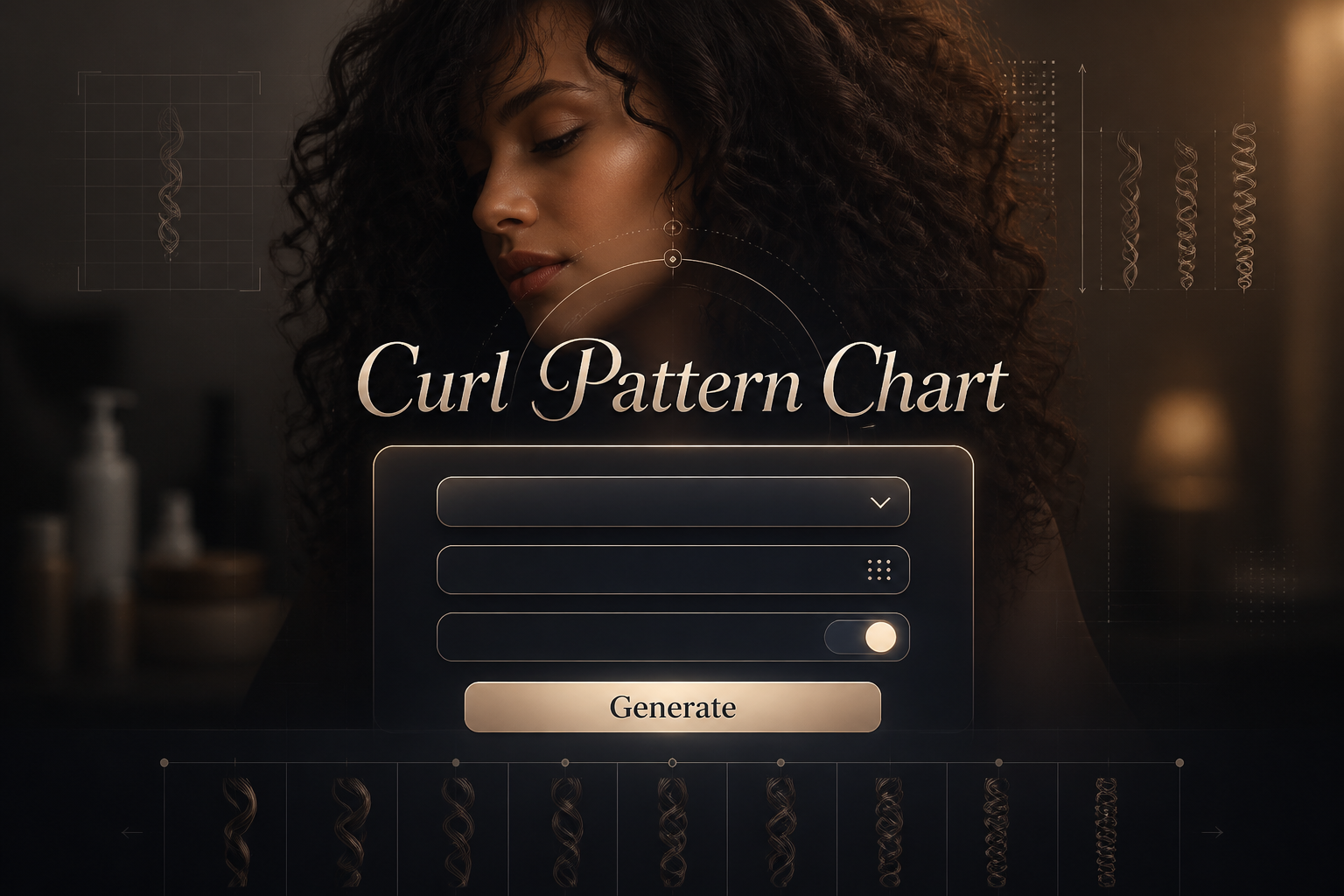
Curl Pattern Chart — Types 2 Through 4
| Curl Type | Pattern Name | Visual Pattern Description | Curl Diameter | Texture Feel | Shrinkage |
|---|---|---|---|---|---|
| 2A | Loose Wave | Soft S-wave starting at mid-shaft | No defined diameter — flat wave | Fine and silky | 5 to 15% |
| 2B | Defined Wave | Clear S-wave from root to tip with more body | Flat S-shape | Medium texture with slight frizz | 10 to 20% |
| 2C | Deep Wave | Strong S-wave with frizz and some curl | Wide S-shape | Coarser and thicker | 15 to 25% |
| 3A | Loose Curl | Large springy ringlets with shine | Approx. 1 inch — size of a wine cork | Soft and bouncy | 20 to 30% |
| 3B | Medium Curl | Medium bouncy spirals | About the diameter of a permanent marker | Dense and springy | 30 to 40% |
| 3C | Tight Curl | Tight corkscrew spirals | About the diameter of a pencil | Dense and voluminous | 40 to 50% |
| 4A | Soft Coil | Defined tight S-coil | About the diameter of a crochet hook | Soft but fragile and prone to dryness | 50 to 60% |
| 4B | Z-Pattern Coil | Sharp Z or zigzag bends — angular pattern with less circular definition | Angular — no circular coil | Dense and tightly packed | 60 to 70% |
| 4C | Tight Coil | Tightest coil with least definition and most shrinkage | Smaller than a pencil — nearly invisible coil | Most fragile curl type | 70 to 75% |
Source: NaturallyCurly — Andre Walker Hair Typing System with community extensions for 3C and 4 subtypes
Curl Porosity Chart
| Porosity Level | Float Test Result | Signs in Daily Use | Best Products and Techniques |
|---|---|---|---|
| Low Porosity | Hair floats for 4+ minutes | Water beads on the hair. Products sit on top and cause build-up. Takes long to get wet and long to dry. | Lightweight water-based leave-ins. Apply to warm damp hair to slightly open the cuticle. Clarify regularly with a clarifying shampoo. |
| Medium Porosity | Hair sinks slowly over 2–4 minutes | Absorbs and retains moisture well. Most products work. Low maintenance. | Most product types work well. Maintain with regular protein and moisture balance. |
| High Porosity | Hair sinks quickly under 2 minutes | Absorbs moisture fast but loses it equally fast. Hair feels dry shortly after washing. Tangles easily. | Heavy sealants — butters, oils, and thick creams. LOC or LCO method. Regular protein treatments to fill cuticle gaps. |
Product Guide by Curl Pattern
| Curl Type | Recommended Products | Styling Techniques | Things to Avoid |
|---|---|---|---|
| Type 2 — Wavy | Lightweight mousse, curl-enhancing cream, sea salt spray | Scrunch product into damp hair. Diffuse or air dry without touching. | Heavy butters and oils that weigh waves flat. |
| Type 3 — Curly | Leave-in conditioner, curl cream, hold gel | Rake-and-shake or shingling. Diffuse or air dry. | Brushing dry — always detangle wet with conditioner. |
| Type 4 — Coily | Rich leave-in, shea butter, oil, heavy cream | LOC or LCO method. Protective styles. Baggy method for moisture retention. | Dry combing. Protein overload without sufficient moisture balance. |
Curl Type Quiz
Answer 8 questions covering your curl shape, coil size, strand thickness, and porosity to get your personalised curl type classification and a customised care routine.
Curl Type Quiz
Answer 8 questions about your curl shape, coil size, strand thickness, and porosity to get your Andre Walker classification and a customised care routine.
Frequently Asked Questions
How do I determine my curl pattern?
Wash your hair and allow it to air dry completely without any product applied. The natural pattern that forms when fully dry is your curl type — match it to the descriptions in the chart above.
What is the difference between 3B and 3C curls?
Type 3B forms medium ringlets approximately the diameter of a permanent marker — bouncy and well-defined. Type 3C has tighter corkscrew spirals about the width of a pencil — denser, more voluminous, and with more shrinkage.
Can your curl pattern change?
Your natural curl pattern is genetically determined and does not permanently change without chemical processing. Heat damage can loosen curl pattern over time — this damage may be permanent if the cuticle is compromised.
What is curl shrinkage and is it normal?
Shrinkage is the difference between your hair's wet stretched length and its dry curled length — it indicates healthy elasticity and is completely normal. Type 4C hair can shrink up to 75 percent of its actual length.
What is the LOC method?
The LOC method applies products in sequence — Liquid (water or leave-in conditioner), Oil, then Cream — to maximise moisture retention primarily in Type 4 hair. The oil seals moisture from the leave-in and the cream locks it in.
What products are best for wavy hair?
Wavy hair benefits from lightweight products — mousses, curl-enhancing sprays, and light gels that enhance the wave without weighing it flat. Heavy creams and butters designed for Type 4 hair will make Type 2 waves limp.
Is 4C the most fragile curl type?
Yes — Type 4C has the tightest coil structure meaning each strand bends many more times per inch making it the most prone to breakage from mechanical manipulation. Minimising manipulation through protective styles and gentle detangling is the key to retaining length.
What is the difference between 4A and 4B hair?
Type 4A has a defined tight S-shaped coil pattern about the size of a crochet hook — the spiral is visible. Type 4B has a sharper Z-pattern or zigzag shape with much less visible curl definition — it appears more densely packed with less circular structure.