Child Sleep Chart by Age
The Child Sleep Chart by Age is a reference tool covering child sleep chart by age, baby sleep chart, toddler sleep chart, how much sleep does a child need. Use the chart below to look up values instantly. Printable and downloadable versions are available on this page.
Child Sleep Need Calculator
Enter your child's age to get recommended sleep hours, nap guidance, and a bedtime suggestion.
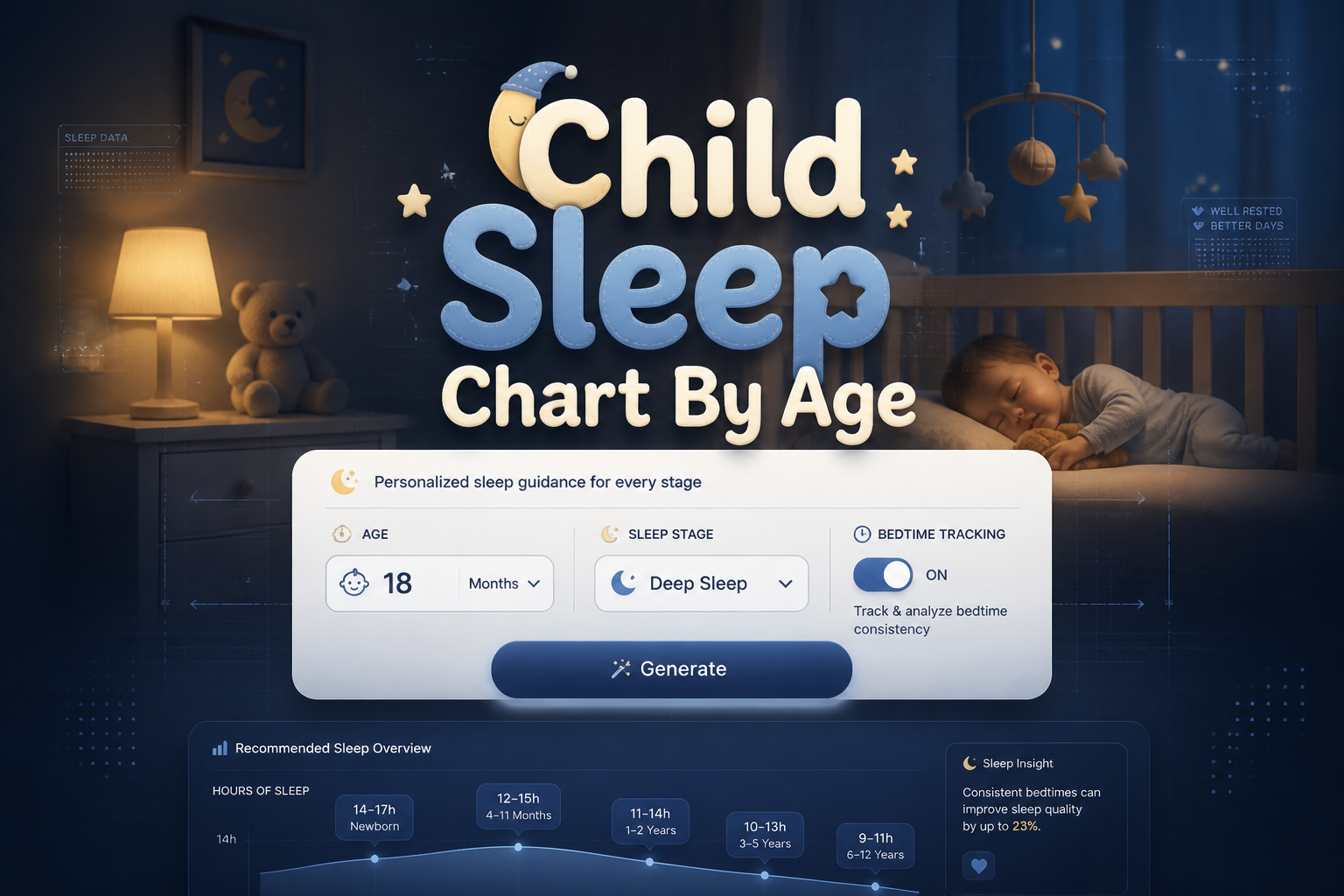
Child Sleep Requirements Chart by Age
Recommended Sleep Hours by Age — American Academy of Sleep Medicine
| Age Group | Recommended Total Sleep Per 24 Hours | Typical Nighttime Sleep | Typical Naps |
|---|---|---|---|
| Newborns 0–3 months | 14–17 hours (NSF) — AASM recommends 14–17 | Sleep occurs in 2–4 hour intervals around the clock — no consolidated night sleep | Frequent naps throughout day and night — no distinction |
| Infants 4–12 months | 12–16 hours including naps | 9–11 hours (with 1–3 night wakings common) | 2–3 naps totalling 2–4 hours per day |
| Toddlers 1–2 years | 11–14 hours including naps | 10–12 hours | 1 nap of 1–3 hours per day |
| Preschool 3–5 years | 10–13 hours including naps | 10–12 hours | 1 nap of 45 min – 1.5 hours (optional — many drop nap by age 4) |
| School age 6–12 years | 9–12 hours | 9–12 hours | No naps needed |
| Teens 13–18 years | 8–10 hours | 8–10 hours | No naps needed (though beneficial if sleep-deprived) |
| Young adults 18–25 years | 7–9 hours | 7–9 hours | Optional naps |
| Adults 26–64 years | 7–9 hours | 7–9 hours | Optional naps |
Source: American Academy of Sleep Medicine (AASM) and National Sleep Foundation (NSF) sleep duration recommendations 2015
Signs of Insufficient Sleep by Age
Signs Your Child Is Not Getting Enough Sleep
| Age Group | Behavioural Signs of Sleep Deprivation | Physical Signs |
|---|---|---|
| Infants (0–12 months) | Difficult to soothe, excessive crying, inability to stay awake during feeding | Rubbing eyes, yawning, pulling ears, glazed expression |
| Toddlers (1–3 years) | Hyperactivity (opposite of what adults show), tantrums, clinginess, poor coordination | Dark under-eye circles, falling asleep in the car frequently, waking irritable |
| Preschool (3–5 years) | Difficulty focusing, emotional outbursts, resistance to bedtime despite visible tiredness | Yawning throughout morning activities, sleeping past usual wake time on weekends |
| School age (6–12 years) | Difficulty concentrating, falling asleep in class, irritability, poor academic performance | Fatigue by early afternoon, difficulty waking in the morning |
| Teens (13–18 years) | Excessive daytime sleepiness, mood swings, decreased motivation, falling asleep within 5 minutes of lying down | Social withdrawal, increased caffeine use, later and later sleep timing |
Sleep Schedule Tips by Age
- Newborns (0–3 months) — Sleep cannot be scheduled at this stage. Feed on demand and sleep when the baby sleeps. Night and day distinctions begin to develop around 6 to 8 weeks with light exposure cues.
- Infants (4–12 months) — Consistent bedtime routines (bath, feed, story, sleep) help signal sleep. Most babies are ready for sleep training between 4 to 6 months. Aim for a bedtime between 6:00 and 8:00 PM.
- Toddlers and preschoolers — Maintain the same bedtime and wake time every day including weekends. A 20 to 30 minute wind-down routine without screens is highly effective. Nap should end by 3:00 PM to avoid interference with nighttime sleep.
- School-age children — No screens in the bedroom and no screens within 1 hour of bedtime. The light from screens suppresses melatonin production. Most children this age need 9 to 12 hours — a 9:00 PM bedtime with a 7:00 AM wake time provides 10 hours.
- Teenagers — Teens experience a biological shift toward later sleep timing (delayed sleep phase). School start times conflicting with this biology are a documented public health concern. Create a screen-free wind-down period and keep weekend sleep timing within 1 hour of weekday timing to avoid social jet lag.
Child Sleep Need Calculator
Enter your child's age to get the recommended total sleep hours, nap duration, and bedtime suggestion — and compare their current sleep to age-specific guidelines.
Frequently Asked Questions
How many hours should a 7-year-old sleep?
The American Academy of Sleep Medicine recommends 9 to 12 hours of sleep per night for school-age children aged 6 to 12. A 7-year-old consistently sleeping fewer than 9 hours is likely to show signs of sleep deprivation.
Is it normal for a 2-year-old to still take naps?
Yes — toddlers aged 1 to 2 typically need 11 to 14 total hours of sleep per day including 1 to 2 hours of napping. Most toddlers continue napping until age 3 to 4 and some until age 5.
How much sleep does a newborn need?
Newborns (0 to 3 months) need 14 to 17 hours of total sleep per 24 hours. This sleep occurs in short intervals throughout the day and night — consolidated nighttime sleep does not develop until approximately 3 to 6 months of age.
At what age do kids stop needing naps?
Most children naturally drop naps between ages 3 and 5. Signs that the afternoon nap is no longer needed include taking more than 30 minutes to fall asleep at naptime or struggling to fall asleep at the usual bedtime after napping.
Is 8 hours of sleep enough for a teenager?
The minimum recommended sleep for teenagers is 8 hours but most benefit from 9 to 10 hours. Chronic sleep deprivation in teenagers is associated with poor academic performance, mood disorders, increased accident risk, and obesity.
Why do teenagers stay up so late?
Adolescence brings a biological shift in circadian rhythm that delays melatonin production by 1 to 3 hours relative to children and adults. This is not laziness — it is a documented physiological change that makes it genuinely difficult for teenagers to fall asleep before 11:00 PM.
How do I get my toddler to sleep through the night?
Establishing a consistent bedtime routine and ensuring the toddler's total sleep needs are being met (11 to 14 hours) are the first steps. Most sleep consultants recommend age-appropriate sleep training methods starting around 4 to 6 months of age when biological capacity for longer sleep consolidation develops.
What is a good bedtime for a 10-year-old?
A 10-year-old needs 9 to 12 hours of sleep. If the school day starts at 7:30 AM and the child needs to wake at 6:30 AM a 8:30 to 9:30 PM bedtime would provide 9 to 10 hours of sleep.