Tip Calculator
A tip calculator helps you quickly figure out how much to tip at a restaurant, bar, or for any service. Enter your bill amount, select a tip percentage, and optionally split the bill between multiple people to see exactly what each person owes.
What Is a Tip Calculator?
A tip calculator is a tool that computes the gratuity amount on a bill, adds it to the subtotal to produce a total, and optionally divides the result among a group of people. It removes the mental math required when dining out, ordering delivery, or paying for personal services. Instead of estimating 15 or 20 percent in your head, you enter the exact bill amount, choose a tip percentage, and get a precise dollar figure instantly.
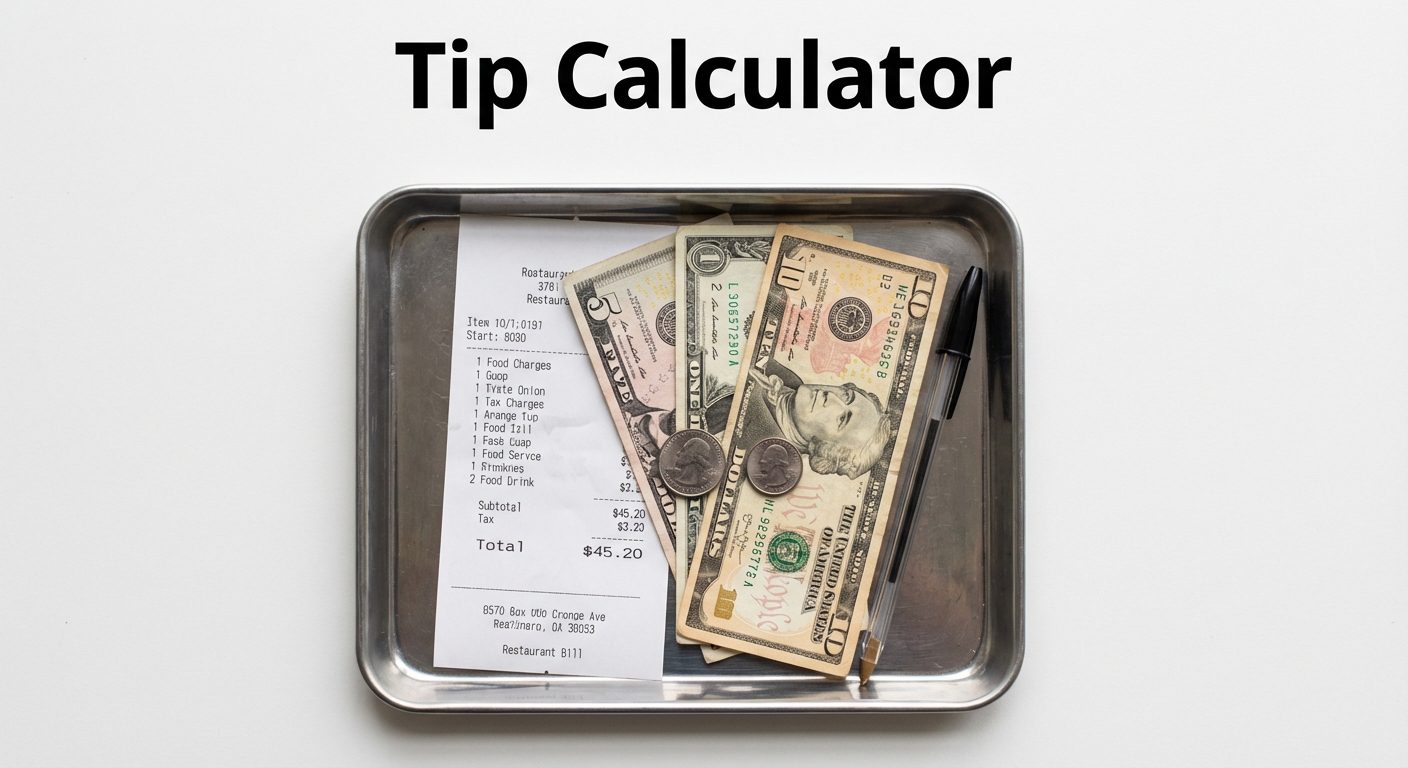
Tip calculators are useful for restaurants, bars, hotel room service, food delivery, taxi and rideshare rides, hair salons, spa appointments, and anywhere gratuity is customary. You can use this calculator for both simple individual bills and group dining where the total needs to be divided evenly. For additional financial calculations, see our pricing calculator for cost estimates.
How to Calculate a Tip
The Basic Tip Formula
The formula for calculating a tip is straightforward:
Total = Bill Total + Tip Amount
Per Person = Total / Number of People
For example, on an $85 bill with a 20% tip: tip = $85 x 0.20 = $17.00, total = $85 + $17 = $102.00. If split between 2 people, each person pays $51.00. The panel on the left does this instantly using whatever inputs you provide.
Tip on Pre-Tax vs Post-Tax Amount
Many bills show a subtotal before tax and a total that includes sales tax. Tipping on the pre-tax subtotal is technically standard and slightly reduces the tip amount. Tipping on the post-tax total is more common in practice because it is simpler. The difference is small: on a $100 pre-tax bill in a state with 8% sales tax, tipping 20% on the subtotal gives $20 while tipping 20% on the post-tax total gives $21.60. Either approach is acceptable. This calculator uses whichever bill amount you enter, so enter the pre-tax or post-tax amount based on your preference. To find exactly how much tax was added to your bill, use our sales tax calculator before calculating the tip.
Standard Tip Percentages by Service
Tip expectations vary by service type. The following ranges reflect current US norms as tracked by the National Restaurant Association tipping statistics and industry surveys.

Restaurants (15-20%)
Full-service restaurant servers typically expect 15 to 20 percent for average service and 20 to 25 percent for excellent service. At upscale restaurants, 20 percent is now considered the standard starting point. For counter service or fast casual where you order at the counter, tipping is optional and typically 10 to 15 percent if you choose to leave one. Budget at least 18 to 20 percent as a baseline for sit-down restaurants where a server attends to your table throughout the meal.
Bars and Delivery (15-20%)
For bartenders, $1 to $2 per drink is the standard minimum, or 15 to 20 percent of the tab for larger bar tabs. For food delivery, 15 to 20 percent of the order total (with a $3 to $5 minimum) is standard. Delivery drivers face parking challenges, weather conditions, and often cover their own transportation costs, so tipping on the lower end of the range should only reflect truly exceptional circumstances rather than routine service.
Hair Salons and Spas (15-25%)
For hair stylists, colorists, massage therapists, aestheticians, and nail technicians, 15 to 20 percent is standard and 20 to 25 percent for exceptional work. Tipping the salon owner, if they personally provide the service, was historically considered optional but is now increasingly expected at the same rate as other service providers. For spa packages, check if gratuity is already included before adding additional tip.
Rideshare and Taxi (15-20%)
Rideshare apps like Uber and Lyft suggest tip amounts after each ride. Standard is 15 to 20 percent for a clean vehicle and competent driving, with 20 to 25 percent for exceptional service such as help with luggage or navigating difficult conditions. Traditional taxi drivers typically expect 15 to 20 percent. Tip more generously for longer rides, late-night pickups, or rides during severe weather.
How Tip Pooling Works
Tip pooling is a practice where all or a portion of tips collected by servers, bartenders, and other tipped employees are combined and redistributed among the staff according to a predetermined formula. This is common in many restaurants and is governed by federal law. According to Department of Labor tipping laws, employers can require tip pooling as long as the pool only includes employees who customarily receive tips.

Tip Out Percentage for Support Staff
In many restaurants, servers are required to tip out a percentage of their sales or tips to support staff such as bussers, food runners, hosts, and bartenders. A typical tip-out structure might require a server to contribute 1 to 2 percent of total sales to bussers, 0.5 to 1 percent to food runners, and 1 to 2 percent to bartenders. The exact percentages vary widely by restaurant and state law. This means that when you leave a 20% tip, your server may retain only 15 to 17 percent after tip-out obligations. Understanding tip pooling helps explain why service industry advocates recommend erring on the higher end of tip percentages for attentive service.
Tipping Etiquette in the United States
Tipping is a deeply embedded part of American service culture, with Emily Post tipping etiquette guidelines dating back over a century. In the US, server wages are often legally set below the standard minimum wage with the expectation that tips will bring total compensation up to or above it. This system means that leaving no tip, except in cases of genuinely poor service, can effectively result in a server earning less than minimum wage for the time spent serving you.
A general rule: tip based on the quality of service, not the quality of the food. Kitchen errors are not the server's fault. If something was wrong with your meal that the server had no control over, that is not a reason to reduce the tip. Reduced tips are appropriate for consistently inattentive service, incorrect orders that were the server's error, or unprofessional conduct. A 10 to 12 percent tip communicates dissatisfaction clearly without withholding tip entirely.
Tip Calculator Examples
Example: $85 Dinner, 20% Tip, Split 2 Ways
Total = $85 + $17 = $102.00
Per person = $102 / 2 = $51.00
Each person at a two-person dinner pays $51.00 when splitting a $102 total (including a 20% tip on an $85 bill). If one person orders significantly more than the other, you may want to calculate individual tabs before splitting, or use the AI option to work through an uneven split.
Frequently Asked Questions
Should I tip on tax?
Tipping on the pre-tax subtotal is the traditional approach and reduces the tip amount slightly. Tipping on the post-tax total is more common in practice and easier to calculate. The difference on most bills is small — on a $100 bill in a state with 8% sales tax, the difference between tipping 20% pre-tax vs post-tax is $1.60. Either is acceptable and the choice is entirely yours.
What is a good tip percentage?
For full-service restaurants, 18 to 20 percent is the current standard for average service, with 20 to 25 percent for excellent service. Fifteen percent, once considered the standard, is now seen by many in the industry as a below-average tip for sit-down restaurant service. For counter service, coffee shops, and fast casual, tipping is optional but 10 to 15 percent is appreciated.
How do you calculate a 20% tip?
To calculate a 20% tip mentally, move the decimal point one place to the left to get 10% of the bill, then double that number. On an $85 bill: 10% = $8.50, doubled = $17.00. Add $17 to $85 for a $102 total. The calculator on this page does this automatically and also handles splits and custom percentages.
Is it rude to tip 15%?
In today's US restaurant environment, 15% is considered a below-average tip for full table service and may communicate mild dissatisfaction. It is not outright rude, but most servers consider 18% the minimum for adequate service and 20% the standard starting point. For delivery and personal services like hair and spa appointments, 15% is still within the acceptable range.
How does tip pooling work?
Tip pooling combines some or all tips from tipped employees and redistributes them according to a formula set by the employer. Servers typically keep 75 to 90 percent of their tips and contribute the remainder to support staff (bussers, food runners, bartenders). Under the Fair Labor Standards Act, employers can mandate tip pools among employees who customarily receive tips, but cannot include managers or owners in tip pools.