Cash Counter Calculator
A cash counter calculator totals the money in your cash register, drawer, or safe by entering the quantity of each bill and coin denomination. Use the panel on the left to enter your counts and get an instant total, or ask the AI for a detailed breakdown and reconciliation tips.
What Is a Cash Counter Calculator?
A cash counter calculator is a tool that multiplies the quantity of each denomination by its face value and sums the results to produce a grand total. It eliminates manual arithmetic errors that occur during cash counting, which is one of the most common sources of discrepancies in retail, hospitality, and small business environments.
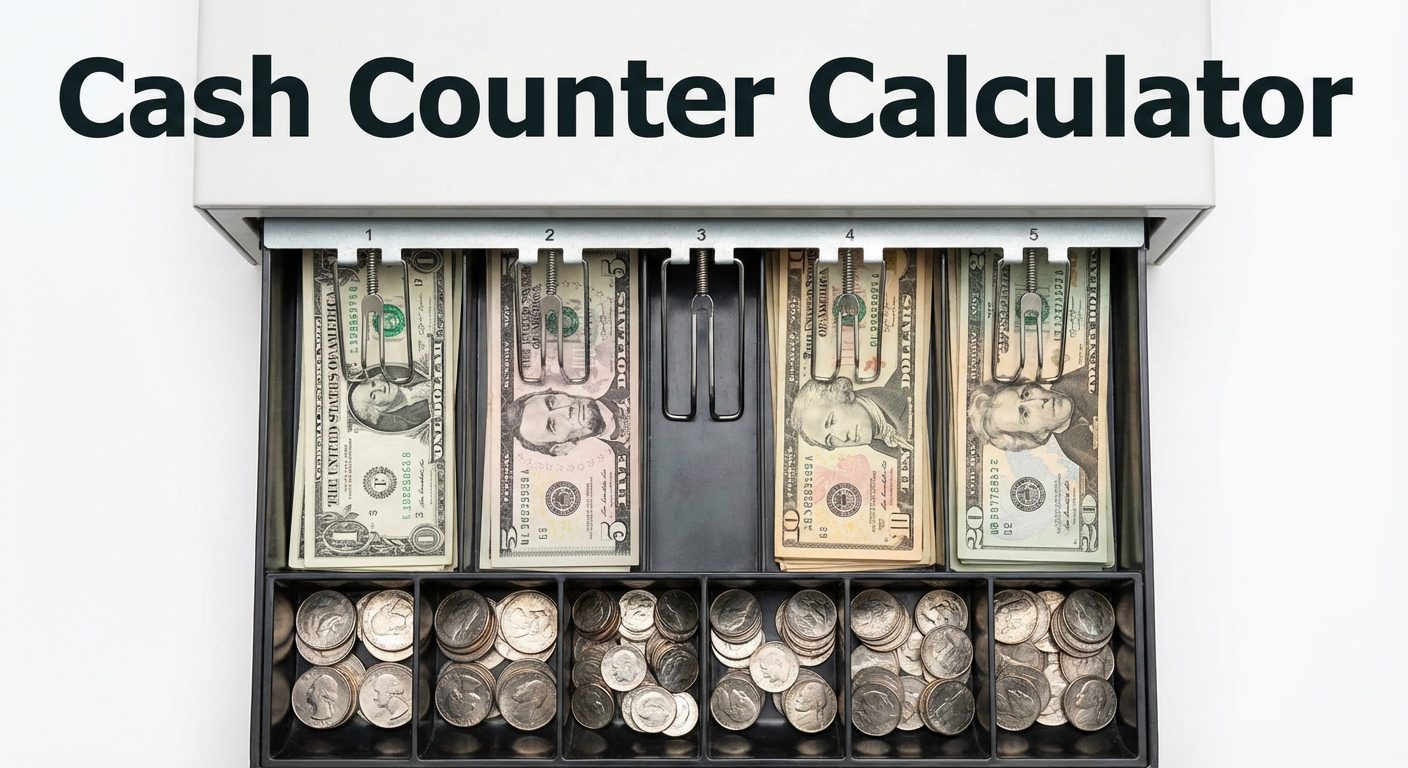
Whether you are counting a starting till, a closing drawer, a petty cash box, or a safe deposit, a cash counter ensures accuracy by separating each denomination into its own quantity field. The result gives you both a denomination-level breakdown and a grand total in seconds. If you only need to count paper currency without coins, our dedicated bill counter calculator provides denomination breakdowns, strap counts, and bundle totals for bills alone. For totaling loose coins and small bills from a change jar or cash box, our change counter calculator includes bill conversion and coin roll summaries. For a unified view of all bills and coins in a single grand total, our money counter calculator combines every denomination together.
How to Use the Cash Counter
Enter the number of each denomination you have physically counted. Start with your largest bills and work down to pennies. You do not need to fill in every field. Leave any denomination at zero if you have none of that type. Click Count Cash and your total appears instantly as a breakdown showing each denomination's subtotal and the grand total.
If you want a full reconciliation analysis or have questions about expected till amounts and over-short variances, use the AI option. The AI will receive all your counts and can answer follow-up questions about cash management, accounting entries, or discrepancy investigation.
US Currency Denominations
Bill Denominations
| Denomination | Value | 10 Bills | 20 Bills | 50 Bills |
|---|---|---|---|---|
| $100 | $100.00 | $1,000 | $2,000 | $5,000 |
| $50 | $50.00 | $500 | $1,000 | $2,500 |
| $20 | $20.00 | $200 | $400 | $1,000 |
| $10 | $10.00 | $100 | $200 | $500 |
| $5 | $5.00 | $50 | $100 | $250 |
| $1 | $1.00 | $10 | $20 | $50 |
Coin Denominations
| Coin | Value | Roll Qty | Roll Value |
|---|---|---|---|
| Quarter | $0.25 | 40 coins | $10.00 |
| Dime | $0.10 | 50 coins | $5.00 |
| Nickel | $0.05 | 40 coins | $2.00 |
| Penny | $0.01 | 50 coins | $0.50 |
How to Count a Cash Register Drawer
Step-by-Step Cash Counting Process
Begin with your largest denomination and work your way down to pennies. Count each denomination separately and record the quantity before moving on. Facing your bills (all in the same direction, portrait-up) before counting reduces errors and speeds up the process. For coins, count by rolling them into standard bank rolls or by grouping them on a flat surface.
Remove the drawer from the register and place it on a flat, private surface.
Count $100 bills first. Record the quantity. Set aside.
Repeat for $50, $20, $10, $5, and $1 bills in that order.
Count quarters, then dimes, nickels, and pennies.
Enter each quantity into the cash counter above.
Compare the total against your expected till or closing balance.
Record any variance (over or short) in your cash log.
Starting and Ending Cash Counts
A starting till (or opening float) is the cash placed in the drawer before a business day begins. A typical retail starting till is $100 to $300, structured to include adequate change for common transactions. An ending count is completed at close of business and compared against the starting till plus net sales to determine whether cash is over or short. Both counts should be witnessed and signed by two people where possible.
Cash Counting Best Practices
Double Counting Method
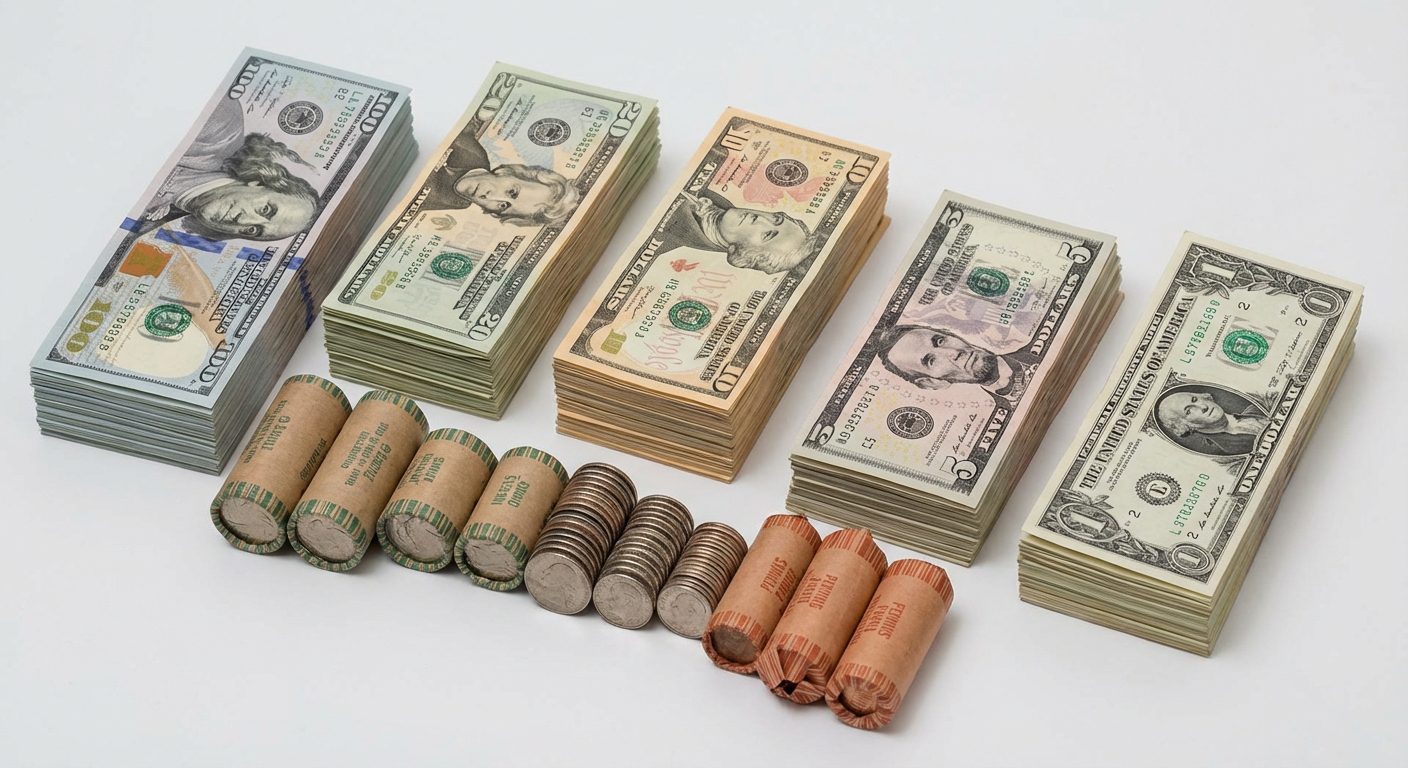
Always count cash twice. The first count establishes your raw total. The second count, ideally done without looking at your first result, confirms accuracy. If the two counts match, record the amount. If they differ, count a third time. Double counting catches transposition errors (such as recording 4 bills as 14) and misidentified denominations (such as $10 bills mixed with $20 bills).
Reconciling Differences
A cash over means you have more cash than expected. A cash short means you have less. Small variances of $1 to $5 are often caused by giving wrong change. Larger variances require investigation. Common causes include incorrect change given to a customer, accepting counterfeit bills, entering incorrect amounts in the register, or unauthorized removal of cash. Document every variance regardless of size. Patterns in the direction or timing of variances often reveal systemic issues.
Petty Cash Tracking
What Is Petty Cash?
Petty cash is a small amount of cash kept on hand for minor business expenses such as office supplies, postage, delivery tips, or emergency purchases. The typical petty cash fund ranges from $50 to $500 depending on the size and nature of the business. According to IRS guidelines for petty cash, petty cash expenditures must be supported by receipts and tracked through a formal petty cash log for tax and audit purposes.

How to Maintain a Petty Cash Log
Each petty cash transaction should be recorded with the date, amount, payee, purpose, and receipt number. The log balance should always equal the fund amount minus total disbursements. When the fund runs low (typically below 25 percent of its starting balance), replenish it to the original amount by writing a check payable to Petty Cash. The SBA small business cash management guidelines recommend reconciling petty cash at least monthly, or more frequently in high-volume environments.
Use this cash counter to verify the physical petty cash balance against your log total. The sum of (cash on hand + total disbursement receipts) should equal the original fund amount at all times.
Cash Count Sheet Templates
A cash count sheet is a physical or digital record used to document denomination counts and reconcile a cash drawer. A standard count sheet lists each denomination in a column with space to record quantity, extended value (quantity times face value), and subtotals for bills and coins. The sheet then compares the counted total against the expected till amount and records any variance with a signature line for the counter and a witness.
This cash counter tool serves as a digital count sheet. For businesses that require a physical paper record, you can print the results and attach them to your daily cash report. For logging and reconciling petty cash funds specifically, use our petty cash calculator which includes a full expense log and reconciliation helper. For in-depth analysis of petty cash accounting, see petty cash accounting explained at Investopedia.
For broader financial planning beyond cash counting, AI business tools on this site can help with profit and loss analysis, budget planning, and other financial tasks.
Frequently Asked Questions
How do I count a safe?
Count a safe the same way you count a drawer: start with the largest bills and work down to coins. For large safe balances, it helps to band bills in standard bundles (100 bills per band for $1s and $5s, 100 bills for $20s and $100s) and count by bundle rather than individual note. Use the cash counter to input your quantities by denomination for the total.
What is a typical starting till amount?
A typical starting till for a retail register ranges from $100 to $300. A common breakdown might be: 4 x $20 ($80), 4 x $5 ($20), 10 x $1 ($10), plus coins totaling approximately $20 to $30. The exact starting amount depends on your average transaction size and how much change your customers are likely to need.
How should I handle cash discrepancies?
Document every discrepancy immediately. Record the date, shift, amount over or short, and the cashier responsible for that drawer. Investigate by reviewing the register transaction log, checking for voided sales, and looking at the timing of the variance. Require a dual-count policy where two people count the drawer together for high-volume periods. Small consistent shorts may indicate change-giving errors; larger variances require more formal investigation.
What is cash over and short?
Cash over and short is an accounting term for the difference between the cash amount actually counted in a register or drawer and the amount that should be there based on sales records. A positive number means cash over (more money than expected); a negative number means cash short (less money than expected). Most businesses record the over/short amount as a miscellaneous expense or income account for accounting purposes.
How often should I count petty cash?
Petty cash should be counted and reconciled at least once per month. High-traffic businesses or those with frequent petty cash transactions should reconcile weekly. Count whenever the fund is replenished, when responsibility transfers between custodians, and during any internal or external audit. Unannounced spot counts are also a useful fraud deterrent.