UK Imperial Units
UK imperial units include inches, feet, yards, miles, ounces, pounds, stones, pints, and gallons as defined by the British Imperial System. Use the converter on the left to translate between imperial and metric units, or browse the complete guide to all British imperial measurements below.
What Are UK Imperial Units?
UK imperial units are a system of measurement formally established by the British Weights and Measures Act of 1824. The act standardised a collection of units that had evolved from older English customary measures, creating a unified system used across the British Empire. The imperial system defines units for length (inch, foot, yard, mile), mass (ounce, pound, stone, hundredweight, ton), and volume (fluid ounce, pint, quart, gallon).
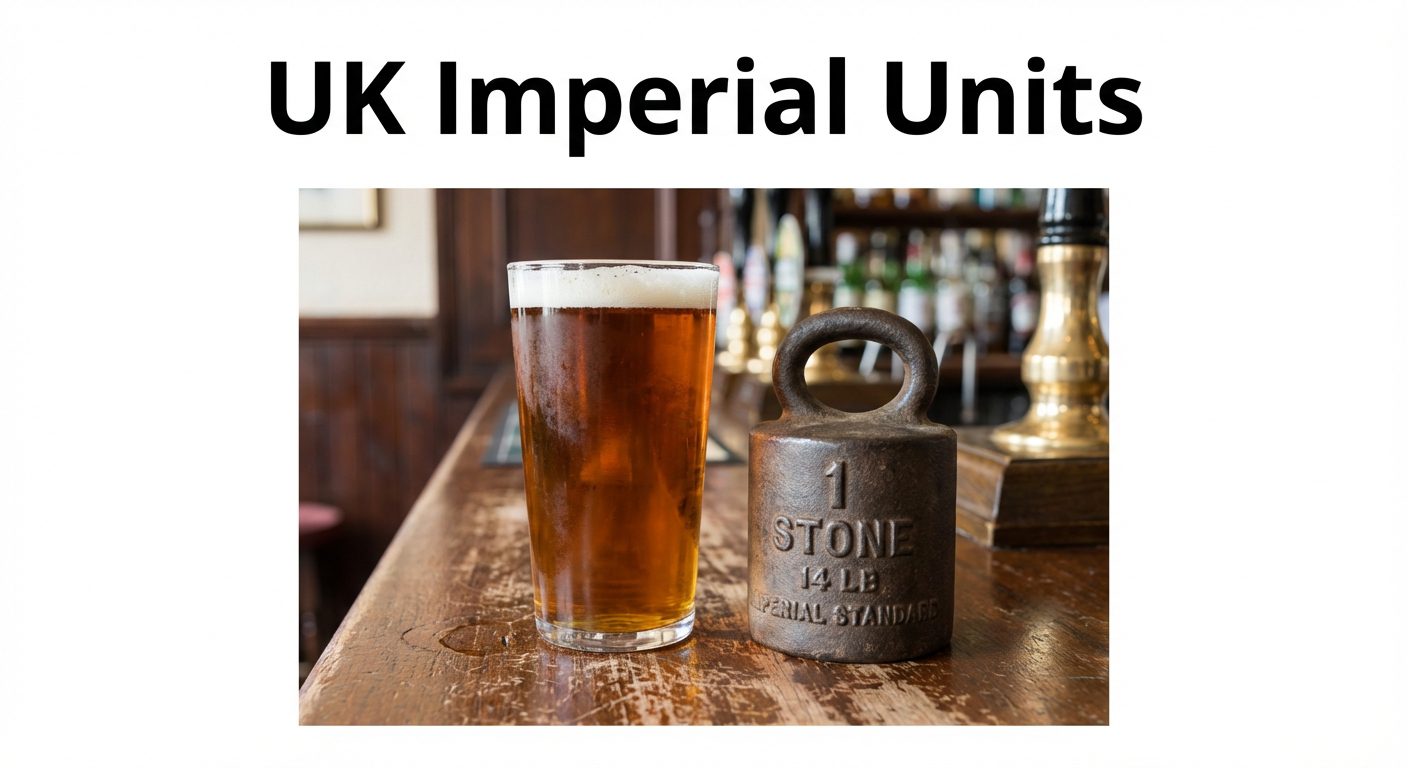
Although the United Kingdom officially adopted the metric system for trade and industry through a series of Acts from the 1960s onwards, imperial units remain deeply embedded in British everyday life. Road signs display distances in miles, beer is sold by the pint, and body weight is still commonly expressed in stones and pounds. Understanding UK imperial units is essential for anyone working with older British documents, recipes, construction drawings, or communicating with UK residents about everyday measurements.
Imperial System vs Metric System
The imperial system and the metric system are fundamentally different in their design philosophy. The metric system, formally known as the International System of Units (SI), is built on powers of ten. Every unit is a decimal multiple or submultiple of a base unit, making conversions as simple as moving a decimal point. One kilometre is exactly 1,000 metres; one kilogram is exactly 1,000 grams.
The imperial system, by contrast, uses historically derived relationships that are not based on powers of ten. There are 12 inches in a foot, 3 feet in a yard, and 1,760 yards in a mile. There are 16 ounces in a pound, 14 pounds in a stone, and 8 pints in a gallon. These irregular multipliers make imperial arithmetic more complex but reflect centuries of practical use and trade convention.
The metric system is now the official system of measurement in the United Kingdom for most purposes under the Units of Measurement Regulations. However, certain imperial units remain legally permitted for specific uses, including miles on road signs, pints for draught beer, and troy ounces for precious metals.
Imperial vs US Customary Units
While the UK imperial system and the US customary system share many unit names, they are not identical. Both descended from English customary measures, but the United States standardised its system before the British reforms of 1824, leading to permanent differences. For a comparison with American units, see our US measurement units converter.
Key Differences: Gallons, Pints, and Tons
The most significant differences between UK and US units are in volume and weight:
| Unit | UK Imperial | US Customary |
|---|---|---|
| Fluid ounce | 28.413 ml | 29.574 ml |
| Pint | 568.26 ml (20 fl oz) | 473.18 ml (16 fl oz) |
| Gallon | 4.546 litres | 3.785 litres |
| Ton | 2,240 lb (long ton) | 2,000 lb (short ton) |
Length units (inch, foot, yard, mile) and most weight units (ounce, pound) are identical in both systems. The stone and hundredweight are used in the UK but not in the United States. The UK hundredweight is 112 pounds (compared to the US short hundredweight of 100 pounds).
Imperial Length Units
Imperial length units form a chain from very small (the inch) to very large (the mile), connected by irregular but historically established ratios. These units are still used in the UK for road distances, personal height, and property dimensions in some contexts.
Inches, Feet, Yards, and Miles
| Unit | Abbreviation | Metric Equivalent | Relationship |
|---|---|---|---|
| Inch | in | 2.54 cm | Base unit |
| Foot | ft | 30.48 cm | 12 inches |
| Yard | yd | 91.44 cm | 3 feet / 36 inches |
| Mile | mi | 1.60934 km | 1,760 yards / 5,280 feet |
The inch was defined precisely as 25.4 millimetres in 1959, making all imperial length units exact multiples of metric units. The mile traces back to the Roman mille passuum (a thousand paces), which was adopted and modified through English history to arrive at the current 1,760 yards. Road distances throughout the UK are legally required to be posted in miles under the Traffic Signs Regulations.
Imperial Weight Units
The UK imperial weight system uses the avoirdupois system for everyday goods and body weight. This system is distinct from the troy system used for precious metals and the apothecaries' system historically used for medicinal compounds.

Ounces, Pounds, Stones, Hundredweight, and Ton
| Unit | Abbreviation | Metric Equivalent | Relationship |
|---|---|---|---|
| Ounce | oz | 28.3495 g | Base unit |
| Pound | lb | 453.592 g | 16 ounces |
| Stone | st | 6.35029 kg | 14 pounds |
| Hundredweight | cwt | 50.8023 kg | 112 pounds / 8 stone |
| Long Ton | t | 1,016.05 kg | 2,240 pounds / 20 cwt |
The stone remains a uniquely British unit with no direct equivalent in the US system. It is still widely used in everyday conversation to express body weight throughout the UK and Ireland. A person described as "11 stone 4" weighs 158 pounds or 71.7 kilograms. The UK long ton (2,240 lb) differs from the US short ton (2,000 lb) and the metric tonne (2,204.6 lb / 1,000 kg).
Imperial Volume Units
UK imperial volume units cover the full range from the small fluid ounce to the large gallon. These units are defined for liquid volume, and the UK versions differ meaningfully from their US counterparts due to the divergence of the two systems before the 1824 standardisation.
Fluid Ounces, Pints, Quarts, and Gallons
| Unit | Abbreviation | Metric Equivalent | Relationship |
|---|---|---|---|
| Fluid Ounce | fl oz | 28.413 ml | Base unit |
| Pint | pt | 568.26 ml | 20 fluid ounces |
| Quart | qt | 1.13652 litres | 2 pints |
| Gallon | gal | 4.54609 litres | 8 pints / 4 quarts |
UK Gallon vs US Gallon
The UK gallon (4.546 litres) and the US gallon (3.785 litres) are frequently confused, but they represent a difference of approximately 20%. This distinction is critical for fuel consumption figures, recipe scaling, and international trade. A car that achieves 40 miles per UK gallon would achieve only about 33 miles per US gallon. The UK pint (568 ml) is also larger than the US pint (473 ml), which is why a pint of beer in the UK contains more liquid than the same order in the United States.
History of the Imperial System
The British Imperial System was formally established by the Weights and Measures Act of 1824, which replaced a chaotic collection of regional and trade-specific measures with a unified national standard. The Act defined the imperial yard, pound, and gallon as legal standards, with all other units derived from these. The gallon was specifically defined based on the volume of 10 pounds of distilled water at a specified temperature.
The system spread throughout the British Empire, reaching India, Australia, Canada, South Africa, and dozens of other territories. Most of these countries switched to metric during the 20th century. Australia metricated in the 1970s, Canada in the 1970s and 1980s, and India had already adopted metric by 1957. The United Kingdom began metrication in 1965 and completed most industrial and commercial transitions by the 1990s, though a statutory exemption preserves miles, pints, and certain other imperial units for specific uses. For more information on UK measurement law, see the UK Government weights and measures legislation.
The United States never adopted the imperial system as defined by the 1824 Act. Instead, the US retained older English customary measures, resulting in the separate US customary system with its different gallon, pint, and ton values. For a comprehensive comparison of measurement systems, the NIST measurement system comparison provides official conversion factors. The historical background of the British Imperial System is documented by Britannica British Imperial System.
Frequently Asked Questions
What is the imperial system?
The imperial system is a standardised system of measurement established by the British Weights and Measures Act of 1824. It defines units for length (inch, foot, yard, mile), weight (ounce, pound, stone, hundredweight, ton), and volume (fluid ounce, pint, quart, gallon). It was used across the British Empire and remains partially in use in the UK today.
How is the UK gallon different from the US gallon?
A UK imperial gallon equals 4.546 litres, while a US gallon equals 3.785 litres. The UK gallon is approximately 20% larger. This difference also carries through to pints: a UK pint is 568 ml (20 fl oz), while a US pint is 473 ml (16 fl oz). Always confirm which gallon is being used in international recipes, fuel specifications, or product labelling.
What is a stone in weight?
A stone is a UK imperial unit of weight equal to 14 pounds or approximately 6.35 kilograms. It is unique to the British Isles and not used in the US customary system. In the UK and Ireland, body weight is commonly expressed in stones and pounds: for example, a person weighing 70 kg is approximately 11 stone (154 lb).
Does the UK still use imperial units?
Yes. The UK uses a mixture of metric and imperial. Road signs and speed limits remain in miles and miles per hour. Draught beer and milk sold in returnable containers are legally permitted in pints. Body weight is commonly expressed in stones and pounds, and height in feet and inches. Most other commercial and scientific measurements use metric units.
What units does the UK use for everyday measurements?
In everyday UK life: distances on roads are measured in miles; height is expressed in feet and inches; body weight uses stones and pounds; beer and milk are sold by the pint. Food packaging, fuel sold in litres, temperature in Celsius, and most scientific or commercial measurements use metric units. The UK is effectively a dual-unit country with specific imperial units legally protected for defined uses.