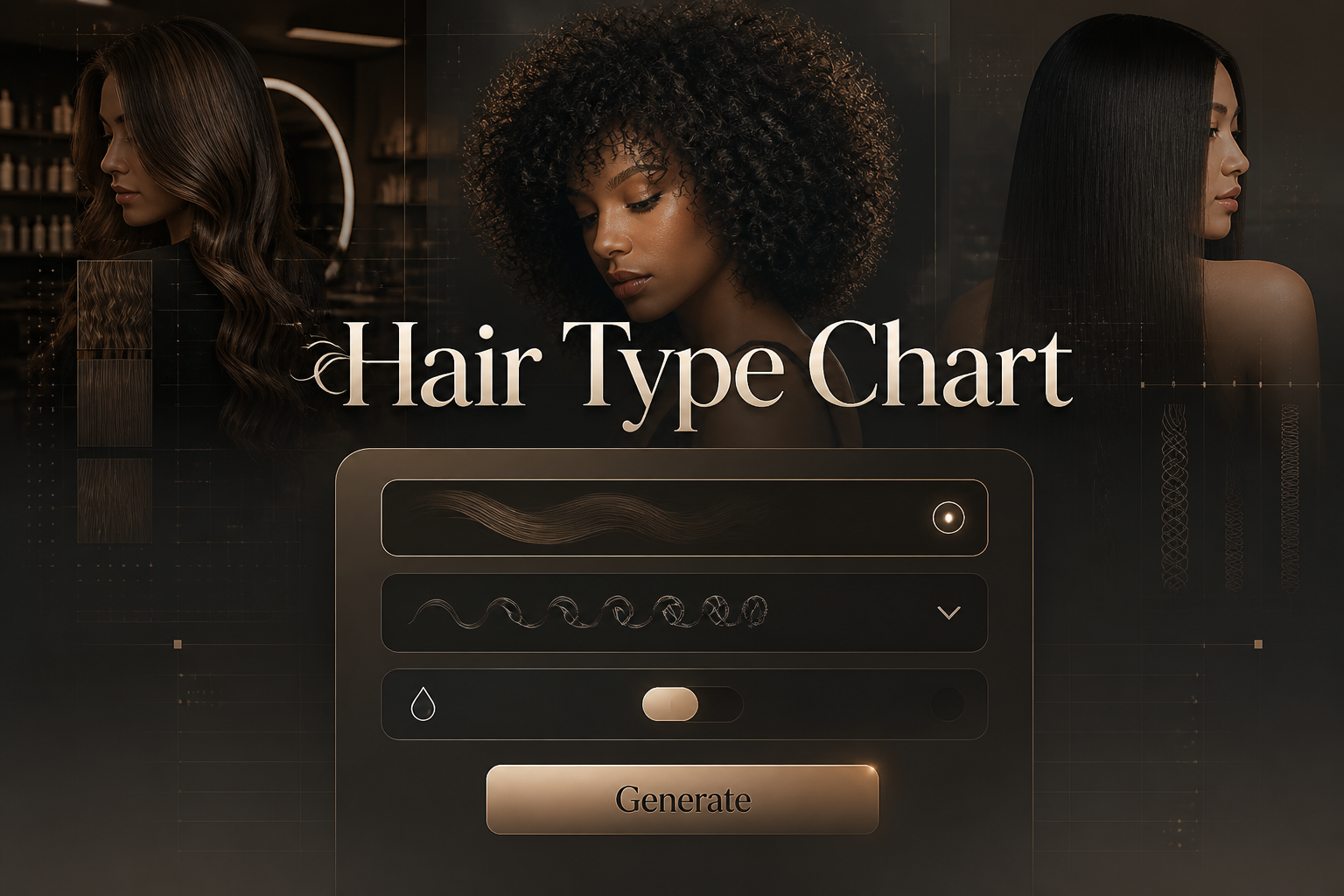
Hair Type Chart
The Hair Type Chart is a sizing reference tool covering hair type chart, curl type chart, hair texture chart, natural hair type chart. Use the chart below to look up values instantly. Printable and downloadable versions are available on this page.
Hair Type Chart — The Andre Walker System
The Andre Walker Hair Typing System, developed by celebrity hair stylist Andre Walker in the 1990s, is the most widely used hair classification system — it organises hair into four main types based on natural curl pattern.
| Hair Type | Sub-Category | Pattern Description | Curl Diameter or Pattern Width | Key Characteristics |
|---|---|---|---|---|
| 1A | Straight — fine | Completely straight with no wave or bend | None | Very fine, thin, and silky. Oiliness develops quickly. Difficult to hold a curl. |
| 1B | Straight — medium | Straight with slight body and movement | None | Medium texture. More volume than 1A. Still smooth to the touch. |
| 1C | Straight — coarse | Straight and resistant. Thick strands | None | Coarser feel. Resistant to styling and chemical processing. |
| 2A | Wavy — fine | Loose S-wave beginning from mid-shaft | Flat S-shape | Fine and thin strands. Easy to straighten. Prone to going limp. |
| 2B | Wavy — medium | Defined S-waves from root to tip | Defined flat S-wave | More resistant to styling than 2A. Some frizz at the roots. |
| 2C | Wavy — coarse | Thick defined waves with frizz. Can border on curly | Wide S-wave | Coarser texture. Prone to frizz. Hard to straighten for long. |
| 3A | Curly — loose | Large loose spirals with shine | Approximately 1 inch wide | Shiny and bouncy. Well-defined curl when dry. Prone to frizz in humidity. |
| 3B | Curly — medium | Springy ringlets of medium diameter | About the width of a marker pen | Dense and full. More prone to dryness than 3A. |
| 3C | Curly — tight | Tight corkscrew spirals. High density | About the width of a pencil | Very full and voluminous. Can be a mix of curly and coily. |
| 4A | Coily — soft | Tight S-coil pattern. Defined when wet | About the width of a crochet needle | Soft but fragile. High shrinkage. Prone to moisture loss. |
| 4B | Coily — Z-pattern | Sharp Z or zigzag pattern with less visible definition | Angular Z-shape | Dense packing. Shrinks significantly. Less curl definition. |
| 4C | Coily — tight | Tightest coil with least definition. Very dense | Smaller than a pencil — almost no visible circle | Most fragile type. 70–75% shrinkage. Appears significantly shorter than actual length. |
Source: Andre Walker Hair Typing System — published in Andre Talks Hair, 1997. Additional references: NaturallyCurly Hair Types Guide, Healthline Hair Type Overview, Allure Hair Types Chart.
Hair Porosity Chart
Hair porosity — how easily your hair absorbs and retains moisture — is as important as curl type when selecting products and building a hair care routine.
| Porosity Level | The Float Test Result | Characteristics | Best Product and Technique Approach |
|---|---|---|---|
| Low Porosity | Hair floats for 4 minutes or more | Cuticles lie flat and overlap tightly. Resists water absorption. Products tend to sit on top and cause build-up. | Use lightweight water-based products. Apply to warm damp hair to open the cuticle slightly. Clarify regularly to remove build-up. |
| Medium Porosity | Hair floats for 2–4 minutes then sinks | Cuticles are slightly raised. Absorbs and retains moisture well. Least maintenance of the three types. | Most product types work well. Maintain balance of protein and moisture. Avoid over-processing. |
| High Porosity | Hair sinks quickly in under 2 minutes | Cuticles are raised or have gaps from damage or genetics. Absorbs moisture quickly but loses it just as fast. | Use heavier butters and oils to seal moisture. Layer leave-in conditioner, cream, and oil. Regular protein treatments help close gaps in the cuticle. |
The float test (placing a clean strand of hair in a glass of water and observing how quickly it sinks) gives a rough indication of porosity. More accurate assessment involves observing how hair behaves with water and products over time.
Hair Care Routine by Type
| Hair Type | Wash Frequency | Key Products | Styling Tips |
|---|---|---|---|
| Type 1 Straight | Every 1–2 days due to rapid oil build-up | Lightweight volumising shampoo and conditioner. Avoid heavy serums. | Avoid heavy oils and creams which flatten fine hair. Dry shampoo extends time between washes. |
| Type 2 Wavy | Every 2–3 days | Curl-enhancing cream or light mousse. Lightweight leave-in. | Scrunch product into damp hair. Do not brush when dry. Diffuse or air dry. |
| Type 3 Curly | Every 3–7 days. Co-wash between full washes. | Rich conditioner, curl cream, and gel. Deep condition weekly. | Rake and shake method or shingling for definition. Diffuse or air dry. Do not towel rub. |
| Type 4 Coily | Once a week or every 7–10 days | Deep conditioner, leave-in, oil, and cream. The LOC method (Liquid, Oil, Cream). | Detangle only when wet with conditioner. Protective styles reduce manipulation and retain length. |
Hair Type Quiz
Answer 8 questions about curl pattern, thickness, porosity, and strand behaviour to get your hair type classification and personalised product and routine recommendations.
When your hair air dries without any products, what does it look like?
Frequently Asked Questions
How do I find out my hair type?
Wash your hair and let it air dry completely without applying any products. The natural pattern that forms when fully dry is your hair type — match it to the chart above.
What is the difference between Type 4A and Type 4C hair?
Type 4A has a defined tight coil pattern about the diameter of a crochet needle — the coil is visible. Type 4C has the tightest coil with the least visible curl definition and the greatest shrinkage of up to 75 percent.
Can you have more than one hair type on your head?
Yes — many people have two adjacent types in different areas. The crown is often a different type from the nape or temples.
What is high porosity hair and how do I know if I have it?
High porosity hair has raised or damaged cuticles that absorb moisture quickly but also lose it rapidly. Signs include hair that dries very quickly, feels dry shortly after washing, and tangles easily.
What is the LOC method?
The LOC method — Liquid, Oil, Cream — is a moisturising layering technique primarily used for Type 4 hair. A water-based leave-in conditioner is applied first, then an oil to seal the moisture in, then a cream to lock it all in.
Is Type 4C the most fragile hair type?
Yes — Type 4C has the tightest coil structure meaning each strand bends and curves the most per inch of length. This makes it the most prone to breakage from mechanical manipulation.
What is the difference between wavy and curly hair?
Wavy hair (Type 2) forms an S-shaped flat wave pattern and generally loses definition when dry without products. Curly hair (Type 3) forms distinct three-dimensional spirals or ringlets that hold their shape when dry.
Does hair type change over time?
Hair texture can change due to hormonal shifts, pregnancy, medication, heat damage, or ageing. Chemically processed or heat-damaged hair may appear to have a looser pattern than the natural texture underneath.