Electronegativity Chart
The Electronegativity Chart is a science reference tool covering electronegativity chart, electronegativity table, periodic table electronegativity, and electronegativity values chart. Use the chart below to look up values instantly. Printable and downloadable versions are available on this page.
Electronegativity Chart — All Elements
Electronegativity is a measure of how strongly an atom attracts electrons in a chemical bond — the Pauling scale is the most widely used, running from 0.7 (francium, least electronegative) to 4.0 (fluorine, most electronegative).
Source: NIST — Periodic Table of Elements · Pauling scale original values from Pauling 1932, revised by Allred 1961
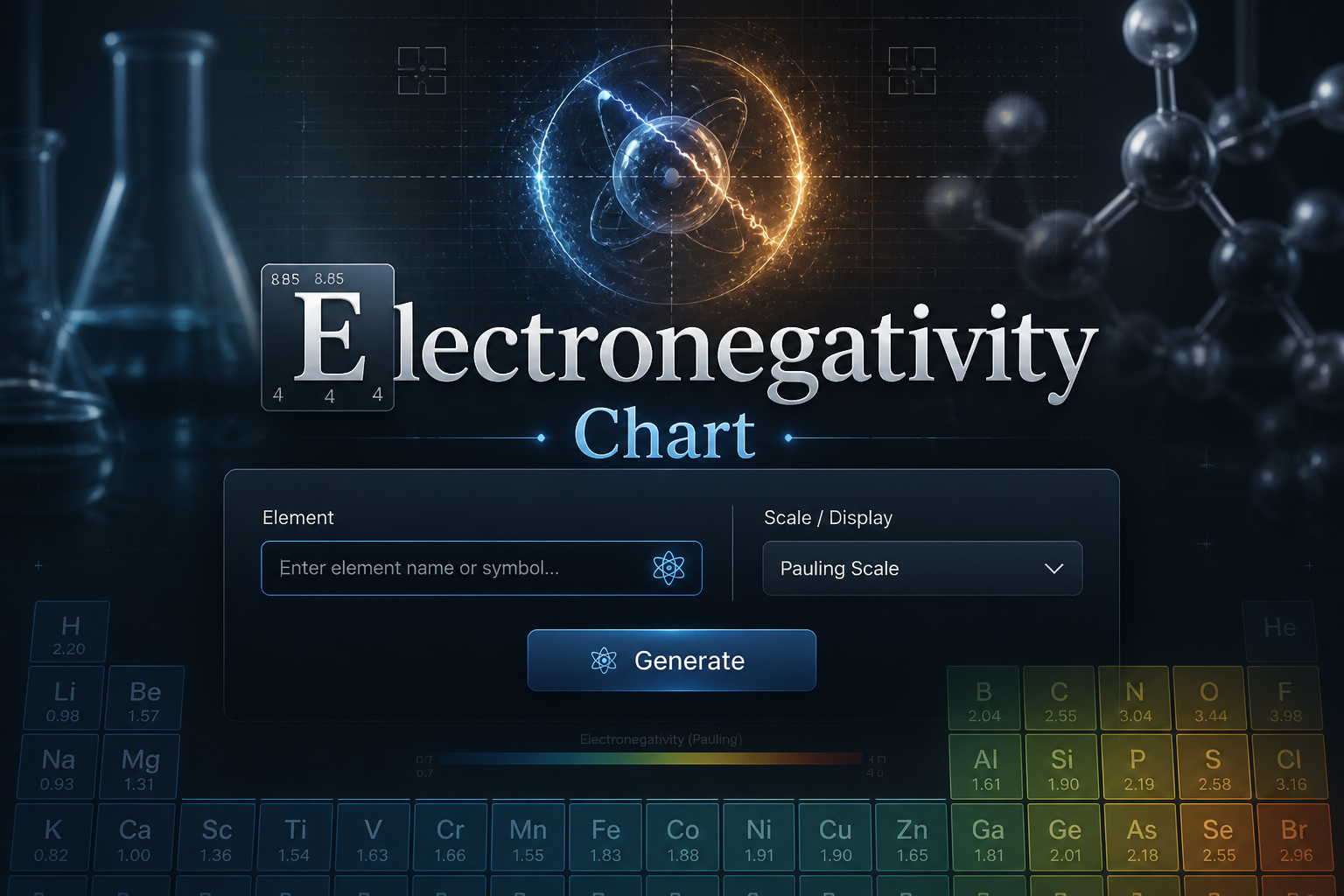
Electronegativity Trends on the Periodic Table
Electronegativity follows predictable periodic trends that can be explained by atomic structure — understanding these trends allows prediction of bond polarity without memorising every value.
- Across a period left to right electronegativity increases. As the number of protons increases across a row the effective nuclear charge increases — pulling shared electrons more strongly toward that atom. Example: Na (0.93) to Cl (3.16) across Period 3.
- Down a group electronegativity decreases. As atoms get larger the bonding electrons are farther from the nucleus and are shielded by more inner electron shells — reducing the pull on shared electrons. Example: F (4.00) to I (2.66) down Group 17.
- Noble gases (He, Ne, Ar, Kr, Xe, Rn) have no standard electronegativity values because they do not normally form chemical bonds.
- The most electronegative element is fluorine (F) at 4.00. The least electronegative element with a standard value is francium (Fr) at 0.70.
Bond Polarity and Electronegativity Difference
| Electronegativity Difference | Bond Type | Description | Example |
|---|---|---|---|
| 0.0 – 0.4 | Nonpolar covalent | Electrons shared approximately equally between both atoms | H–H bond in H₂ (difference 0). C–H bonds in methane (difference 0.35). |
| 0.4 – 1.7 | Polar covalent | Electrons shared unequally — partial charges develop. The more electronegative atom carries a partial negative charge. | H–Cl bond (difference 0.96). O–H bond in water (difference 1.24). |
| 1.7 and above | Ionic | Electron transfer occurs rather than sharing — results in fully charged ions | Na–Cl in sodium chloride (difference 2.23). Mg–O in magnesium oxide (difference 2.13). |
The 1.7 boundary between polar covalent and ionic is a general guideline not a strict rule. Some sources use 1.7 to 2.0. Bonds near this threshold have significant ionic character but are classified differently by different references.
Source: LibreTexts Chemistry — Electronegativity and Bond Polarity
Most and Least Electronegative Elements
| Element | Symbol and Atomic Number | Pauling Electronegativity |
|---|---|---|
| Fluorine Highest | F — Z = 9 | 4.00 |
| Oxygen | O — Z = 8 | 3.44 |
| Chlorine | Cl — Z = 17 | 3.16 |
| Nitrogen | N — Z = 7 | 3.04 |
| Bromine | Br — Z = 35 | 2.96 |
| — Least electronegative — | ||
| Caesium | Cs — Z = 55 | 0.79 |
| Francium Lowest | Fr — Z = 87 | 0.70 |
| Rubidium | Rb — Z = 37 | 0.82 |
| Potassium | K — Z = 19 | 0.82 |
| Barium | Ba — Z = 56 | 0.89 |
Source: NIST Chemistry WebBook — Pauling scale values
Bond Polarity Calculator
Enter two element symbols to get their electronegativity values, the difference between them, and the resulting bond type with a visual dipole indicator.
Frequently Asked Questions
What is electronegativity?
Electronegativity is a measure of how strongly an atom attracts the shared electrons in a chemical bond. It is a relative property — there are no absolute units — and values on the Pauling scale range from about 0.7 to 4.0.
Which element has the highest electronegativity?
Fluorine has the highest electronegativity at 4.00 on the Pauling scale. It is placed at the top right of the periodic table (excluding noble gases) which is where electronegativity is highest.
Which element has the lowest electronegativity?
Francium has the lowest standard electronegativity at approximately 0.70. Caesium at 0.79 is more practically relevant as francium is extremely rare and radioactive.
How does electronegativity affect bond type?
A large electronegativity difference (above 1.7) between two bonding atoms leads to ionic bond character — one atom essentially takes the electrons. A small difference (below 0.4) results in a nonpolar covalent bond. Values in between produce polar covalent bonds with partial charges on each atom.
What is the difference between electronegativity and electron affinity?
Electron affinity measures the energy released when a gas-phase atom gains an electron — it is an absolute measurable quantity in kJ/mol. Electronegativity measures the relative tendency of a bonded atom to attract shared electrons and is a dimensionless relative scale.
Why does fluorine have the highest electronegativity?
Fluorine has 9 protons creating a very strong nuclear charge while being a small atom with the bonding electrons close to the nucleus. It also has a nearly complete outer shell — one electron short — giving it a strong tendency to attract shared electrons.
How does electronegativity change across a period?
Electronegativity increases from left to right across a period. This is because the nuclear charge increases across the period while the atomic radius decreases — making the nucleus pull more strongly on shared bonding electrons.
What is the Pauling scale?
The Pauling scale was developed by chemist Linus Pauling in 1932 to quantify electronegativity differences between bonded atoms. It is a dimensionless relative scale — fluorine is arbitrarily assigned 4.00 and all other values are calculated relative to it from bond energy data.