pH Chart
The pH Chart is a science reference tool covering ph chart, ph level chart, ph scale chart, ph of aqueous salt solutions chart. Use the chart below to look up values instantly. Printable and downloadable versions are available on this page.
pH Calculator
Enter a pH value, H⁺ concentration, or OH⁻ concentration to find pH, pOH and the nearest common substance.
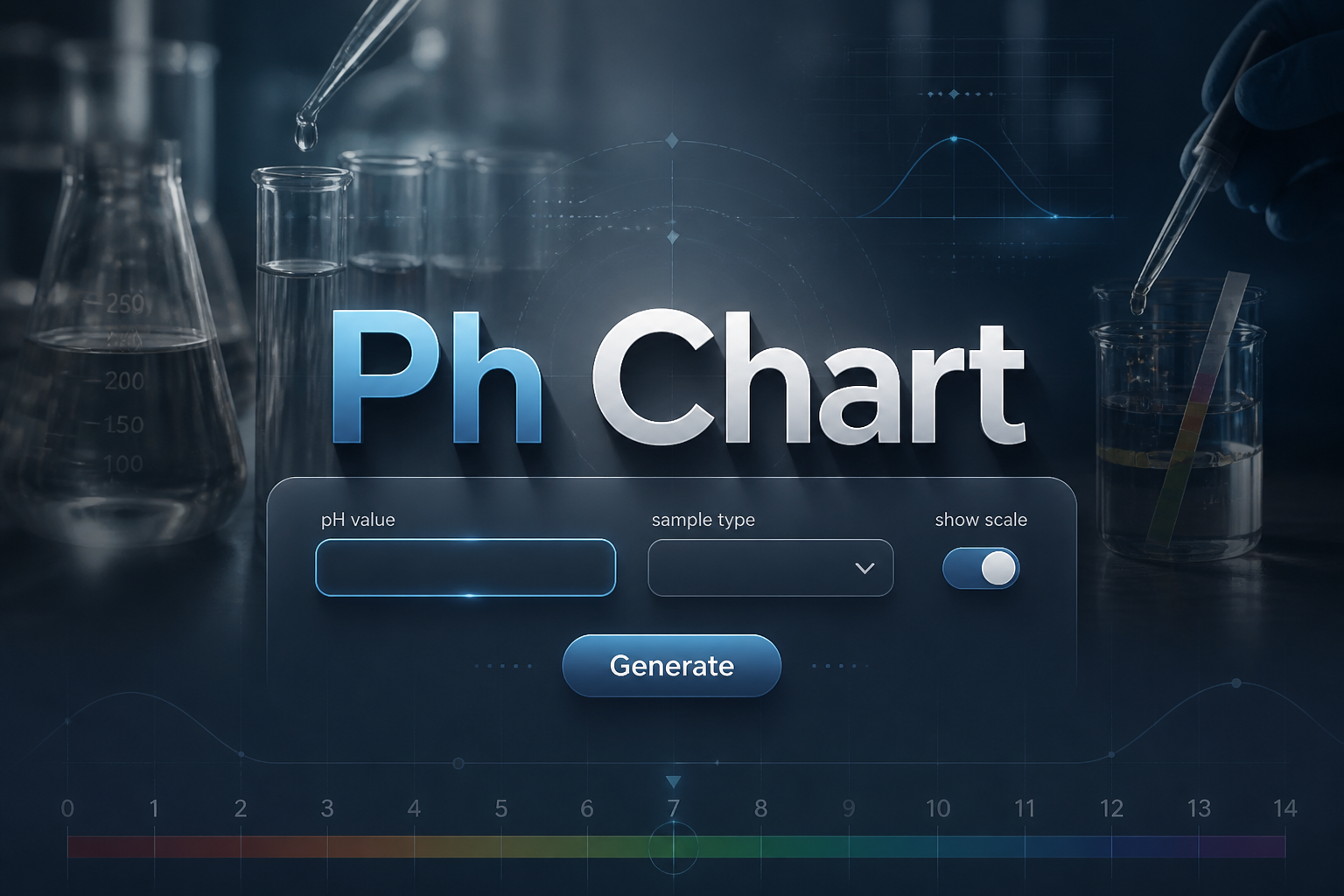
pH Scale Chart — 0 to 14 Reference
| pH Value | Classification | [H⁺] mol/L | Common Examples |
|---|---|---|---|
| 0 | Strongly acidic | 1.0 mol/L | Battery acid (sulphuric acid) |
| 1 | Strongly acidic | 0.1 mol/L | Gastric acid (stomach acid) |
| 2 | Strongly acidic | 0.01 mol/L | Lemon juice, vinegar |
| 3 | Acidic | 0.001 mol/L | Orange juice, grapefruit juice |
| 4 | Acidic | 0.0001 mol/L | Tomato juice, coffee |
| 5 | Weakly acidic | 0.00001 mol/L | Black coffee, rainwater |
| 6 | Weakly acidic | 0.000001 mol/L | Milk, urine (normal range) |
| 7 | Neutral | 0.0000001 mol/L | Pure water |
| 8 | Weakly basic (alkaline) | 0.00000001 mol/L | Sea water, baking soda solution |
| 9 | Weakly basic | 0.000000001 mol/L | Baking soda, antacids |
| 10 | Basic | 0.0000000001 mol/L | Milk of magnesia |
| 11 | Strongly basic | 0.00000000001 mol/L | Ammonia solution |
| 12 | Strongly basic | 0.000000000001 mol/L | Soapy water |
| 13 | Strongly basic | 0.0000000000001 mol/L | Bleach, oven cleaner |
| 14 | Extremely basic | 0.00000000000001 mol/L | Liquid drain cleaner (sodium hydroxide) |
Standard chemistry pH scale — Sørensen 1909. See US EPA: pH in Water and USGS: pH and Water
pH of Common Substances
| Substance | Approximate pH |
|---|---|
| Battery acid | 0 |
| Gastric acid (stomach) | 1.5 – 2.0 |
| Lemon juice | 2.0 – 2.6 |
| Vinegar | 2.4 – 3.4 |
| Coca-Cola | 2.5 – 3.5 |
| Orange juice | 3.3 – 4.2 |
| Tomato juice | 4.0 – 4.4 |
| Coffee (black) | 4.5 – 5.5 |
| Rainwater (normal) | 5.6 |
| Milk | 6.3 – 6.8 |
| Human urine (normal) | 6.0 – 7.5 |
| Pure water | 7.0 |
| Human blood | 7.35 – 7.45 |
| Seawater | 7.8 – 8.5 |
| Baking soda solution | 8.3 |
| Soapy water | 9 – 11 |
| Milk of magnesia | 10.5 |
| Household ammonia | 11.5 |
| Bleach | 12 – 12.5 |
| Drain cleaner (NaOH) | 13 – 14 |
See CRC Handbook of Chemistry and Physics and NIST Standard Reference Data
How pH Works
- pH is defined as the negative base-10 logarithm of the hydrogen ion concentration: pH = −log₁₀[H⁺]. Pure water has a hydrogen ion concentration of 1 × 10⁻⁷ mol/L so its pH = −log₁₀(10⁻⁷) = 7.
- Because pH uses a logarithmic scale each unit change represents a 10-fold change in acidity or alkalinity. A substance with pH 3 is 10 times more acidic than pH 4 and 100 times more acidic than pH 5.
- pH below 7 is acidic — more H⁺ ions than OH⁻ ions in solution. pH above 7 is basic (alkaline) — more OH⁻ ions than H⁺ ions. pH of exactly 7 is neutral at 25°C — equal concentrations of H⁺ and OH⁻.
- The pH scale technically extends beyond 0 and 14 for very concentrated strong acids and bases. Concentrated sulphuric acid has a pH of approximately −1 and concentrated sodium hydroxide can reach pH 15.
pH Calculator
Enter a pH value, H⁺ concentration, or OH⁻ concentration to instantly calculate pH, pOH, ion concentrations, and see where the value falls on the pH scale.
Frequently Asked Questions
What is pH?
pH is a measure of the acidity or alkalinity of a solution — specifically the concentration of hydrogen ions (H⁺) in the solution. The scale runs from 0 to 14 with 7 being neutral, below 7 acidic, and above 7 basic or alkaline.
What pH is neutral?
pH 7.0 at 25°C is neutral — it is the pH of pure water where the concentration of H⁺ ions and OH⁻ ions are exactly equal.
Is a higher pH more acidic or more basic?
A higher pH is more basic (alkaline). pH above 7 indicates a solution with more hydroxide ions (OH⁻) than hydrogen ions (H⁺). The further above 7, the more basic.
What is the pH of human blood?
Normal human blood pH is tightly maintained between 7.35 and 7.45 — slightly alkaline. A blood pH below 7.35 is called acidosis and above 7.45 is alkalosis — both are medical emergencies requiring treatment.
Why is stomach acid so acidic?
Gastric acid has a pH of 1.5 to 2.0 — strongly acidic. This acidity is necessary to denature proteins for digestion and to kill most pathogens ingested with food. The stomach lining is protected by a thick layer of mucus.
What is an acid-base indicator?
An acid-base indicator is a substance that changes colour depending on the pH of the solution — litmus turns red in acid and blue in base. Indicators are used to test pH when a precise numerical value is not needed.
What is the difference between an acid and a base?
In the Brønsted-Lowry definition an acid is a proton (H⁺) donor and a base is a proton acceptor. In the Arrhenius definition an acid produces H⁺ ions in water and a base produces OH⁻ ions. Both definitions are used in chemistry depending on the context.
How does pH affect plant growth?
Most plants thrive in slightly acidic to neutral soil — pH 6.0 to 7.0. At incorrect pH levels essential nutrients become unavailable even if present in the soil — for example iron and manganese become less available above pH 7.0, while aluminium and manganese become toxic below pH 5.5.