Codon Chart
The codon chart is a molecular biology reference tool covering the standard genetic code, mRNA codon table, codon to amino acid mapping, start codon, and stop codons. Use the lookup tool below to find any codon instantly. Printable and downloadable versions are available on this page.
Codon Lookup Tool
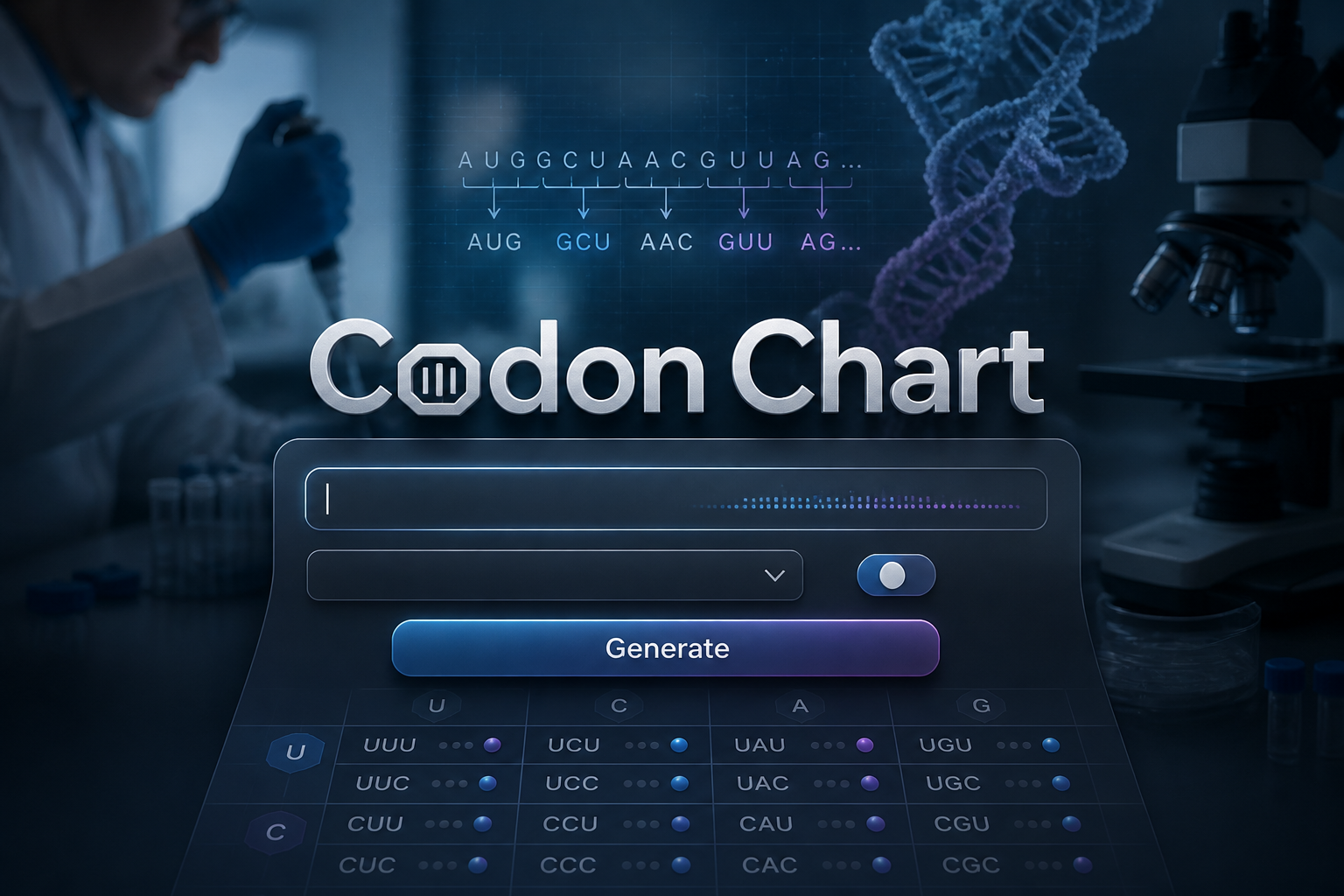
Standard Genetic Code — Full Codon Chart
The table below lists all 64 mRNA codons, the amino acid each encodes, the standard three-letter and single-letter abbreviations, and whether the codon is a start or stop signal.
| mRNA Codon | Amino Acid (3-letter) | Single-Letter Code | Full Name | Notes |
|---|---|---|---|---|
| UUU | Phe | F | Phenylalanine | |
| UUC | Phe | F | Phenylalanine | |
| UUA | Leu | L | Leucine | |
| UUG | Leu | L | Leucine | |
| UCU | Ser | S | Serine | |
| UCC | Ser | S | Serine | |
| UCA | Ser | S | Serine | |
| UCG | Ser | S | Serine | |
| UAU | Tyr | Y | Tyrosine | |
| UAC | Tyr | Y | Tyrosine | |
| UAA | Stop | * | Stop codon | STOP — Ochre |
| UAG | Stop | * | Stop codon | STOP — Amber |
| UGU | Cys | C | Cysteine | |
| UGC | Cys | C | Cysteine | |
| UGA | Stop | * | Stop codon | STOP — Opal |
| UGG | Trp | W | Tryptophan | |
| CUU | Leu | L | Leucine | |
| CUC | Leu | L | Leucine | |
| CUA | Leu | L | Leucine | |
| CUG | Leu | L | Leucine | |
| CCU | Pro | P | Proline | |
| CCC | Pro | P | Proline | |
| CCA | Pro | P | Proline | |
| CCG | Pro | P | Proline | |
| CAU | His | H | Histidine | |
| CAC | His | H | Histidine | |
| CAA | Gln | Q | Glutamine | |
| CAG | Gln | Q | Glutamine | |
| CGU | Arg | R | Arginine | |
| CGC | Arg | R | Arginine | |
| CGA | Arg | R | Arginine | |
| CGG | Arg | R | Arginine | |
| AUU | Ile | I | Isoleucine | |
| AUC | Ile | I | Isoleucine | |
| AUA | Ile | I | Isoleucine | |
| AUG | Met | M | Methionine | START |
| ACU | Thr | T | Threonine | |
| ACC | Thr | T | Threonine | |
| ACA | Thr | T | Threonine | |
| ACG | Thr | T | Threonine | |
| AAU | Asn | N | Asparagine | |
| AAC | Asn | N | Asparagine | |
| AAA | Lys | K | Lysine | |
| AAG | Lys | K | Lysine | |
| AGU | Ser | S | Serine | |
| AGC | Ser | S | Serine | |
| AGA | Arg | R | Arginine | |
| AGG | Arg | R | Arginine | |
| GUU | Val | V | Valine | |
| GUC | Val | V | Valine | |
| GUA | Val | V | Valine | |
| GUG | Val | V | Valine | |
| GCU | Ala | A | Alanine | |
| GCC | Ala | A | Alanine | |
| GCA | Ala | A | Alanine | |
| GCG | Ala | A | Alanine | |
| GAU | Asp | D | Aspartate | |
| GAC | Asp | D | Aspartate | |
| GAA | Glu | E | Glutamate | |
| GAG | Glu | E | Glutamate | |
| GGU | Gly | G | Glycine | |
| GGC | Gly | G | Glycine | |
| GGA | Gly | G | Glycine | |
| GGG | Gly | G | Glycine |
Source: NCBI — The Genetic Codes
Amino Acid Reference Chart
The 20 standard amino acids encoded by the genetic code are listed below with their three-letter abbreviations, single-letter codes, the number of codons encoding each, and their chemical properties.
| Amino Acid | 3-Letter Code | 1-Letter Code | Number of Codons | Chemical Property |
|---|---|---|---|---|
| Alanine | Ala | A | 4 | Nonpolar, aliphatic |
| Arginine | Arg | R | 6 | Positively charged (basic) |
| Asparagine | Asn | N | 2 | Polar, uncharged |
| Aspartate | Asp | D | 2 | Negatively charged (acidic) |
| Cysteine | Cys | C | 2 | Polar, uncharged |
| Glutamate | Glu | E | 2 | Negatively charged (acidic) |
| Glutamine | Gln | Q | 2 | Polar, uncharged |
| Glycine | Gly | G | 4 | Nonpolar, aliphatic |
| Histidine | His | H | 2 | Positively charged (basic) |
| Isoleucine | Ile | I | 3 | Nonpolar, aliphatic |
| Leucine | Leu | L | 6 | Nonpolar, aliphatic |
| Lysine | Lys | K | 2 | Positively charged (basic) |
| Methionine | Met | M | 1 | Nonpolar, aliphatic — Start codon |
| Phenylalanine | Phe | F | 2 | Nonpolar, aromatic |
| Proline | Pro | P | 4 | Nonpolar, aliphatic |
| Serine | Ser | S | 6 | Polar, uncharged |
| Threonine | Thr | T | 4 | Polar, uncharged |
| Tryptophan | Trp | W | 1 | Nonpolar, aromatic |
| Tyrosine | Tyr | Y | 2 | Polar, uncharged |
| Valine | Val | V | 4 | Nonpolar, aliphatic |
Source: NCBI — Biochemistry (Berg et al.)
Start and Stop Codons
The start codon (AUG) initiates translation and always encodes methionine as the first amino acid. The three stop codons (UAA, UAG, UGA) terminate translation — they do not encode any amino acid. Each stop codon has a traditional name derived from early research.
| Codon | Type | Name | Function | Amino Acid Encoded |
|---|---|---|---|---|
| AUG | Start codon | — | Initiates translation — signals the ribosome to begin building the protein | Methionine (Met, M) |
| UAA | Stop codon | Ochre | Terminates translation — no amino acid added; ribosome releases the polypeptide | None |
| UAG | Stop codon | Amber | Terminates translation — no amino acid added; ribosome releases the polypeptide | None |
| UGA | Stop codon | Opal | Terminates translation — no amino acid added; ribosome releases the polypeptide | None |
Source: NCBI — The Genetic Codes
How to Read a Codon Chart
A codon chart maps every possible three-base mRNA sequence to the amino acid it encodes. Use the following steps to decode any codon.
- Write down the mRNA codon you want to look up — for example, GCA.
- Find the first base (G) in the left column of the chart.
- Find the second base (C) across the top row.
- Find the third base (A) in the right column within that row group.
- The intersecting cell contains the amino acid — in this case, Alanine (Ala, A).
- Check whether the codon is a start codon (AUG) or a stop codon (UAA, UAG, UGA). These have regulatory functions beyond encoding an amino acid.
DNA uses thymine (T) instead of uracil (U). When working from a DNA sequence, replace every T with U to get the corresponding mRNA codon before looking it up in this chart.
Codon Degeneracy — Why Multiple Codons Encode the Same Amino Acid
With 64 possible codons and only 20 amino acids plus 3 stop signals, most amino acids are encoded by more than one codon. This is called codon degeneracy (or redundancy). The third base of a codon — the wobble position — often varies without changing the amino acid, which provides protection against point mutations at that position.
| Number of Codons | Amino Acids |
|---|---|
| 1 codon | Methionine (AUG only — also the start codon), Tryptophan (UGG only) |
| 2 codons | Phenylalanine, Tyrosine, Cysteine, Histidine, Glutamine, Asparagine, Lysine, Aspartate, Glutamate |
| 3 codons | Isoleucine |
| 4 codons | Valine, Proline, Threonine, Alanine, Glycine |
| 6 codons | Leucine, Serine, Arginine |
| Stop signals | UAA (Ochre), UAG (Amber), UGA (Opal) |
Source: NCBI — Biochemistry (Berg et al.)
Frequently Asked Questions
What is a codon?
A codon is a sequence of three consecutive nucleotide bases in a messenger RNA (mRNA) molecule that specifies a particular amino acid or serves as a start or stop signal during protein synthesis. Each codon is read by the ribosome during translation, and the corresponding amino acid is added to the growing polypeptide chain.
How many codons are there?
There are 64 possible codons in the standard genetic code — derived from 4 possible bases (U, C, A, G) arranged in triplets (4³ = 64). Of these, 61 encode the 20 standard amino acids and 3 are stop codons (UAA, UAG, UGA) that terminate translation.
What is the start codon?
The start codon is AUG, which encodes methionine and signals the ribosome to begin translating the mRNA sequence into a protein. Every protein begins with methionine, although this first methionine is often removed by post-translational processing in the final protein.
How many stop codons are there?
There are three stop codons: UAA (Ochre), UAG (Amber), and UGA (Opal). None of these codons encode an amino acid — instead they signal the ribosome to release the completed polypeptide chain and terminate translation.
What is the difference between a codon and an anticodon?
A codon is the three-base sequence on an mRNA molecule that specifies an amino acid. An anticodon is the complementary three-base sequence on a transfer RNA (tRNA) molecule that pairs with the codon during translation. Each tRNA carries the specific amino acid corresponding to its anticodon.
Why does the genetic code have 64 codons for only 20 amino acids?
The genetic code is degenerate — most amino acids are specified by more than one codon. This redundancy arises because four bases in triplets produce 64 combinations, far more than the 20 amino acids needed. The extra codons primarily differ at the third (wobble) position, providing protection against the effects of point mutations at that position.
Is the genetic code the same in all organisms?
The standard genetic code applies to the vast majority of organisms, including bacteria, plants, animals, and fungi — reflecting the common ancestry of all life. However, some organisms and organelles (such as mitochondria) use slight variations of the standard code, where a small number of codons are reassigned to different amino acids or stop signals.
What does DNA codon versus mRNA codon mean?
DNA codons refer to the triplet sequences on the coding strand of DNA, while mRNA codons are the corresponding sequences transcribed from the template strand. The mRNA codon sequence matches the DNA coding strand except that thymine (T) is replaced by uracil (U). Codon charts always use mRNA notation — convert any DNA sequence by replacing T with U before looking it up.