Unit Circle Chart
The Unit Circle Chart is a educational reference tool covering unit circle chart, unit circle, trig circle chart, radian circle chart. Use the chart below to look up values instantly. Printable and downloadable versions are available on this page.
Unit Circle Reference Tool
Click any angle on the unit circle to see exact sin, cos, and tan values, the reference point, and quadrant information.
cos
1/2
sin
√3/2
tan
√3
Point: (1/2, √3/2)
All angles — quick reference
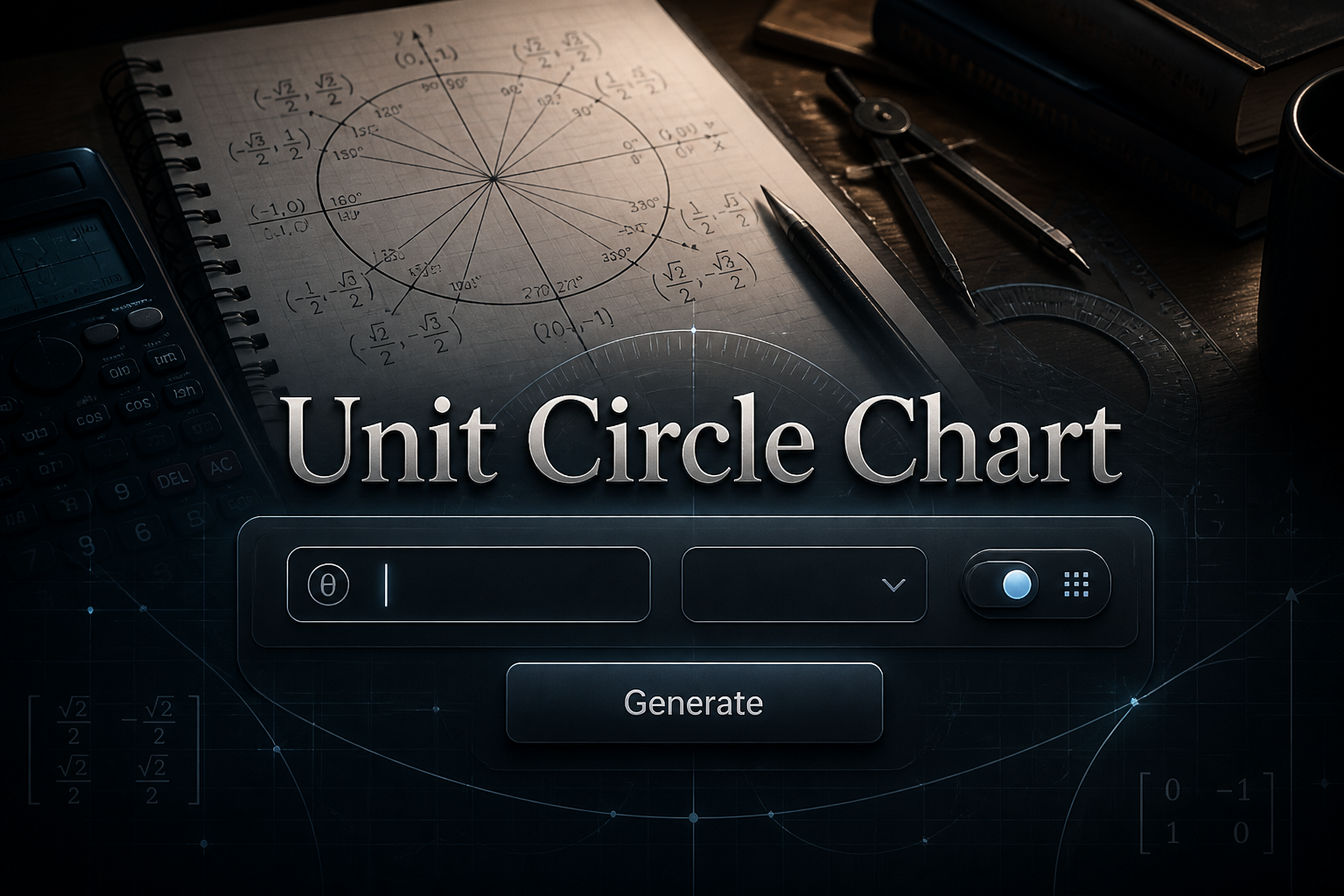
Unit Circle Chart — Complete Reference
| Angle (Degrees) | Angle (Radians) | Radian Simplified | Cosine (x) | Sine (y) | Tangent (sin/cos) |
|---|---|---|---|---|---|
| 0° | 0 | 0 | 1 | 0 | 0 |
| 30° | π/6 | π/6 | √3/2 | 1/2 | √3/3 |
| 45° | π/4 | π/4 | √2/2 | √2/2 | 1 |
| 60° | π/3 | π/3 | 1/2 | √3/2 | √3 |
| 90° | π/2 | π/2 | 0 | 1 | Undefined |
| 120° | 2π/3 | 2π/3 | -1/2 | √3/2 | -√3 |
| 135° | 3π/4 | 3π/4 | -√2/2 | √2/2 | -1 |
| 150° | 5π/6 | 5π/6 | -√3/2 | 1/2 | -√3/3 |
| 180° | π | π | -1 | 0 | 0 |
| 210° | 7π/6 | 7π/6 | -√3/2 | -1/2 | √3/3 |
| 225° | 5π/4 | 5π/4 | -√2/2 | -√2/2 | 1 |
| 240° | 4π/3 | 4π/3 | -1/2 | -√3/2 | √3 |
| 270° | 3π/2 | 3π/2 | 0 | -1 | Undefined |
| 300° | 5π/3 | 5π/3 | 1/2 | -√3/2 | -√3 |
| 315° | 7π/4 | 7π/4 | √2/2 | -√2/2 | -1 |
| 330° | 11π/6 | 11π/6 | √3/2 | -1/2 | -√3/3 |
| 360° | 2π | 2π | 1 | 0 | 0 |
Standard trigonometry unit circle — sine and cosine defined as y and x coordinates on a circle of radius 1. See Khan Academy: The Unit Circle
Unit Circle Quadrant Signs Reference
| Quadrant | Angle Range | Sign of Sine | Sign of Cosine | Sign of Tangent |
|---|---|---|---|---|
| Quadrant I (upper right) | 0° to 90° | Positive (+) | Positive (+) | Positive (+) |
| Quadrant II (upper left) | 90° to 180° | Positive (+) | Negative (-) | Negative (-) |
| Quadrant III (lower left) | 180° to 270° | Negative (-) | Negative (-) | Positive (+) |
| Quadrant IV (lower right) | 270° to 360° | Negative (-) | Positive (+) | Negative (-) |
ASTC mnemonic — All Students Take Calculus: All positive in Q1, Sine positive in Q2, Tangent positive in Q3, Cosine positive in Q4.
How to Memorise the Unit Circle
- Learn the four key reference angles — 30°, 45°, 60°, and 90°. These four angles and their reflections into the other three quadrants generate the entire unit circle. Everything else is derived from these four.
- Memorise the three special sine values: sin(30°) = 1/2, sin(45°) = √2/2, sin(60°) = √3/2. Notice the pattern: the numerators are √1, √2, and √3 divided by 2. Cosine has the reverse order: cos(30°) = √3/2, cos(45°) = √2/2, cos(60°) = 1/2.
- Use the ASTC mnemonic (All Students Take Calculus) to remember which trig functions are positive in each quadrant. All positive in Q1, Sine in Q2, Tangent in Q3, Cosine in Q4.
- For angles beyond 90° use the reference angle — the acute angle between the terminal side and the nearest x-axis. The value of sin or cos at 150° has the same magnitude as at 30° (the reference angle) — only the sign changes based on the quadrant.
Unit Circle Reference Tool
Click any point on the interactive unit circle below to instantly look up exact sin, cos, and tan values for that angle. Enable quiz mode to test your knowledge.
cos
1/2
sin
√3/2
tan
√3
Point: (1/2, √3/2)
All angles — quick reference
Frequently Asked Questions
What is the unit circle?
The unit circle is a circle with radius 1 centred at the origin (0, 0) on the coordinate plane. Every point on the circle can be described by the coordinates (cosine θ, sine θ) where θ is the angle measured counterclockwise from the positive x-axis — this is why the unit circle defines the trigonometric functions.
Why is the unit circle important?
The unit circle provides the foundation for all of trigonometry and extends trigonometric functions beyond right triangles to all real angles including negative angles and angles greater than 360°. It is essential for calculus, physics, engineering, signal processing, and any field that involves periodic phenomena.
What is sin(90°)?
sin(90°) = 1. At 90° the point on the unit circle is at (0, 1) — the y-coordinate (sine) is 1.
What is cos(0°)?
cos(0°) = 1. At 0° the point on the unit circle is at (1, 0) — the x-coordinate (cosine) is 1.
What is tan(45°)?
tan(45°) = 1. At 45°, sin(45°) = cos(45°) = √2/2, so tan = sin/cos = 1.
Why is tangent undefined at 90° and 270°?
Tangent is defined as sine divided by cosine. At 90° and 270° the cosine equals zero — and dividing by zero is undefined in mathematics.
What does radian measure mean?
A radian is the angle subtended at the centre of a circle by an arc equal in length to the radius. One full rotation (360°) equals 2π radians — so π radians = 180°, making π/2 = 90°, π/3 = 60°, and so on.
What is the difference between degrees and radians?
Degrees divide a full circle into 360 equal parts — an arbitrary convention from Babylonian mathematics. Radians are the natural unit for angles in mathematics — they arise directly from the geometry of circles and make calculus formulas for trigonometric derivatives and integrals much simpler.