Growth Chart (Baby/Child)
The Growth Chart (Baby/Child) is a health reference tool covering baby growth chart, growth chart, growth chart boys, growth chart girls. Use the chart below to look up values instantly. Printable and downloadable versions are available on this page.
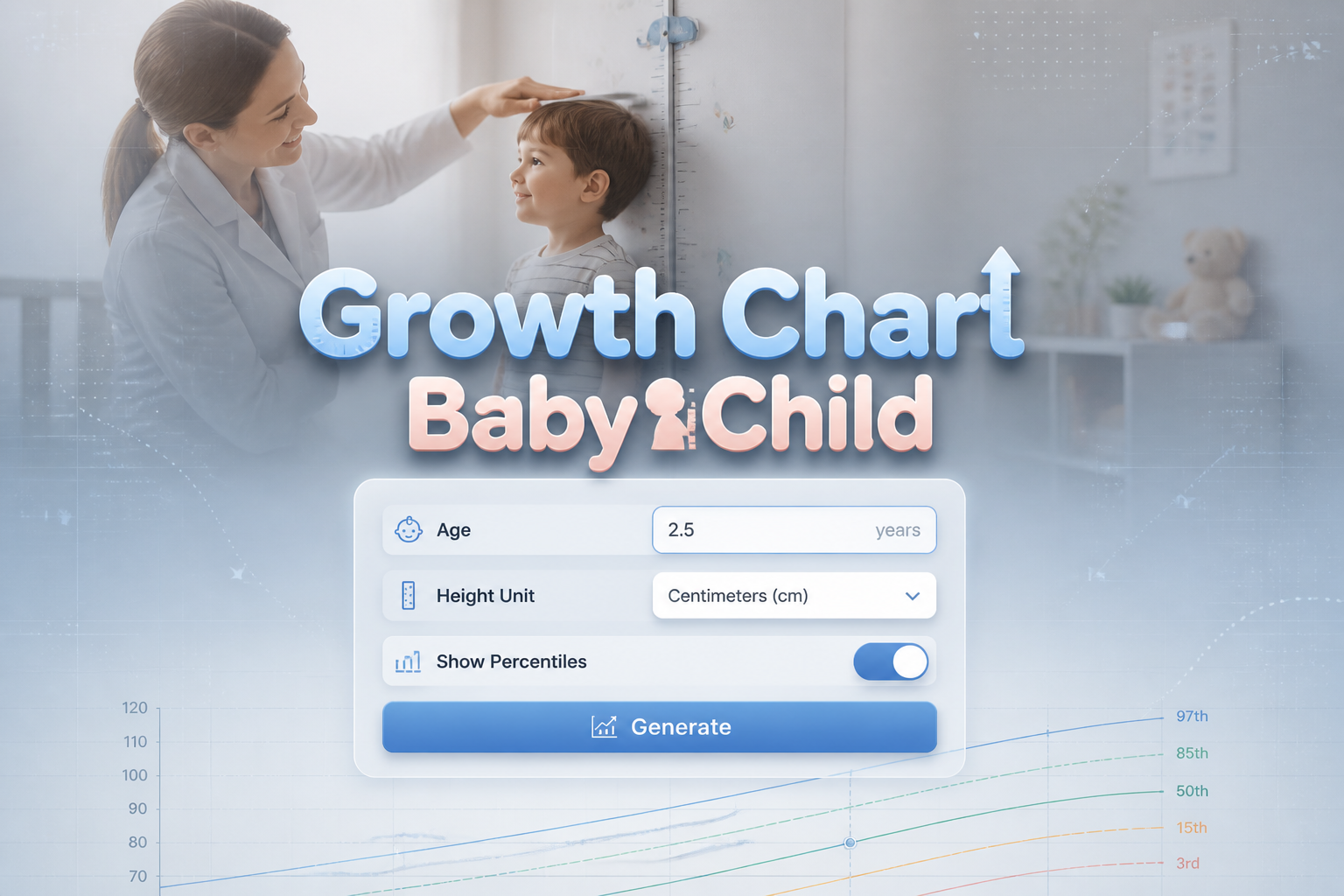
Child Growth Percentile Calculator
Enter child's age, height, and weight; plot on WHO/CDC growth chart; show current percentile and trend over time.
Enter your child's details to see which percentile band they fall in for height and weight.
Growth Chart — Boys Weight for Age (Birth to 24 Months)
| Age (months) | 5th (kg) | 10th (kg) | 25th (kg) | 50th (kg) | 75th (kg) | 90th (kg) | 95th (kg) |
|---|---|---|---|---|---|---|---|
| Birth (0) | 2.5 | 2.7 | 3.0 | 3.3 | 3.7 | 4.1 | 4.4 |
| 1 | 3.4 | 3.6 | 4.0 | 4.5 | 5.0 | 5.5 | 5.8 |
| 2 | 4.2 | 4.5 | 5.0 | 5.6 | 6.2 | 6.7 | 7.1 |
| 3 | 4.9 | 5.2 | 5.8 | 6.0 | 7.1 | 7.7 | 8.2 |
| 4 | 5.5 | 5.9 | 6.5 | 7.2 | 7.9 | 8.6 | 9.1 |
| 6 | 6.6 | 7.0 | 7.7 | 8.5 | 9.3 | 10.2 | 10.7 |
| 9 | 7.7 | 8.2 | 9.0 | 9.8 | 10.7 | 11.7 | 12.3 |
| 12 | 8.6 | 9.1 | 9.9 | 10.2 | 11.8 | 12.8 | 13.5 |
| 15 | 9.1 | 9.7 | 10.6 | 11.5 | 12.6 | 13.7 | 14.4 |
| 18 | 9.7 | 10.3 | 11.2 | 11.5 | 13.5 | 14.6 | 15.4 |
| 21 | 10.1 | 10.8 | 11.7 | 12.8 | 14.1 | 15.3 | 16.1 |
| 24 | 10.5 | 11.1 | 12.2 | 12.7 | 14.8 | 16.0 | 16.9 |
Child Growth Chart — Percentile Lines
Source: CDC Clinical Growth Charts 2000 revision — developed by the National Center for Health Statistics in collaboration with the National Center for Chronic Disease Prevention and Health Promotion.
Growth Chart — Girls Weight for Age (Birth to 24 Months)
| Age (months) | 5th (kg) | 10th (kg) | 25th (kg) | 50th (kg) | 75th (kg) | 90th (kg) | 95th (kg) |
|---|---|---|---|---|---|---|---|
| Birth (0) | 2.4 | 2.5 | 2.8 | 3.2 | 3.6 | 3.9 | 4.2 |
| 1 | 3.1 | 3.3 | 3.7 | 4.2 | 4.7 | 5.1 | 5.5 |
| 2 | 3.8 | 4.0 | 4.5 | 5.1 | 5.7 | 6.2 | 6.6 |
| 3 | 4.4 | 4.7 | 5.2 | 5.4 | 6.4 | 7.0 | 7.5 |
| 4 | 4.9 | 5.3 | 5.8 | 6.5 | 7.3 | 7.9 | 8.4 |
| 6 | 5.9 | 6.4 | 7.0 | 7.3 | 8.5 | 9.3 | 9.9 |
| 9 | 7.0 | 7.5 | 8.2 | 8.6 | 10.0 | 11.0 | 11.6 |
| 12 | 7.7 | 8.2 | 9.0 | 9.5 | 11.0 | 12.0 | 12.7 |
| 15 | 8.3 | 8.8 | 9.6 | 10.5 | 11.7 | 12.9 | 13.7 |
| 18 | 8.7 | 9.3 | 10.2 | 10.8 | 12.6 | 13.8 | 14.6 |
| 21 | 9.2 | 9.8 | 10.7 | 11.7 | 13.2 | 14.6 | 15.5 |
| 24 | 9.6 | 10.2 | 11.3 | 12.1 | 14.1 | 15.5 | 16.4 |
Source: CDC Clinical Growth Charts 2000
Growth Chart — Height for Age (Children 2 to 18 Years)
| Age (years) | Boys 50th Percentile Height | Girls 50th Percentile Height |
|---|---|---|
| 2 | 87.1 cm (34.3 in) | 85.7 cm (33.7 in) |
| 3 | 96.1 cm (37.8 in) | 94.8 cm (37.3 in) |
| 4 | 103.1 cm (40.6 in) | 102.0 cm (40.2 in) |
| 5 | 110.0 cm (43.3 in) | 109.0 cm (42.9 in) |
| 6 | 116.0 cm (45.7 in) | 115.4 cm (45.4 in) |
| 7 | 121.9 cm (48.0 in) | 121.2 cm (47.7 in) |
| 8 | 127.5 cm (50.2 in) | 127.9 cm (50.4 in) |
| 9 | 132.7 cm (52.2 in) | 133.5 cm (52.6 in) |
| 10 | 138.5 cm (54.5 in) | 140.5 cm (55.3 in) |
| 11 | 143.5 cm (56.5 in) | 147.2 cm (57.9 in) |
| 12 | 149.0 cm (58.7 in) | 152.5 cm (60.0 in) |
| 13 | 156.3 cm (61.5 in) | 156.7 cm (61.7 in) |
| 14 | 164.0 cm (64.6 in) | 159.5 cm (62.8 in) |
| 15 | 170.1 cm (67.0 in) | 161.0 cm (63.4 in) |
| 16 | 173.5 cm (68.3 in) | 162.0 cm (63.8 in) |
| 17 | 175.7 cm (69.2 in) | 162.5 cm (64.0 in) |
| 18 | 176.5 cm (69.5 in) | 163.0 cm (64.2 in) |
Source: CDC Clinical Growth Charts 2000
How to Read a Growth Chart
- Find your child's age on the x-axis (horizontal axis) and their weight or height on the y-axis (vertical axis). The point where these two values meet on the chart is your child's data point.
- The curved lines on the chart are percentile lines labelled at the right edge — 5th, 10th, 25th, 50th, 75th, 90th, and 95th. The 50th percentile means the child is taller or heavier than 50 percent of children their age in the reference population.
- There is no single "ideal" percentile — a healthy child can be at any percentile from the 3rd to the 97th. What matters most is that a child follows their own growth curve over time, not the absolute percentile.
- A drop of two or more percentile lines over successive measurements — or an unexplained jump upward — warrants discussion with a paediatrician. These crossing-of-lines patterns are more significant than the current percentile position.
Child Growth Percentile Calculator
Enter your child's age, height, and weight below to see their current percentile band based on CDC growth chart reference data.
Enter your child's details to see which percentile band they fall in for height and weight.
Frequently Asked Questions
What does the 50th percentile mean on a growth chart?
The 50th percentile means the child is exactly at the median — taller or heavier than 50 percent of children of the same age and sex in the CDC reference population. It is the statistical middle — not a target or ideal.
Is 25th percentile normal for height?
Yes — any percentile from the 3rd to the 97th is within the normal range. A child at the 25th percentile for height is shorter than 75 percent of peers but taller than 25 percent — this is completely normal variation.
At what age do children have growth spurts?
The first major growth spurt occurs in infancy — babies typically triple their birth weight by one year. The second is during puberty — girls typically between 10 and 14 years and boys between 12 and 16 years.
What does it mean when a child falls off their growth curve?
Falling off the growth curve — dropping two or more percentile lines over time — may indicate inadequate nutrition, an underlying health condition, or a hormonal issue. It warrants evaluation by a paediatrician regardless of the child's absolute percentile.
How often should a child's growth be measured?
The American Academy of Pediatrics recommends growth measurement at every well-child visit — typically 6 times in the first 2 years, annually from age 2 to 6, and then annually through adolescence.
What is BMI-for-age in children?
BMI-for-age is a growth chart measure specifically for children that compares BMI to the reference population of the same age and sex. Unlike adult BMI the thresholds change with age — a BMI at or above the 95th percentile for age is classified as obese in children.
What is the difference between WHO and CDC growth charts?
WHO growth charts (released 2006) describe how children should grow under ideal conditions — they are based on a multinational sample of healthy breastfed children in optimal environments. CDC charts (2000) describe how children actually grew in a reference US sample and are used as a statistical reference for the US population.
My baby dropped from the 75th to the 50th percentile — should I worry?
A single shift of one to two percentile lines is often normal — especially during the first two years when many babies settle into their own growth curve. Discuss any change with your paediatrician at the next well-child visit — they will assess the pattern over time rather than from a single data point.