Foot Reflexology Chart
The Foot Reflexology Chart is a reference tool covering foot reflexology chart, reflexology chart, foot pressure points chart, reflexology foot map. Use the chart below to look up values instantly. Printable and downloadable versions are available on this page.
Foot Reflexology Chart — Right Foot
| Foot Zone or Region | Corresponding Organ or Body System | Location Description on the Foot |
|---|---|---|
| Big toe tip | Brain and pineal gland | Tip of the big toe — top pad |
| Big toe pad (full) | Head and sinuses | Entire pad of the big toe |
| Second and third toes | Eyes | Second toe corresponds to the right eye — third toe to sinuses |
| Fourth and fifth toes | Ears and sinuses | Fourth toe corresponds to the right ear |
| Base of all toes (toe necks) | Neck and thyroid | The joint area where toes meet the ball of the foot |
| Ball of foot — upper third | Chest, lungs, and bronchi | Upper outer portion of the ball |
| Ball of foot — centre | Heart (left foot primarily), Thymus | Centre of the ball under the second and third toes |
| Ball of foot — full | Shoulder and breast tissue | Full ball under all toes |
| Arch — upper half | Liver and gallbladder (right foot only) | Inner upper arch below the ball |
| Arch — middle section | Stomach and pancreas | Mid-arch region |
| Arch — lower half | Small intestine | Lower middle arch area |
| Kidney and adrenal gland point | Kidney and adrenal gland | Centre of the arch — approximately halfway down the foot |
| Inner arch — lower third | Ascending colon (right foot), lower large intestine | Lower inner arch |
| Heel — upper portion | Pelvic area and reproductive organs | Upper heel pad |
| Heel — centre | Sciatic nerve | Centre heel pad |
| Heel — lower | Lower back and sacrum | Base of heel |
| Inner edge of foot (along arch) | Spine | The entire inner edge from big toe to heel represents the spine |
| Outer edge of foot (along pinky side) | Shoulder, arm, knee | Outer edge of foot from fifth toe to heel |
| Ankle area — inner | Uterus or prostate | Soft tissue just behind the inner ankle bone |
| Ankle area — outer | Ovaries or testes | Soft tissue just behind the outer ankle bone |
Reflexology maps vary between schools and practitioners — different traditions place zone boundaries in slightly different locations. The map above follows the most widely published Western reflexology conventions. Reflexology is a complementary therapy. It is not a medical treatment and should not replace professional medical care.
Source: Reflexology Association of America and International Institute of Reflexology zone mapping conventions
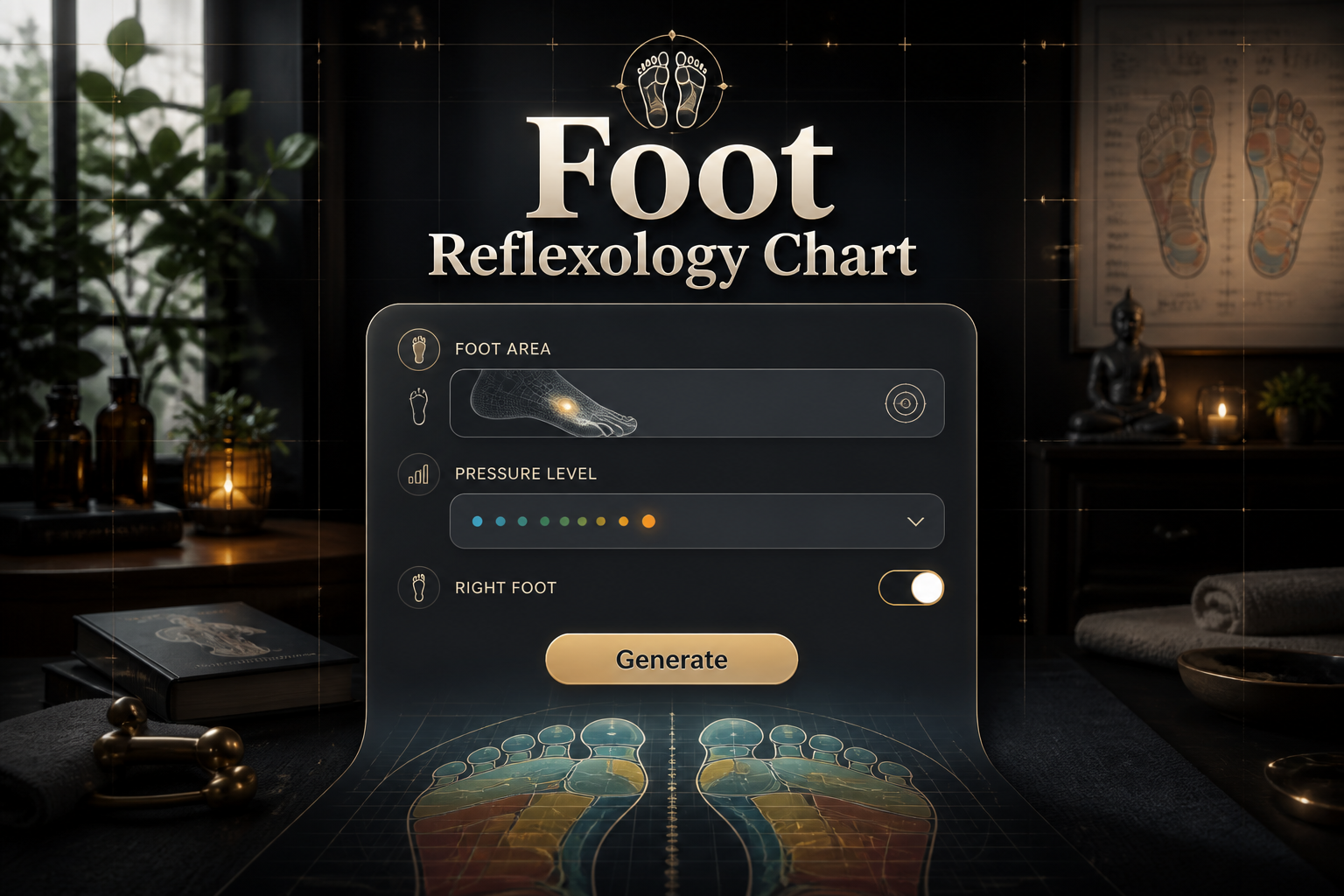
Foot Reflexology Chart — Left Foot Differences
The left foot mirrors the right foot for most zones — the main differences are that the heart, spleen, and descending colon are on the left foot while the liver, gallbladder, and ascending colon are on the right.
| Zone | Left Foot Correspondence |
|---|---|
| Ball of foot — heart zone | Heart is primarily accessed on the LEFT foot — the heart point is in the upper ball of the left foot. |
| Upper arch — liver zone | The spleen and stomach are primarily on the left foot in this zone — not liver (liver is right foot). |
| Lower arch — colon | Descending colon and sigmoid colon — the left foot corresponds to the left side of the large intestine. |
| Gallbladder | No gallbladder point on the left foot — gallbladder is right foot only. |
| Both feet equally | All spine points, kidney, adrenal, bladder, small intestine, and reproductive organs are represented on both feet. |
How to Apply Reflexology Pressure
- The thumb-walking technique is the foundation of reflexology. Bend the thumb slightly at the first joint and walk it forward in tiny caterpillar-like movements across the zone applying steady pressure with the tip of the thumb — not the nail.
- Apply firm but comfortable pressure — the recipient should feel pressure and possibly sensitivity in tender zones but never sharp pain. Adjust pressure based on feedback.
- Work each zone for 30 to 60 seconds — spend extra time on zones that feel tender or gritty (granular texture under the skin can indicate tension in the corresponding area according to reflexology theory).
- A complete session typically lasts 30 to 60 minutes covering the full foot. Begin with relaxation movements (foot circling, toe flexing) before working specific zones and end with calming strokes.
Interactive Reflexology Map
Click any foot zone to see the associated organs, health benefits, and self-massage technique for that area.
Click any zone to see the organ correspondence and self-massage technique.
Frequently Asked Questions
What is reflexology?
Reflexology is a complementary therapy based on the theory that specific points on the feet, hands, and ears correspond to organs and systems throughout the body. Applying pressure to these points is believed to promote relaxation, improve circulation, and support the body's natural healing processes.
Does foot reflexology actually work?
Research evidence for reflexology as a medical treatment is limited and inconclusive for most health conditions. Studies consistently show benefits for relaxation, stress reduction, and subjective wellbeing — making it a valuable complementary therapy for relaxation even if its claims about organ correspondence are not scientifically established.
What does it mean when a reflexology point is tender?
Tenderness in a reflexology zone is interpreted by practitioners as indicating tension, congestion, or imbalance in the corresponding body area. From a physiological standpoint tenderness may simply reflect local tissue tightness, reduced circulation, or referred neural sensitivity in that foot region.
How long does a reflexology session last?
A professional reflexology session typically lasts 45 to 60 minutes covering both feet completely. Self-applied reflexology can be done in shorter 10 to 20 minute sessions targeting specific zones.
Can reflexology help with back pain?
Reflexology practitioners work the spine reflex zone — the entire inner edge of the foot from the big toe to the heel — for back discomfort. Clinical evidence is limited but many recipients report temporary relaxation and relief from muscle tension after sessions.
Is reflexology safe during pregnancy?
Reflexology is generally considered safe during pregnancy when performed by a qualified practitioner but certain zones — particularly the heel (uterus and pelvic reflex) and ankle areas (reproductive organ reflexes) — are traditionally avoided in the first trimester. Always consult your midwife or obstetrician before receiving any complementary therapy during pregnancy.
What is the difference between reflexology and a foot massage?
A foot massage focuses on the muscles and soft tissues of the foot for relaxation and pain relief. Reflexology uses specific pressure techniques applied to mapped reflex zones with the intention of influencing corresponding areas of the body beyond the foot itself.
Where is the heart reflex point on the foot?
The heart reflex point is located primarily on the LEFT foot — in the upper portion of the ball of the foot beneath the third and fourth toes. A smaller secondary point is sometimes used on the right foot.