Ruler Markings
Ruler markings indicate precise measurements using lines of different lengths. On an imperial ruler, the longest lines mark inches, followed by shorter lines for half inches, quarter inches, eighths, and sixteenths. Use the tool to identify any ruler marking or ask our AI to explain measurements.
Hover over any mark to see its measurement
What Are Ruler Markings?
Ruler markings are the lines printed on a ruler that indicate specific measurements. Each line has a different height, and the height of the line directly tells you which fraction of an inch or which millimeter value it represents. The longest line marks the largest unit, and progressively shorter lines mark smaller subdivisions of that unit. Once you understand what each line height means, reading any ruler becomes straightforward.
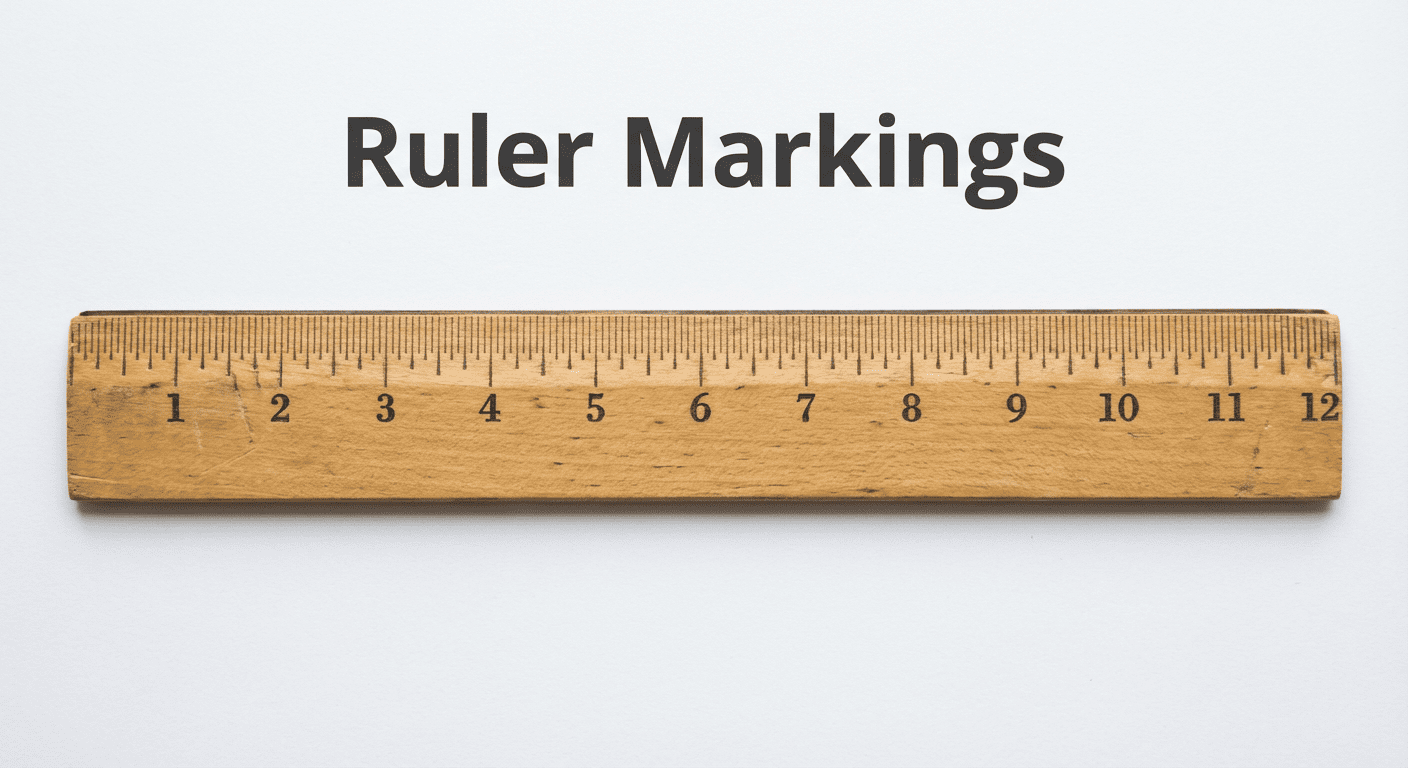
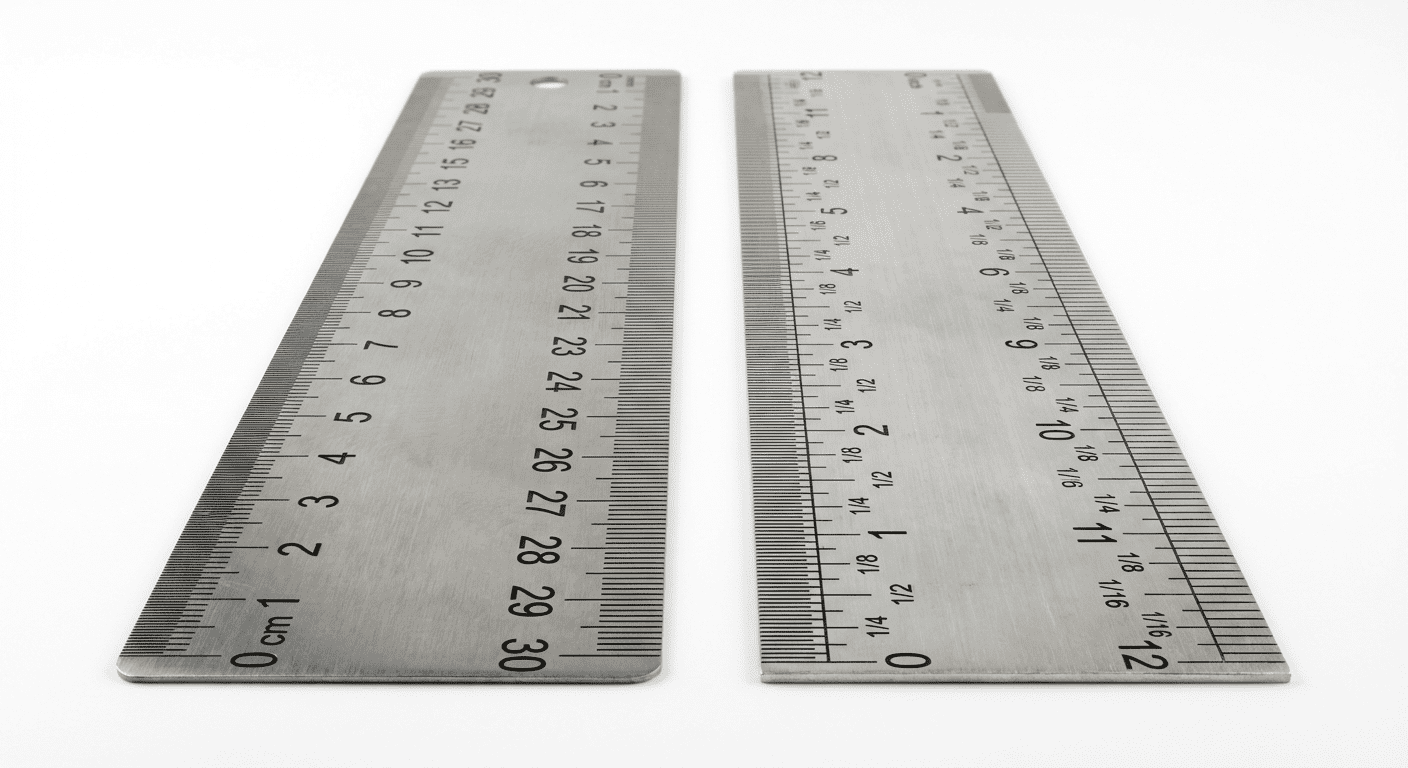
There are two common ruler systems: imperial (inches) used primarily in the United States, and metric (centimeters and millimeters) used in most other countries and in science. Imperial rulers divide inches into fractions — typically halves, quarters, eighths, and sixteenths. Metric rulers divide centimeters into 10 millimeters. Understanding both systems is essential for reading measurements accurately, converting between them, or using tools and materials from different countries.
How to Read an Inch Ruler
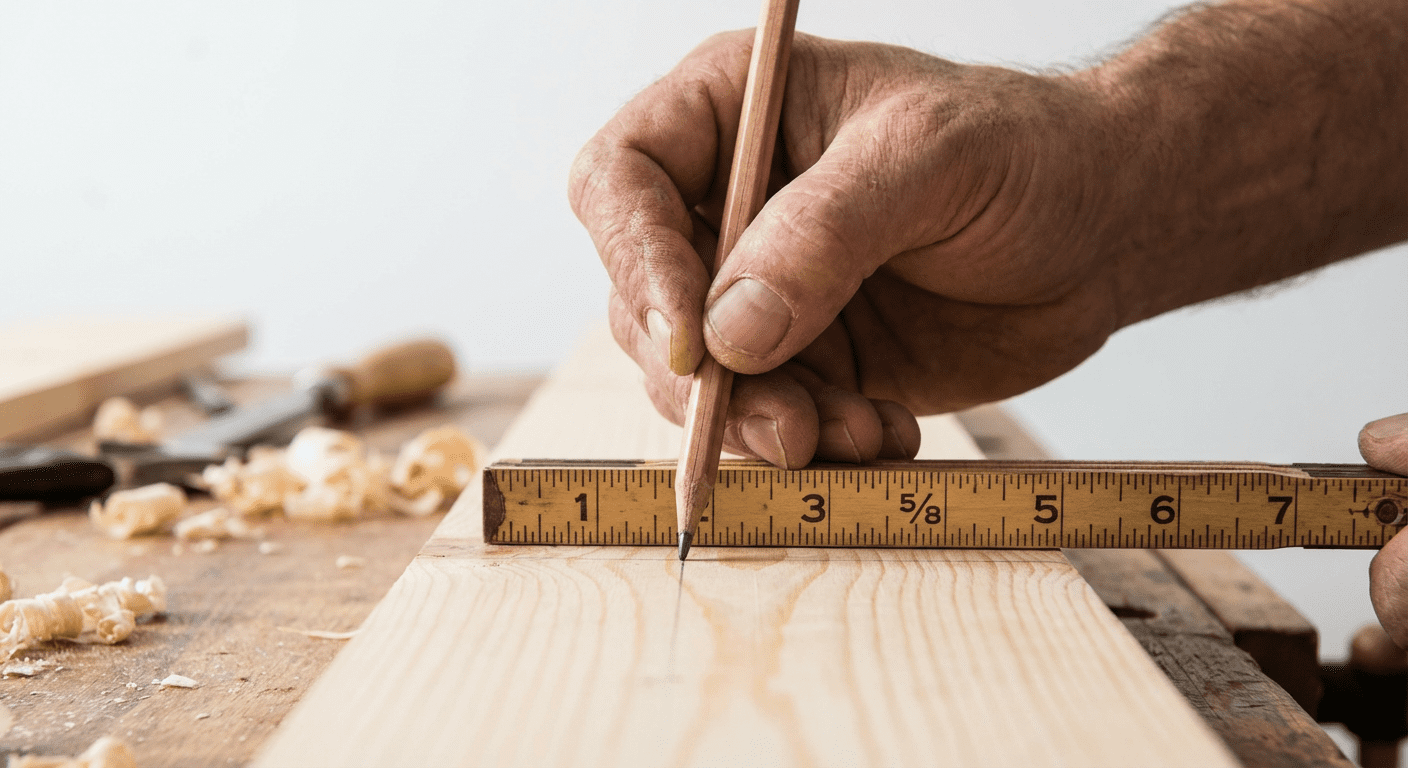
An inch ruler uses lines of five different heights to mark measurements. Each line height corresponds to a specific fraction of an inch. Starting from the longest and working down to the shortest:
Inch Lines (Longest)
The tallest lines on an imperial ruler mark whole inches. These are the easiest to identify because they are noticeably taller than all other lines and have a number printed above or beside them: 1, 2, 3, and so on. When measuring, you always count from the 0 edge of the ruler to the inch line nearest your measurement, then count the smaller lines between it.
Half-Inch Lines
The second-tallest line falls exactly halfway between two inch marks. This line represents one-half inch (1/2"). There is exactly one half-inch line between each pair of inch marks. If your measurement lands on this line, the reading is the whole inch below it plus 1/2 inch. For example, if it falls midway between the 3 and 4 inch marks, your measurement is 3 and 1/2 inches (3.5").
Quarter-Inch Lines
The third-tallest lines fall at quarter-inch intervals. Between each inch mark there are three lines at this height: they appear at 1/4", 1/2", and 3/4" within each inch. The 1/2" mark is also a quarter-inch line, but it is taller than the others. Count: the first quarter line after 0 marks 1/4", the next (taller) marks 1/2", and the third marks 3/4". Quarter-inch lines let you measure to within 0.25 of an inch.
Eighth-Inch Lines
Eighth-inch lines are shorter still and appear between each quarter-inch mark. There is one eighth-inch line between every two quarter-inch lines. These mark increments of 1/8" (0.125"). Within a single inch there are 8 divisions, so you count eighth lines starting from the previous inch: 1/8, 2/8 (=1/4), 3/8, 4/8 (=1/2), 5/8, 6/8 (=3/4), 7/8, and then the next whole inch.
Sixteenth-Inch Lines
The shortest lines on a standard imperial ruler mark sixteenth-inch intervals. There is one sixteenth-inch line between every pair of eighth-inch lines. Within a single inch there are 16 of these divisions. These are the smallest lines on most rulers and can be difficult to count accurately. A sixteenth of an inch equals 0.0625". Woodworking, metalworking, and precision crafts commonly require reading to the nearest 1/16".
How to Read a Metric Ruler
Metric rulers are generally easier to read because the decimal system means each unit divides evenly into 10. There are two main line types on a metric ruler:
Centimeter Lines
The tallest lines on a metric ruler mark centimeters (cm). Each centimeter line has a number printed next to it: 1, 2, 3, and so on. One centimeter equals 10 millimeters. A standard 30cm ruler is used in schools and offices and will have 30 centimeter marks. Reading a metric ruler starts by identifying the nearest centimeter mark below your measurement.
Millimeter Lines
Between each centimeter mark there are 9 smaller lines, each marking one millimeter (mm). The line that falls at exactly 5mm (halfway between two centimeter marks) is slightly taller than the other millimeter lines, making it easier to count from. To read a metric ruler, find the centimeter mark to the left of your measurement, then count the millimeter lines to the right of it. For example, if your measurement falls 3 lines past the 4cm mark, the reading is 4.3cm or 43mm.
Ruler Markings Chart
This table shows the relationship between line length and the measurement it represents on an imperial ruler:
| Line Height | Fraction | Decimal | Count Per Inch | Metric (mm) |
|---|---|---|---|---|
| Tallest | 1" (whole inch) | 1.000" | 1 | 25.4 mm |
| 2nd tallest | 1/2" | 0.500" | 2 | 12.7 mm |
| 3rd tallest | 1/4" | 0.250" | 4 | 6.35 mm |
| 4th tallest | 1/8" | 0.125" | 8 | 3.175 mm |
| Shortest | 1/16" | 0.0625" | 16 | 1.588 mm |
Tips for Reading Ruler Markings Accurately
- Always start from zero. Place the 0 mark of the ruler precisely at one end of what you are measuring. Do not start from the physical edge of the ruler, which may not align with the 0 mark.
- Read at eye level. Hold the ruler flat against the object and look straight down to avoid parallax error, where viewing at an angle makes the measurement appear different from what it actually is.
- Count from the last whole number. Identify the highest whole inch or centimeter mark below your measurement point, then count the smaller lines above it to find the fractional part.
- Use line height as your guide. On an imperial ruler, if a line is very short, it marks a 1/16" increment. Slightly taller means 1/8". Taller still means 1/4". The second-tallest marks 1/2". The tallest marks the whole inch.
- Simplify fractions. After counting, simplify your fraction. 2/16 simplifies to 1/8, 4/16 to 1/4, and 8/16 to 1/2. Always express ruler measurements in their simplest form.
- Use a magnifying glass for 1/16" lines. The shortest lines on a ruler are very close together. A magnifying glass helps when precision is critical, especially for 1/16" and 1/32" measurements.
Common Ruler Measurements
Fractions on a Ruler
The most commonly used fractions on an inch ruler are 1/2, 1/4, 3/4, 1/8, 3/8, 5/8, and 7/8. These come up regularly in woodworking, sewing, cooking measurements, and construction. The fractions 1/16, 3/16, 5/16, 7/16, 9/16, 11/16, 13/16, and 15/16 appear on rulers with 16 subdivisions per inch and are used in precision work. For carpentry and home improvement, the most important fractions to memorize are 1/4, 1/2, and 3/4, since these correspond to common lumber and pipe dimensions.
Converting Ruler Fractions to Decimals
To convert any ruler fraction to a decimal, divide the numerator by the denominator. Common conversions: 1/16 = 0.0625", 1/8 = 0.125", 3/16 = 0.1875", 1/4 = 0.25", 5/16 = 0.3125", 3/8 = 0.375", 7/16 = 0.4375", 1/2 = 0.5", 9/16 = 0.5625", 5/8 = 0.625", 11/16 = 0.6875", 3/4 = 0.75", 13/16 = 0.8125", 7/8 = 0.875", 15/16 = 0.9375". These decimal equivalents are useful when entering measurements into a calculator or comparing them with metric values. One inch equals exactly 25.4mm, so to convert any inch fraction to millimeters, multiply the decimal by 25.4. For example, 3/8" = 0.375 × 25.4 = 9.525mm. For help with any measurement calculation, the free AI math solver can handle fraction-to-decimal and inch-to-mm conversions instantly.
Frequently Asked Questions
What do the small lines on a ruler mean?
Each small line on a ruler represents a fraction of the main unit. On an imperial (inch) ruler, the small lines represent fractions of an inch: the smallest lines are 1/16 inch, slightly taller lines are 1/8 inch, taller still are 1/4 inch, and the second-tallest lines are 1/2 inch. On a metric ruler, the small lines between centimeter marks represent millimeters, with each line equal to 1mm.
How many marks are between inches on a ruler?
On a standard imperial ruler with 1/16 inch precision, there are 15 marks between each pair of inch marks (at every 1/16, 1/8, 3/16, 1/4, 5/16, 3/8, 7/16, 1/2, 9/16, 5/8, 11/16, 3/4, 13/16, 7/8, and 15/16 inch). On a ruler with only 1/8 inch precision, there are 7 marks between each inch. On a 1/4 inch precision ruler, there are just 3 marks between each inch.
What is 1/16 on a ruler?
On a ruler, 1/16 inch is marked by the shortest line. It is the smallest standard subdivision on a typical imperial ruler. One sixteenth of an inch equals 0.0625 inches or approximately 1.588 millimeters. To find a specific 1/16 mark, count the shortest lines from the nearest inch mark: the first short line past an inch mark is 1/16, the second (slightly taller) is 2/16 (= 1/8), and so on up to 16/16 at the next whole inch.
How do you read mm on a ruler?
To read millimeters on a metric ruler, first find the centimeter mark to the left of your measurement point. Each centimeter is numbered (1, 2, 3, etc.). Then count the small lines between that centimeter mark and your measurement point. Each small line equals 1 millimeter. The line that appears slightly taller than the others marks 5mm (half a centimeter). So if your measurement falls 7 lines past the 3cm mark, your reading is 3cm and 7mm, which can be written as 3.7cm or 37mm.
What are the longest lines on a ruler?
The longest lines on a ruler mark the primary unit of measurement. On an imperial (inch) ruler, the longest lines mark whole inches and have numbers printed next to them. On a metric ruler, the longest lines mark centimeters and are also numbered. These tall lines are always the easiest to identify and serve as the anchor points from which you count smaller fractional or millimeter lines to get a precise reading.