RACI Chart
The RACI Chart is a project management reference tool covering raci chart, raci chart template, raci chart definitions, raci chart example. Use the chart below to look up values instantly. Printable and downloadable versions are available on this page.
RACI Chart Builder
Add tasks and roles, assign R/A/C/I to each intersection, validate missing Accountable owners, then export your matrix.
| Task / Deliverable |
|---|
Jump to a chart
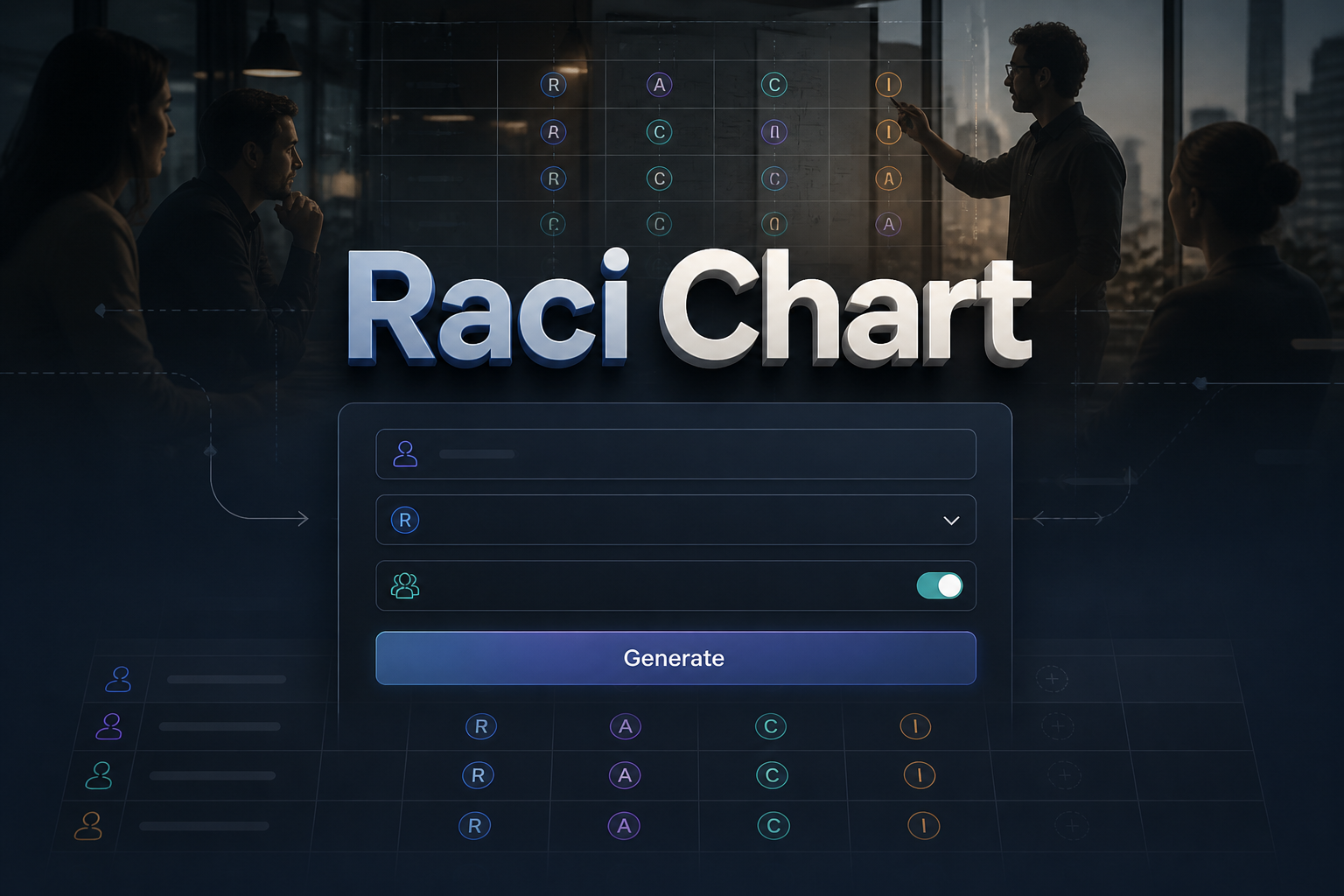
What Is a RACI Chart?
- RACI stands for Responsible, Accountable, Consulted, and Informed — four roles that describe how each person or team relates to each task or decision in a project. Every task in a RACI chart must have exactly one Accountable person and at least one Responsible person.
- Responsible (R) is the person or group who performs the work to complete the task — they do the actual doing. There can be multiple Responsible parties for a single task.
- Accountable (A) is the person who owns the outcome — they have final decision-making authority and answer for success or failure. There must be exactly one Accountable person per task — shared accountability leads to diffused accountability.
- Consulted (C) are people whose input is sought before a decision or deliverable is completed — two-way communication. Informed (I) are people who need to be updated on progress or outcomes after decisions are made — one-way communication.
RACI Chart Template
| Task or Deliverable | Role 1 | Role 2 | Role 3 | Role 4 | Role 5 | Notes |
|---|---|---|---|---|---|---|
| Define project scope | A | R | C | I | I | PM owns scope definition |
| Approve project budget | I | A | C | I | I | Finance lead is accountable |
| Develop project timeline | R | A | I | I | I | — |
| Design solution architecture | C | I | A | R | I | Tech lead owns architecture |
| Write technical requirements | I | C | R | A | I | — |
| Build and code solution | I | I | C | R | A | Development team responsible |
| Test quality assurance | I | I | C | R | A | QA team responsible |
| User acceptance testing | R | A | I | C | I | Business leads UAT |
| Create training materials | R | A | I | I | C | — |
| Deliver training sessions | R | A | I | I | C | — |
| Go-live deployment | C | A | C | R | R | Tech executes, PM accountable |
| Post-launch review | R | A | R | R | R | All team members responsible |
Source: RACI framework — originally described by Bernice McClure in the 1970s and widely used in project management
RACI Common Mistakes to Avoid
- Multiple Accountable people for one task — avoid having two people share the A designation. If both are responsible for the outcome it must be negotiated into a single decision-maker with the other becoming Consulted.
- Too many Consulted designations — every C represents a consultation loop that takes time. Limit C to people whose input genuinely changes the output. Over-consulting slows projects significantly.
- Missing Accountable for a task — every task must have exactly one A. Tasks with no A tend to fall through the cracks or create confusion about who escalates issues.
- Responsible and Accountable always being the same person — this is valid for small teams but in larger organisations it should be a deliberate choice rather than a default. Separating R and A for key deliverables improves oversight.
- Forgetting to communicate the RACI — building the chart without sharing it with all stakeholders defeats its purpose. Every person listed should receive the RACI at project kickoff and it should be reviewed at each major phase.
RACI Variants
| Framework | What the Letters Mean | When to Use |
|---|---|---|
| RACI | Responsible, Accountable, Consulted, Informed | Most projects — the standard framework. Good balance of detail and usability. |
| RASCI | Responsible, Accountable, Supportive, Consulted, Informed | When you need to distinguish between primary responsible parties and supporting contributors. |
| DACI | Driver, Approver, Contributor, Informed | Decision-focused projects — the Driver moves the decision forward, Approver makes the final call. |
| RAPID | Recommend, Agree, Perform, Input, Decide | McKinsey decision-making framework — useful for complex decisions with many stakeholders at different authority levels. |
Source: Project Management Institute (PMI) and standard project management references
RACI Chart Builder
Add tasks and team members, assign R/A/C/I roles for each intersection, and export your completed matrix. The builder automatically flags any task missing an Accountable owner.
| Task / Deliverable |
|---|
Frequently Asked Questions
What does RACI stand for?
RACI stands for Responsible, Accountable, Consulted, and Informed — the four roles in the responsibility assignment matrix.
Can one person have multiple RACI roles for the same task?
A person can be both Responsible and Informed for the same task (they do the work and are kept updated). However having one person as both Accountable and Responsible on critical tasks should be intentional — it means the same person is both doing and owning the outcome.
What is the difference between Responsible and Accountable?
Responsible means doing the work — the person performs the task or produces the deliverable. Accountable means owning the outcome — the person answers for whether it was done correctly and on time, even if they did not personally do the work.
How many Accountable people should a task have?
Exactly one — this is the most important rule of the RACI framework. Tasks with multiple Accountable people often suffer from diffused responsibility where everyone assumes someone else is managing the outcome.
What is the difference between Consulted and Informed?
Consulted involves two-way communication — the consulted person's input is sought and may change the outcome before it is finalised. Informed involves one-way communication — the person is updated after a decision is made but their input is not being solicited.
How do I build a RACI chart?
List all tasks or deliverables as rows and all roles or team members as columns. For each task assign R to those doing the work, A to the single owner, C to those whose input is needed beforehand, and I to those who need to be informed of progress or outcome.
When should a project not use a RACI chart?
RACI charts add most value on projects with 5 or more stakeholders where role clarity is genuinely unclear. Very small projects with 2 to 3 people where everyone understands their role intuitively may find the overhead of building and maintaining a RACI chart exceeds its benefit.
What is a RASCI chart?
RASCI adds a fifth category — Supportive — to the standard RACI framework. Supportive people provide assistance to the Responsible party without being directly accountable for the outcome — useful when you need to distinguish primary responsible parties from those providing background support.